Last Updated on January 13, 2026 by Ch David
Casio G-Shock authentication might seem simple, but the explosion of high-quality replicas has made it trickier than ever to know what’s real.
G-Shock watches are known for their toughness, precision, and decades-long reliability, which is exactly why counterfeit versions have become so common.
From street-market fakes to online listings that look convincing in photos, the differences can be subtle if you don’t know what to check.
The good news is that spotting a fake G-Shock doesn’t require advanced tools. Real models have specific design traits, functional features, and markings that replicas rarely reproduce correctly.
Once you understand those details, it’s easy to separate a genuine G-Shock from a cheap copy.
This guide breaks down the most reliable ways to verify authenticity – using the same steps collectors and long-time G-Shock owners rely on before every purchase.
You are in the right place.
Know before you buy – not after.
We verify what clones can’t fake: the 3-button diagnostics, module code, bezel/strap markings, engraving depth, weight to spec, lume/LED behavior… and more. Get a clear yes/no with notes you can use to buy, return, or resell confidently.
Stop guessing. Start verifying.
Answer: A quick way to identify a fake G-Shock is to perform the three-button test.
On an authentic model, pressing the top-left, bottom-left, and top-right buttons together triggers the screen to display “CASIO.”
Most counterfeit versions don’t have this function coded into the module, so nothing happens when you press them.
It’s a simple test that instantly exposes many replicas. Still, you should also check the back-case engraving, strap quality, and model number consistency for full assurance – all of which are covered in the sections below.
One of the quickest ways to confirm a real G-Shock is by performing what collectors call the 3-button test.
In the video above, you can see how this factory test mode works on a real Casio G-Shock.
It’s a built-in diagnostic feature that displays all segments of the digital screen to check for dead pixels and confirm the module’s identity.
When executed correctly, the display briefly fills with solid black digits before shifting through technical data as you press button C.
Most fakes skip this function entirely. Their internal circuitry can’t handle the test mode, so the screen remains unchanged no matter how many times you try the combination. Some replicas even have decorative buttons that don’t trigger anything at all.
If your G-Shock fails to show the full-pixel screen or the module number sequence, it’s a strong indication you’re dealing with a replica.
→ This test takes just seconds and is one of the most reliable ways to separate genuine Casio engineering from imitation.
Dive-style testing and screw-down crown checks are also detailed in our Seiko SKX007 guide.
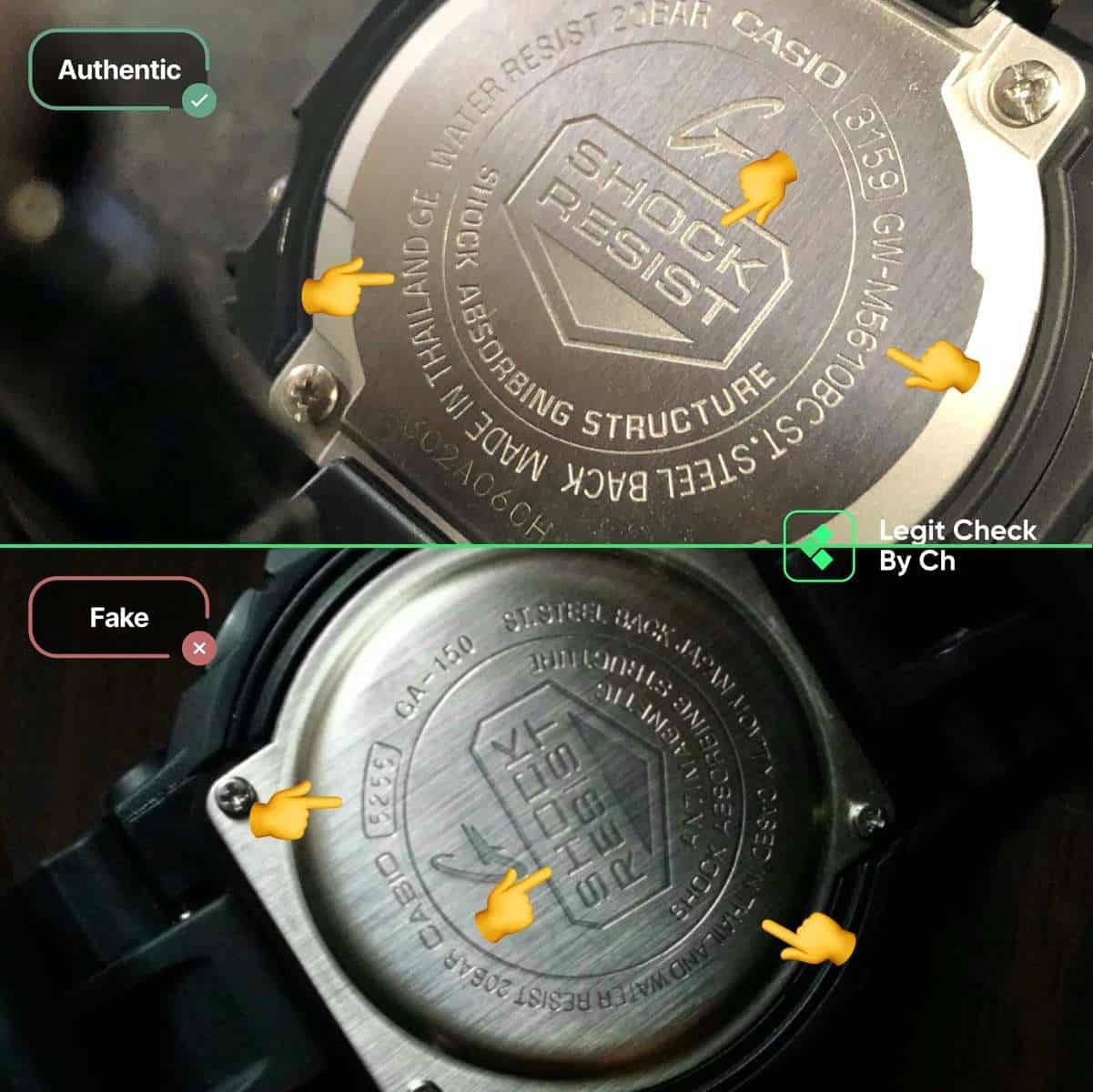
Flip the watch over, and you’ll immediately see why real G-Shocks stand out.
The back engravings are made using laser precision: consistent lettering, perfectly aligned text, and no smudged edges.
Even after years of wear, the font stays legible and deep.
Replicas rarely match this. The lettering feels shallow or oddly bold, and the overall font looks “off.”
On some fakes, the engraved ring of text appears heavier than the center inscription – a detail never seen on genuine Casio production.
Compare engraving depth and spacing with our Audemars Piguet Royal Oak authentication guide.
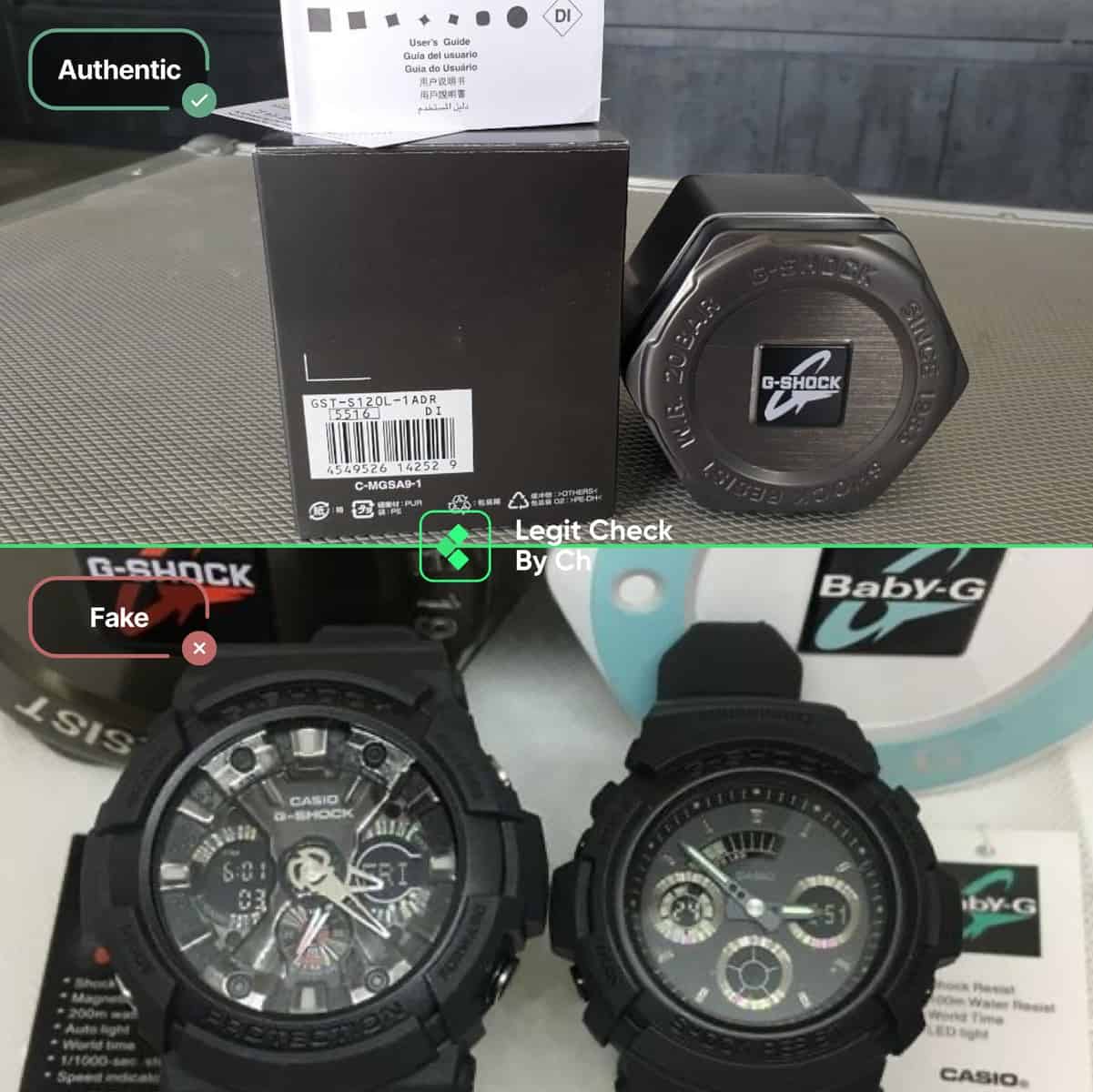
Casio puts real effort into presentation and protection.
The aluminum case fits snugly inside the outer box, which includes barcodes, product codes, and warranty inserts. Everything feels coordinated and professional – because it is.
Fakes, on the other hand, treat packaging as an afterthought. You might receive only the tin or a generic box with no codes or branding.
Others come wrapped in bubble plastic, missing all official accessories.
→ A missing cardboard outer box, mismatched model codes, or cheap foam interior are all strong signs you’re not looking at a real G-Shock.
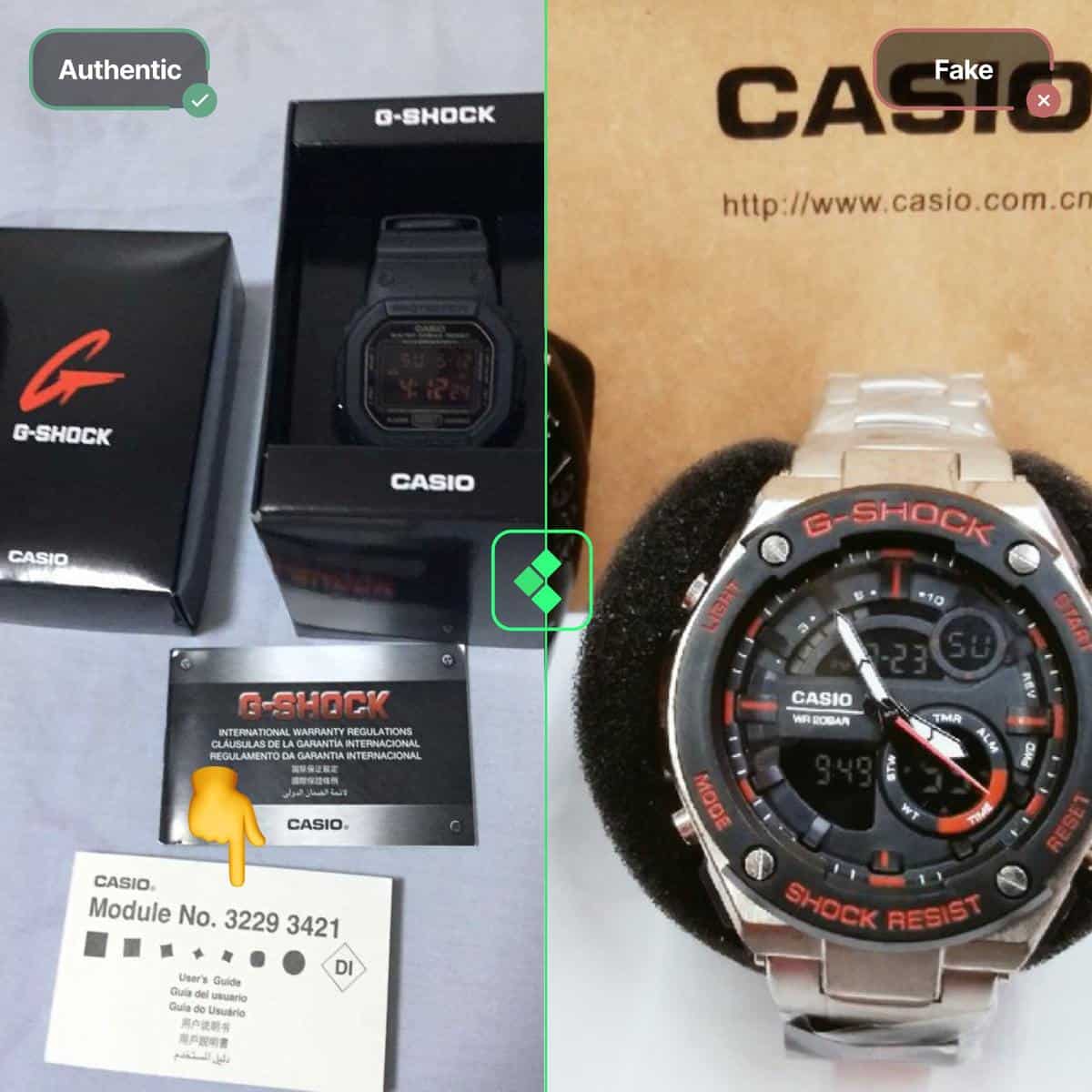
Casio takes documentation seriously. The booklet in an authentic G-Shock package always lists the correct model code – the same one engraved on the case back and printed on the outer box label.
You can even verify that number on Casio’s official website.
Counterfeits rarely bother with this consistency. Many come with manuals that look photocopied or contain pages filled with spelling errors and unrelated models.
Some fakes don’t include a manual at all, or worse, include a guide for a completely different G-Shock.
→ If the codes don’t match across the box, manual, and watch, it’s a red flag right away.

A quick mention:
If in doubt, we recommend double-checking the steps we’ve explained above this line.

G-Shocks are designed to feel substantial. That reassuring weight is part of what made them famous for durability.
For example, if an official listing says 72 grams, a fake might come in at 55 or 60. It’s a small number difference, but one that’s immediately perceptible in hand.
Checking the exact weight is an easy but overlooked step.
→ Use a digital scale and compare your result with Casio’s published spec for the same model.
Any significant deviation (more than a few grams) is a strong indicator that the materials or internal components aren’t authentic.
Spec-matched weight and case density checks compared in our Panerai Luminor real vs fake guide.
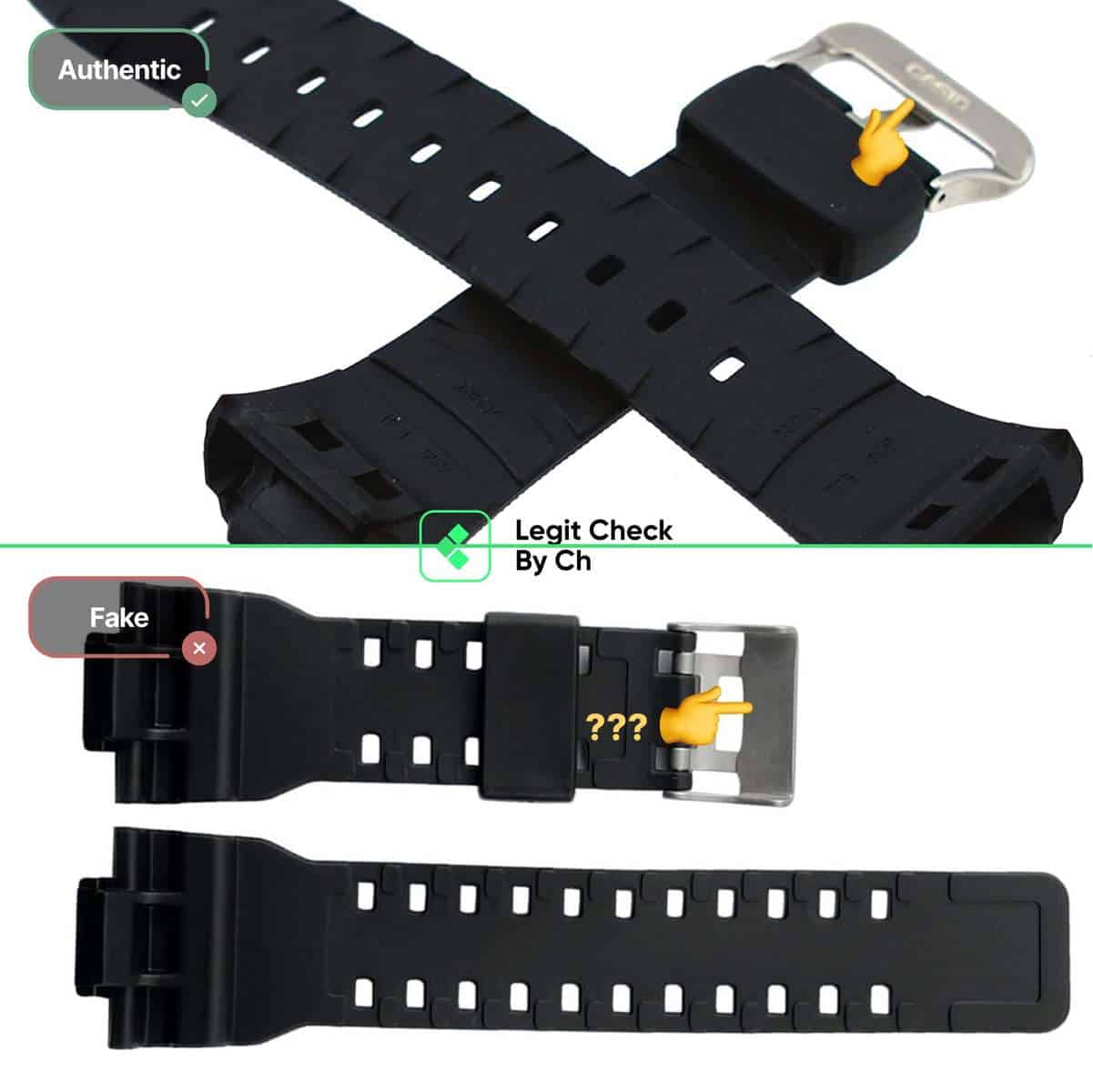
The clasp may look like a small detail, but it’s one of the most consistent authenticity markers across all G-Shock models.
On the real thing, the metal feels weighty, the engraving is deep and evenly cut, and the mechanism locks securely with a tactile snap.
Replicas miss all of that. The metal feels lighter or tinny, the clasp doesn’t always stay shut properly, and the engraving (if present) lacks sharpness.
Some low-quality fakes skip the branding altogether.
→ A quick look inside the clasp can tell you immediately whether you’re holding a Casio or a copy.
For mechanical-function tells on a chronograph, see our Omega Speedmaster Professional Moonwatch legit check.
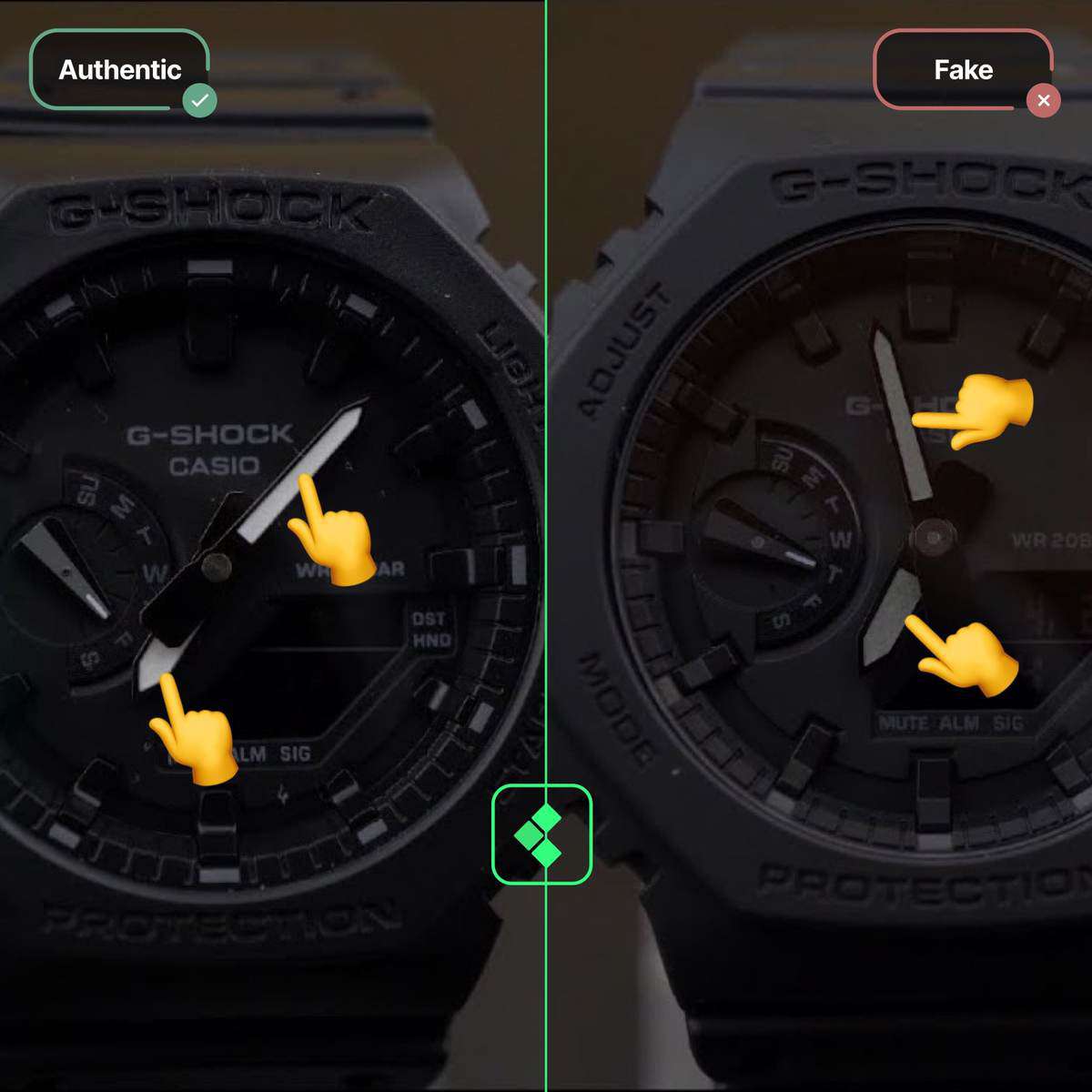
G-Shock’s night visibility is one of its defining features – a combination of strong lume and dependable illumination technology.
When you charge a real G-Shock under bright light and step into darkness, you’ll immediately see a consistent, vivid glow across the hands and markers.
The lume remains visible for several minutes, maintaining even brightness.
Counterfeits can’t replicate that. Some have paint that glows faintly for a few seconds, while others skip the lume entirely, relying on a cheap reflective coating instead.
→ Try pressing the light button – if the hands stay dark or the glow looks patchy and short-lived, you’re likely dealing with a fake.
For a luxury-grade lume comparison, check our Rolex Submariner 126610 guide.
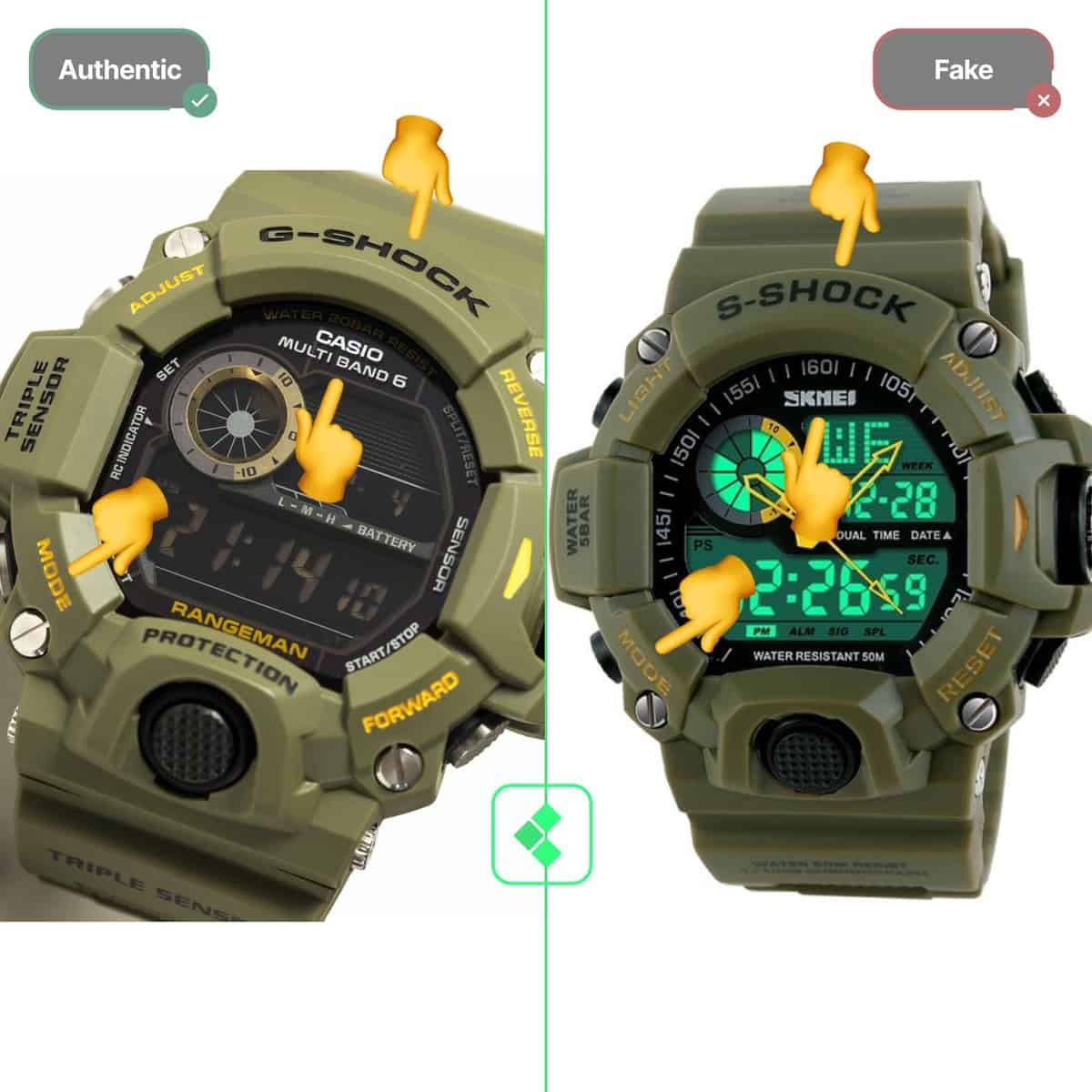
The bezel branding is one of the easiest tells on any G-Shock.
Authentic bezels feature laser-sharp text molded directly into the resin, not printed. The letters have clear depth and precise edges – no bleeding, no smudges.
Fakes typically have surface-level paint with sloppy alignment. It’s common to find “S-SHOCK” printed instead of “G-SHOCK,” or “SKMEI” replacing “CASIO” at the top of the dial.
The font thickness is another dead giveaway – fake bezels exaggerate the letters, making them wider and bolder than the crisp, restrained printing of a real Casio.
Movement precision and bezel detailing are also compared in our Omega Seamaster Diver guide.
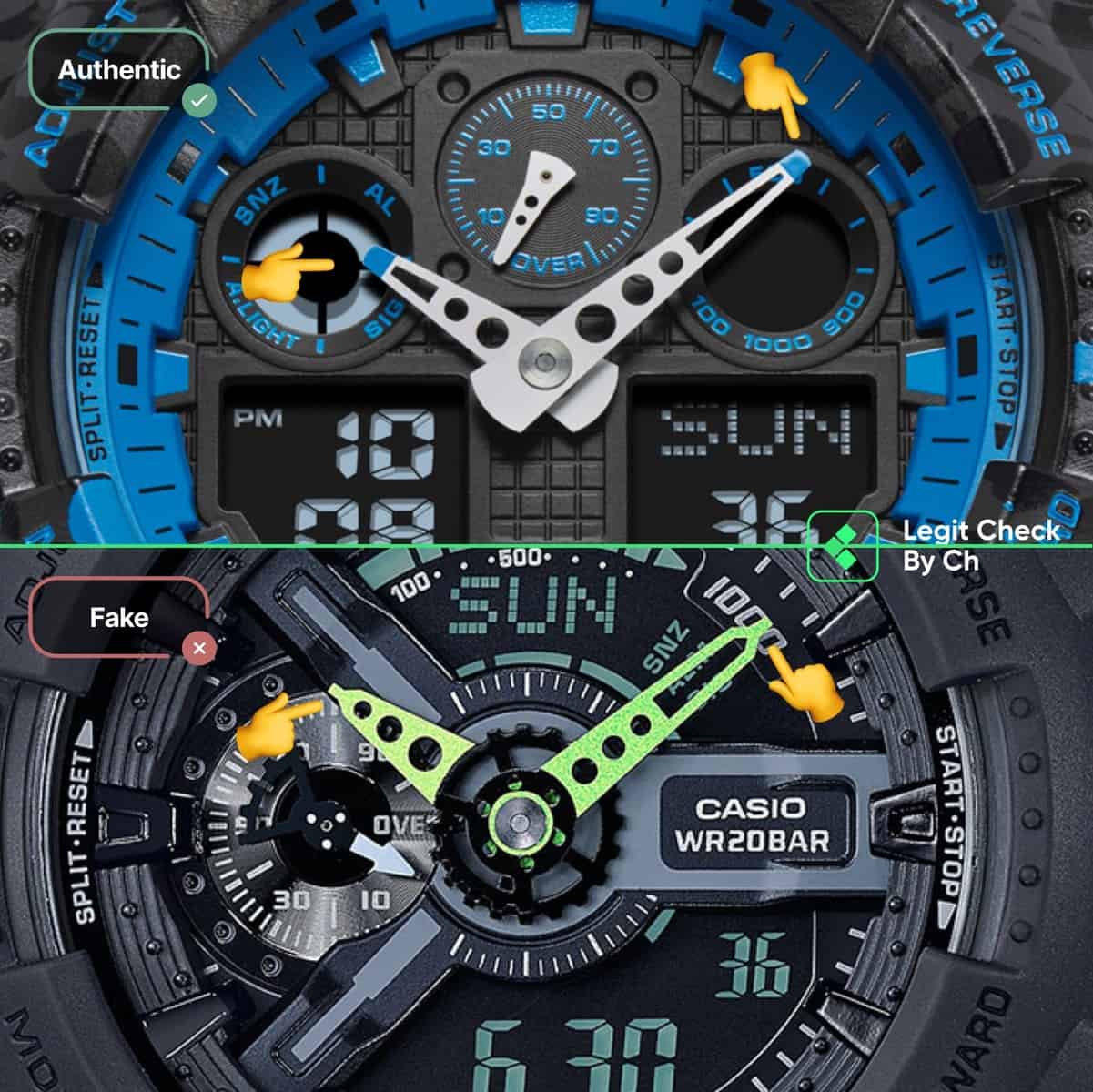
Casio’s color choices are never random.
The slight blue tint at the tip of the hands isn’t just for style – it enhances visibility under light and maintains balance with the rest of the dial.
This precision is part of the design language that makes the G-Shock feel premium even in rugged form.
Fakes often take shortcuts, painting the hands in one uniform shade of silver or white. The lack of contrast makes them harder to read, especially under bright lighting.
On genuine models, that subtle pop of color at the tip catches the light beautifully; on replicas, it simply doesn’t exist.
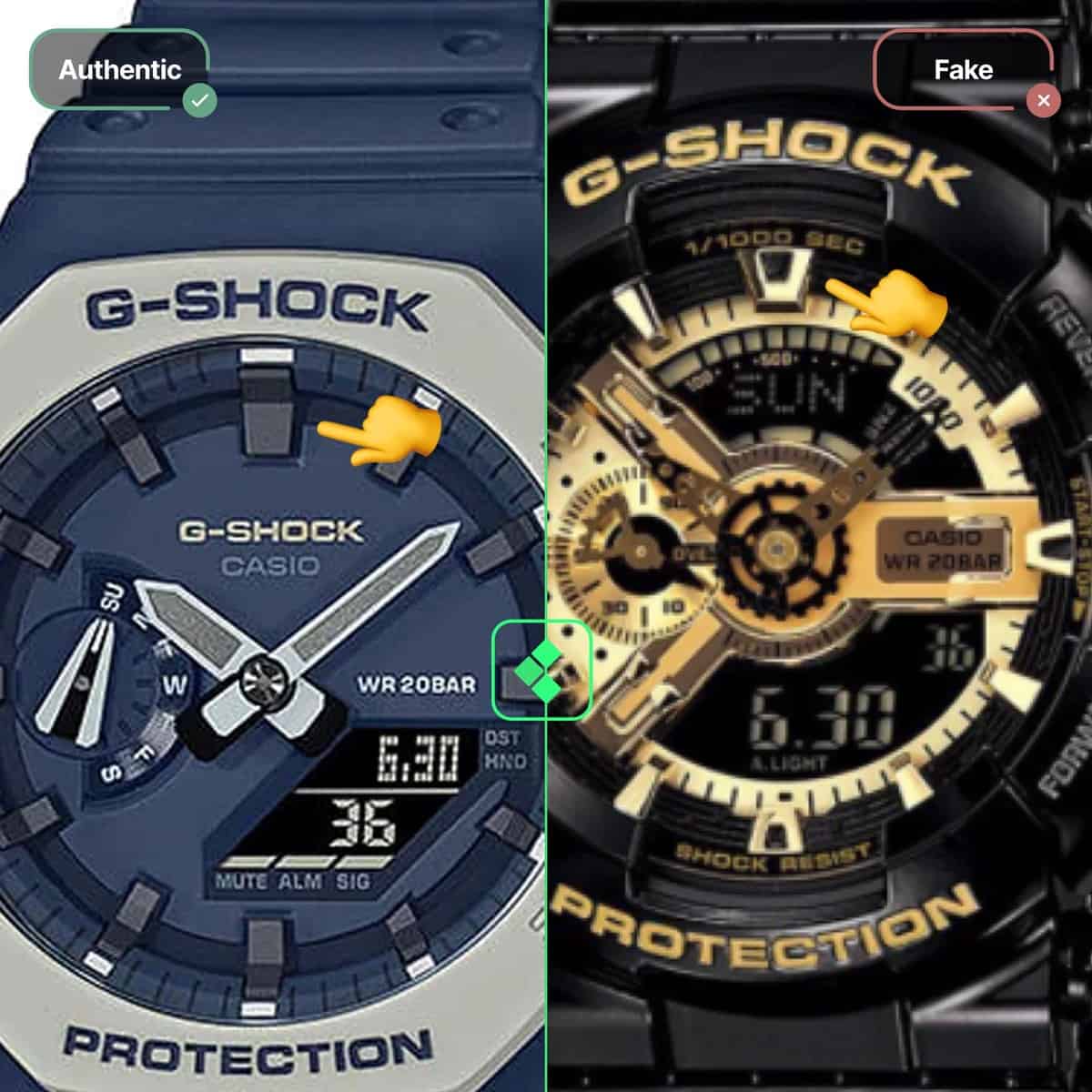
The 12 o’clock pointer is a small but unmistakable design signature.
On authentic G-Shocks, the index has flat, squared corners that line up cleanly with the vertical axis of the dial. It looks balanced, robust, and integrated into the overall geometry of the case.
Counterfeit models frequently miss this subtle precision. Their 12 o’clock markers taper into a triangle or show inconsistent spacing relative to the bezel.
→ The difference may seem minor until you see both side-by-side – the authentic layout feels disciplined and solid; the fake looks rushed and slightly off-center.
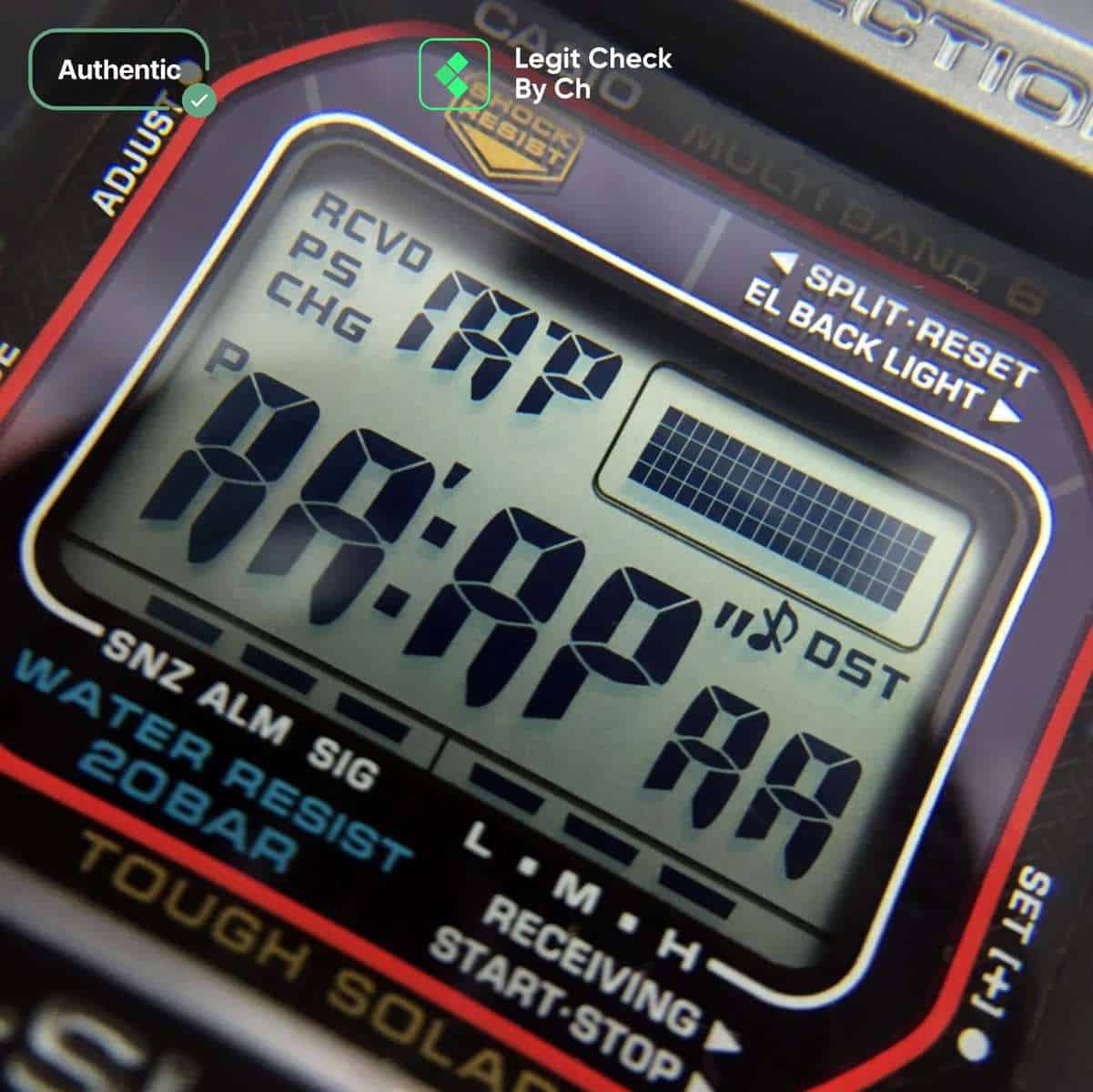
Casio’s quartz modules are built for long-term reliability.
If you track your watch’s timekeeping over a month (either manually or with an app) an authentic G-Shock should stay almost perfectly synchronized, varying by no more than a few seconds.
This precision is part of the brand’s reputation for indestructible dependability.
Counterfeit watches use cheaper movements that can’t hold accuracy. Some run fast or slow by noticeable margins within days.
→ You can verify this easily: set the time to match a digital clock, check again after a week, and compare. If the difference exceeds even 30 seconds, it’s almost certainly not genuine.
Accuracy drift vs movement type is discussed in the Breitling Navitimer authentication guide.
Need a fast way to tell if your G-Shock is genuine? Here’s the short version of the 11-step guide – the essential checks collectors use before buying.
These quick checks expose 95% of counterfeits instantly. When in doubt, cross-verify the model number on Casio’s official site or ask a certified authenticator to confirm.
Check out our watches hub for more authenticity checks like this.
G-Shocks were built to survive anything, but spotting a real one from a fake is tougher than most people think. Over the last few years, replica makers have gotten bold: they copy the shape, mimic the logo, and even imitate Casio’s packaging. That’s why experienced collectors and first-time buyers alike now get their G-Shocks verified before completing a purchase.
Our G-Shock authentication service is fully human-based. Every watch is inspected by specialists who know the difference between a genuine Casio module and an imitation circuit board. We handle classic DW-5600s, Mudmasters, GA-2100 “CasiOaks,” Rangemen, and every other series in between – all checked under professional lighting and magnification.
Here’s what we verify on a Casio G-Shock:
Every step is documented, compared against verified reference samples, and reviewed by a second authenticator before your result is finalized.
Once confirmed, you receive an official Certificate of Authenticity – proof you can use for resale, insurance, or disputes if the watch turns out counterfeit. It’s the simplest way to protect your money and your collection.
👉 Authenticate your Casio G-Shock today and get full clarity before you buy.
G-Shock copies often get the silhouette right but miss the engineering.
Real Casios feel coherent: the buttons trigger hidden diagnostics, the fonts match across parts and paperwork, and the backlight/lume just works.
Fakes cut corners you can feel; lighter resin, soft engravings, sloppy printing, and functions that don’t exist.
Once you know the tells, a genuine G-Shock separates itself in seconds.
Key points to revisit
Still unsure?
If any check raises doubt, don’t gamble. Our G-Shock authentication is fully human: we run the diagnostic key combo, verify module/box/manual codes, measure weight, inspect fonts and engravings under magnification, and test lume/LED and functions.
You’ll get a clear verdict and a Certificate of Authenticity for resale, insurance, or disputes.
👉 Authenticate your Casio G-Shock today and buy with confidence.
Know before you buy – not after.
We verify what clones can’t fake: the 3-button diagnostics, module code, bezel/strap markings, engraving depth, weight to spec, lume/LED behavior… and more. Get a clear yes/no with notes you can use to buy, return, or resell confidently.
Stop guessing. Start verifying.
To check the serial number of a G-Shock watch, you need to:
If you’re having trouble locating the serial number, it’s a good idea to contact Casio customer support for assistance.
Casio G-Shock watches are special because of their rugged durability and resistance to shocks and impacts, making them ideal for outdoor activities. With a wide range of models featuring innovative features and iconic designs, G-Shock watches offer reliability and style for adventurers and professionals alike.
Yes, girls can wear G-Shocks. These watches come in various sizes and designs, many of which are suitable for both men and women. It’s all about personal style and preference.
They’re reliable, cheap to replace, and tough: 200 m WR, shock resistance, excellent legibility, countdown/chronograph alarms, and silent operation when needed. Solar + radio/Bluetooth means hands-off accuracy in the field. Resin cases don’t reflect light or pick up dings like polished steel.
Need our opinion in regards to the authenticity of your watch? It’s a service we provide.
Alternatively, we have free authentication resources for watches: written guides and video tutorials.
Thank you for reading this,
Ch Alex
Other authenticity-check guides for you
The guides below follow the same structured approach, covering other popular tool and dive watches often cross-shopped by G-Shock enthusiasts and collectors.