Last Updated on January 13, 2026 by Ch David
This guide is dedicated to the Omega Seamaster Planet Ocean. It is something every buyer should know before investing in this watch.
The Planet Ocean line combines the Seamaster’s diving heritage with a more contemporary, rugged look, making it a favorite among both divers and collectors.
Its mix of luxury finishing and tool-watch functionality has also made it one of the most counterfeited models in Omega’s catalog.
Many replicas look convincing in photos, but once you handle them, the differences start to show. The dial detailing, hand alignment, and overall sharpness of the text and markers are areas where fake Planet Oceans consistently fall short.
Genuine watches have a depth and refinement that imitations rarely match.
This guide explains what to look for when authenticating any Planet Ocean reference (regardless of colorway) using the same steps trusted by experts and long-time collectors.
We’ve got a separate guide for the Omega Seamaster.
Ocean-ready confidence, before the wire.
Photos miss the tells. We don’t. From orange-tone consistency to AR performance, pearl centering and end-link geometry – get certainty before you commit thousands.
Discreet. Expert-led. Built to protect your money – and the watch you actually want.
Answer: A reliable way to identify a fake Omega Seamaster Planet Ocean is to examine the dial closely.
Authentic models feature precise printing, perfectly applied markers, and a clean, balanced layout. Replicas often reveal flaws such as uneven fonts, oversized hour markers, or poor alignment between the hands and indices.
Because the dial is the visual centerpiece of the Planet Ocean, any imperfection stands out quickly. This simple observation helps you rule out many counterfeits before even opening the case.
For the full authentication process (including bezel, movement, and caseback checks) continue with the guide below.
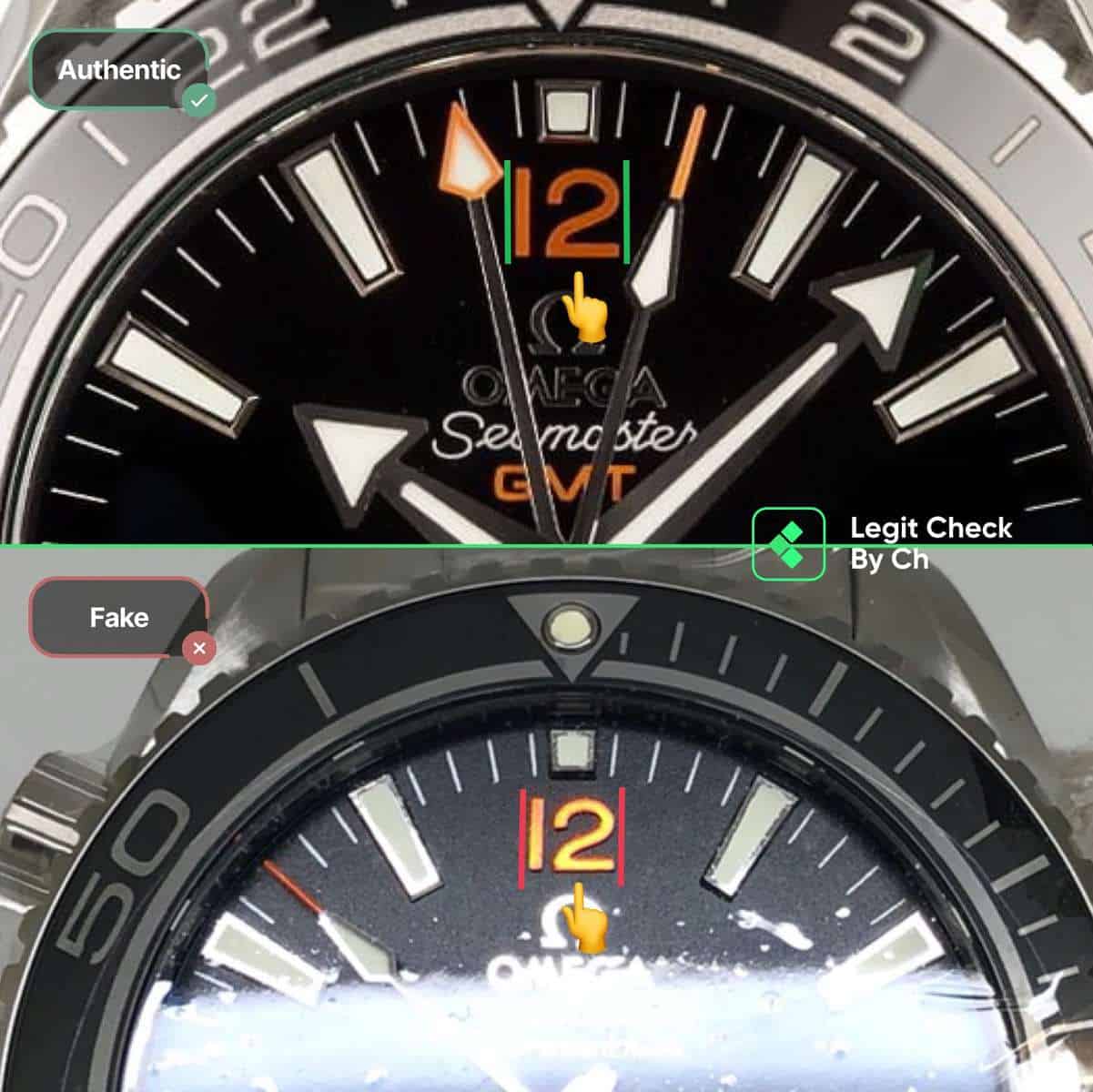
The dial is one of the most immediate ways to tell an authentic Omega Planet Ocean from a replica.
On the genuine piece, every numeral and inscription aligns with precision – the “12” sits perfectly symmetrical, and the orange details complement rather than overpower the rest of the dial. The result is balanced, legible, and distinctly premium.
Counterfeit versions struggle with this refinement. Their numerals often sit slightly crooked or too close together, and the orange hue tends to look overly saturated under light. Even subtle color mismatches between the markers and the “Seamaster” text can indicate a fake.
→ When inspecting, compare how natural and harmonious the orange looks. The authentic watch always has a restrained, uniform tone.
Another comparison:
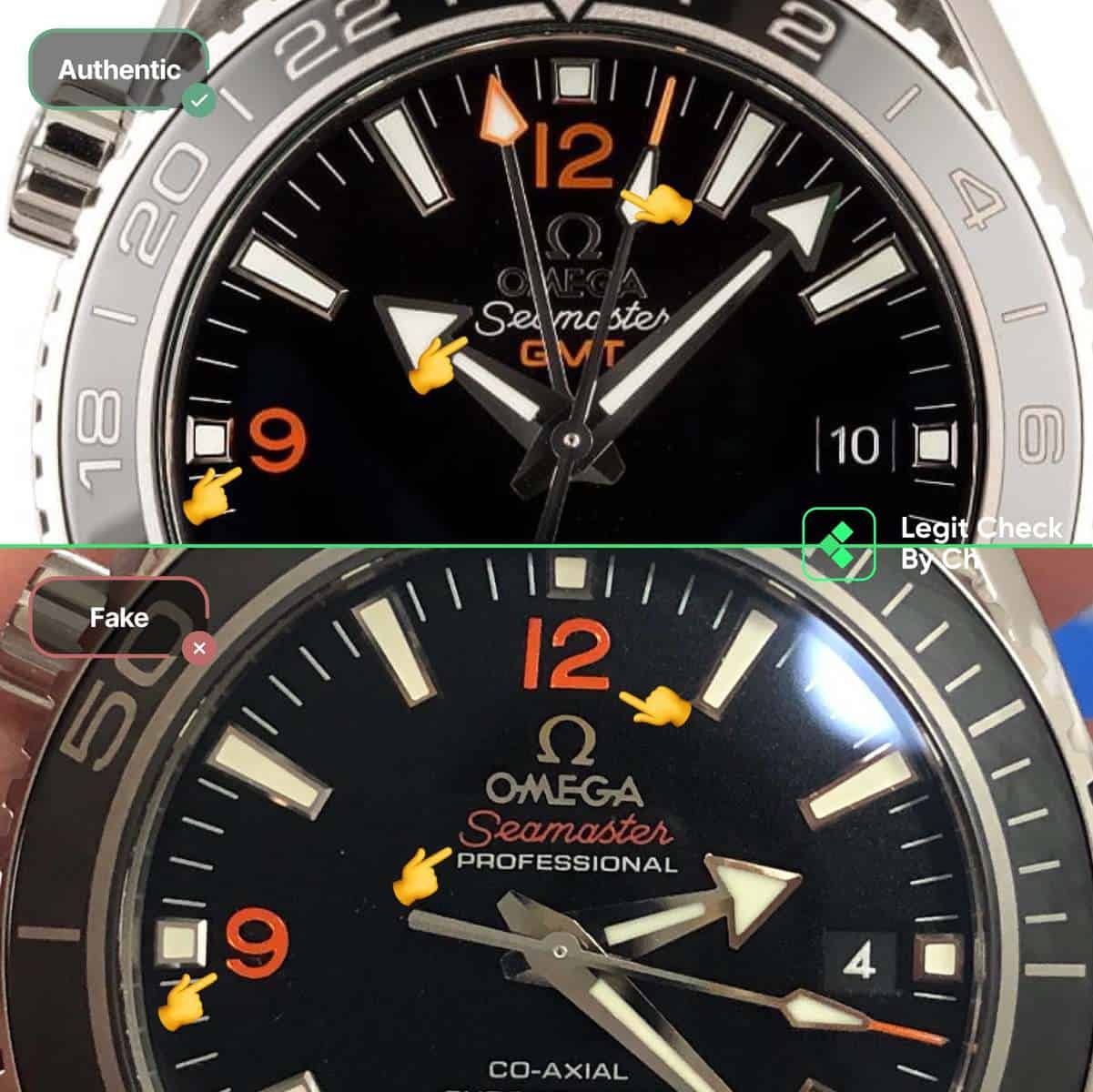
On an authentic Omega Planet Ocean, the orange accents across the dial (including the text and markers) display a muted, consistent tone that feels balanced and refined.
The shade is neither too bright nor too dull, perfectly complementing the rest of the design.
In contrast, counterfeit models often exaggerate this color. Their orange appears overly saturated or uneven, with slight variations from one element to another.
Some replicas even use the wrong hue altogether, especially on the “Seamaster” inscription, which may appear brighter or mismatched compared to the genuine watch’s harmonious finish.
Dial print consistency is also clear in our Omega Speedmaster guide.
Want the expert's opinion? Let our Omega authenticators check your watch:
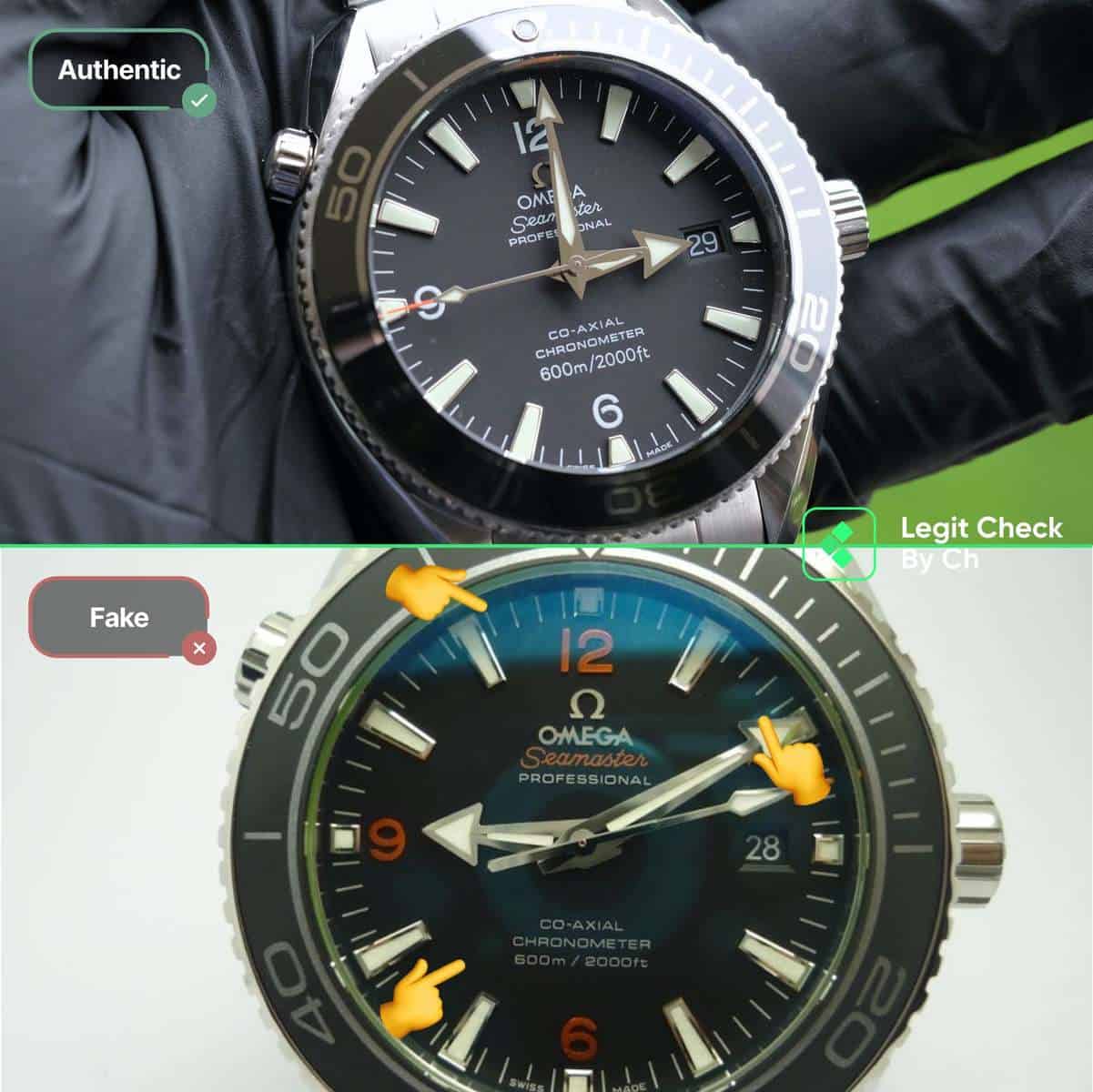
A genuine Omega Planet Ocean will remain legible from any angle. Even under harsh light, the crystal diffuses reflections evenly, allowing you to see the hour markers and text clearly.
This is achieved through multiple layers of anti-reflective coating – a detail that’s both costly and technically demanding.
Counterfeits, by contrast, tend to skip this process. Their crystals may appear overly glossy, with reflections that make it difficult to read the time in bright conditions.
Some low-tier fakes even use standard mineral glass, which amplifies glare instead of reducing it. Simply tilting the watch under a light source can often reveal whether the anti-reflective treatment is genuine.
This step only applies to the gold authentic Omega Planet Ocean watches.
This inscription is associated with the gold watch.
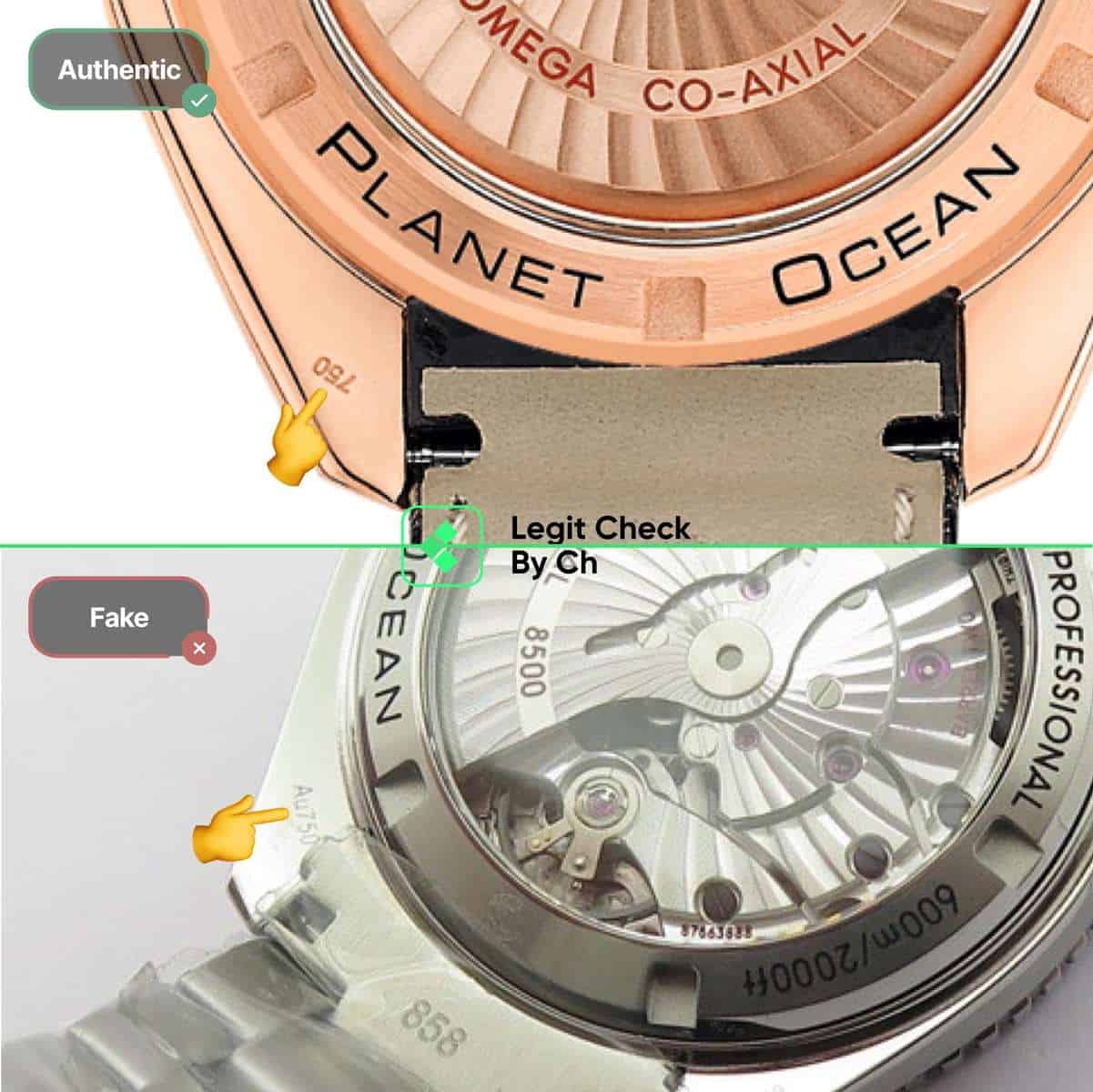
On authentic gold Planet Ocean models, the “Au750” hallmark is more than decoration – it certifies the case’s gold composition.
The color of the metal itself reinforces this, as genuine pieces show a warm, uniform yellow-gold tone throughout the case and lugs.
Replicas often misuse this inscription. You’ll sometimes find “Au750” markings on watches made entirely of steel, which is an instant red flag.
Beyond the text, the quality of the engraving tells the story: on real watches, it’s clean and sharply recessed; on fakes, it looks shallow or uneven.
Always ensure the engraving matches the material – a gold hallmark on silver-colored steel is a sure sign something’s off.
Didn’t notice it? Let’s zoom in:
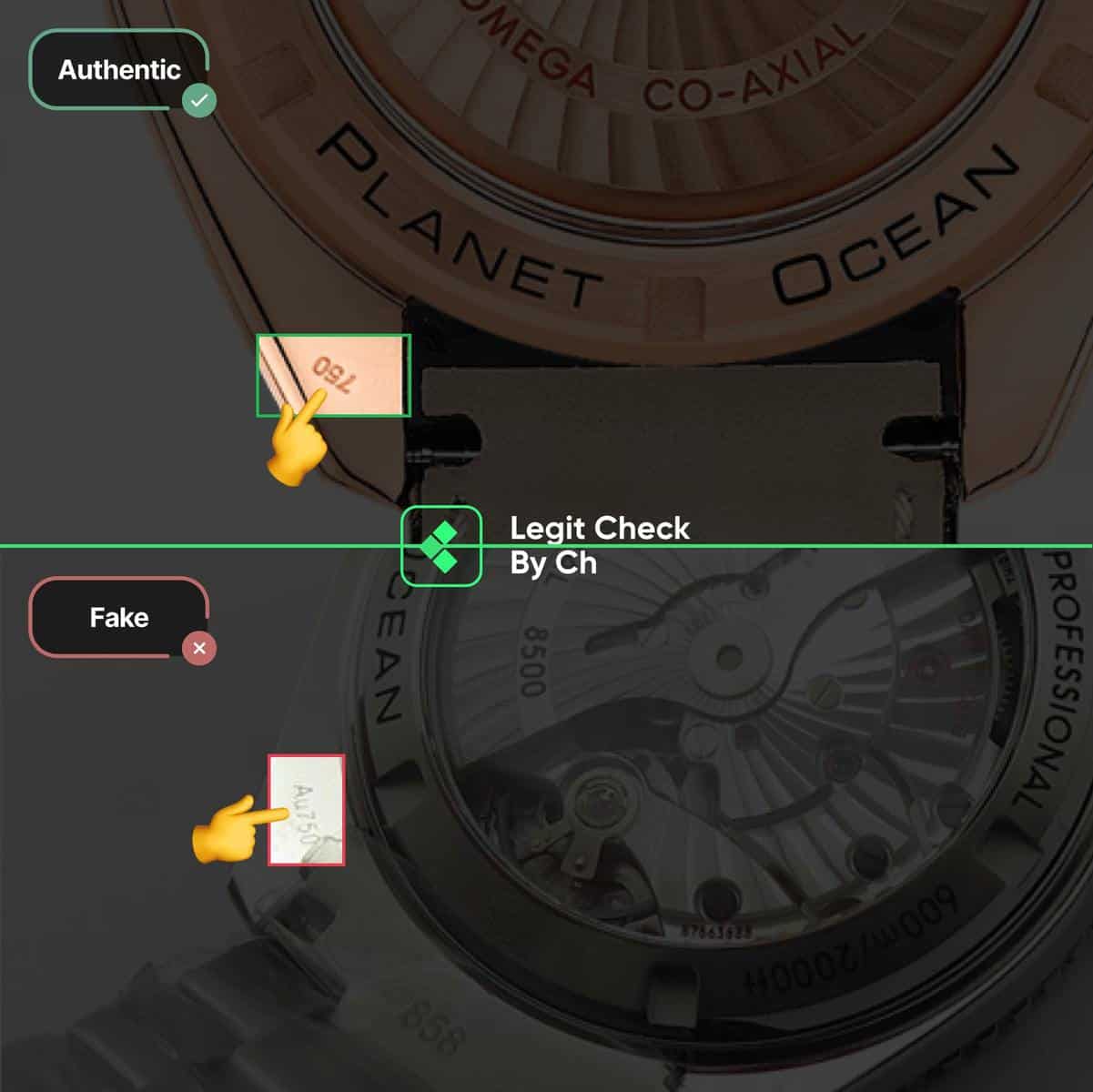
On a genuine Omega Planet Ocean made of gold, the caseback features the “Au750” hallmark – a precise engraving that certifies the watch’s 18K gold composition.
This marking should only appear on authentic gold models, where it’s deeply and evenly inscribed into the metal. Counterfeit versions often misuse this detail, adding the “Au750” inscription to stainless-steel or other non-gold cases.
→ When you see this hallmark on a watch that doesn’t visibly appear to be gold, it’s a clear sign of a replica and one of the easiest red flags to spot during authentication.
Always ensure that the material and inscriptions on your Omega Planet Ocean watch are consistent.

A quick mention:
If in doubt, we recommend double-checking the steps we’ve explained above this line.
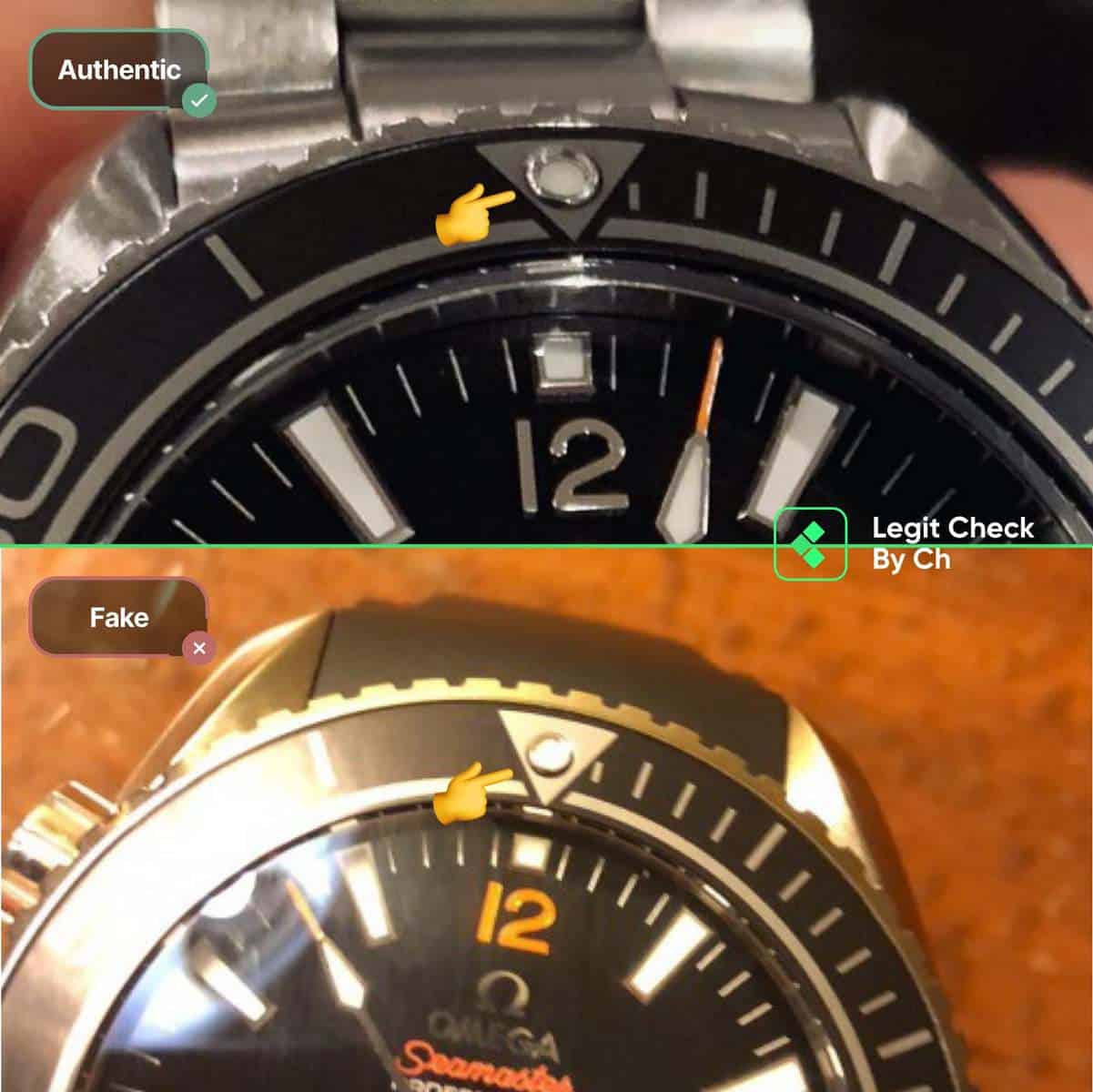
The bezel pearl is one of the most precise components of the Omega Planet Ocean.
On genuine models, it’s not only perfectly aligned but also seamlessly integrated into the bezel insert.
The lume glows evenly, maintaining a clean circular shape even in low light.
On replicas, this detail often exposes the lack of precision. The pearl may be misaligned, creating a subtle tilt inside the triangle, or set at an inconsistent depth.
Under magnification, you’ll also notice that the metal rim surrounding the pearl is either uneven or poorly finished.
This is one of those small yet telling imperfections that instantly distinguish an authentic Planet Ocean from a counterfeit.
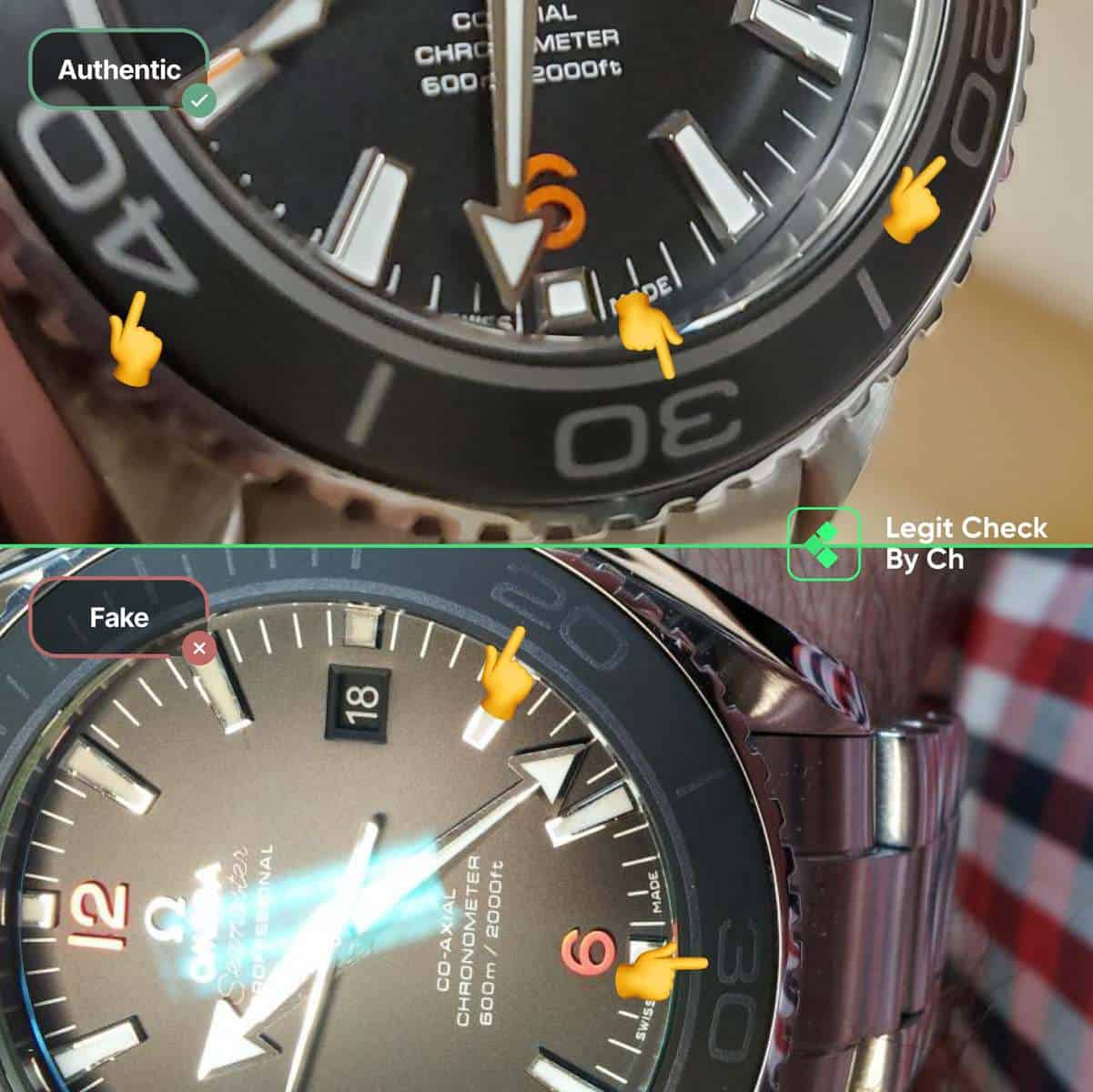
The genuine Planet Ocean’s bezel is crafted to last. Omega uses high-grade materials and precise laser engraving techniques that ensure every numeral and marker remains perfectly defined.
Even after extended use, the bezel maintains its color depth and clarity – a hallmark of Omega’s manufacturing quality.
Replica bezels, on the other hand, often show fading or uneven lettering after minimal wear.
Some are painted rather than engraved, which causes the inscriptions to lose definition quickly.
In worse cases, you might see tiny fractures around the engraved numerals; a sign of poor material composition or rushed machining.
→ When examining, run your fingertip lightly across the bezel: the authentic one feels clean and even, while the fake often feels coarse or inconsistent.
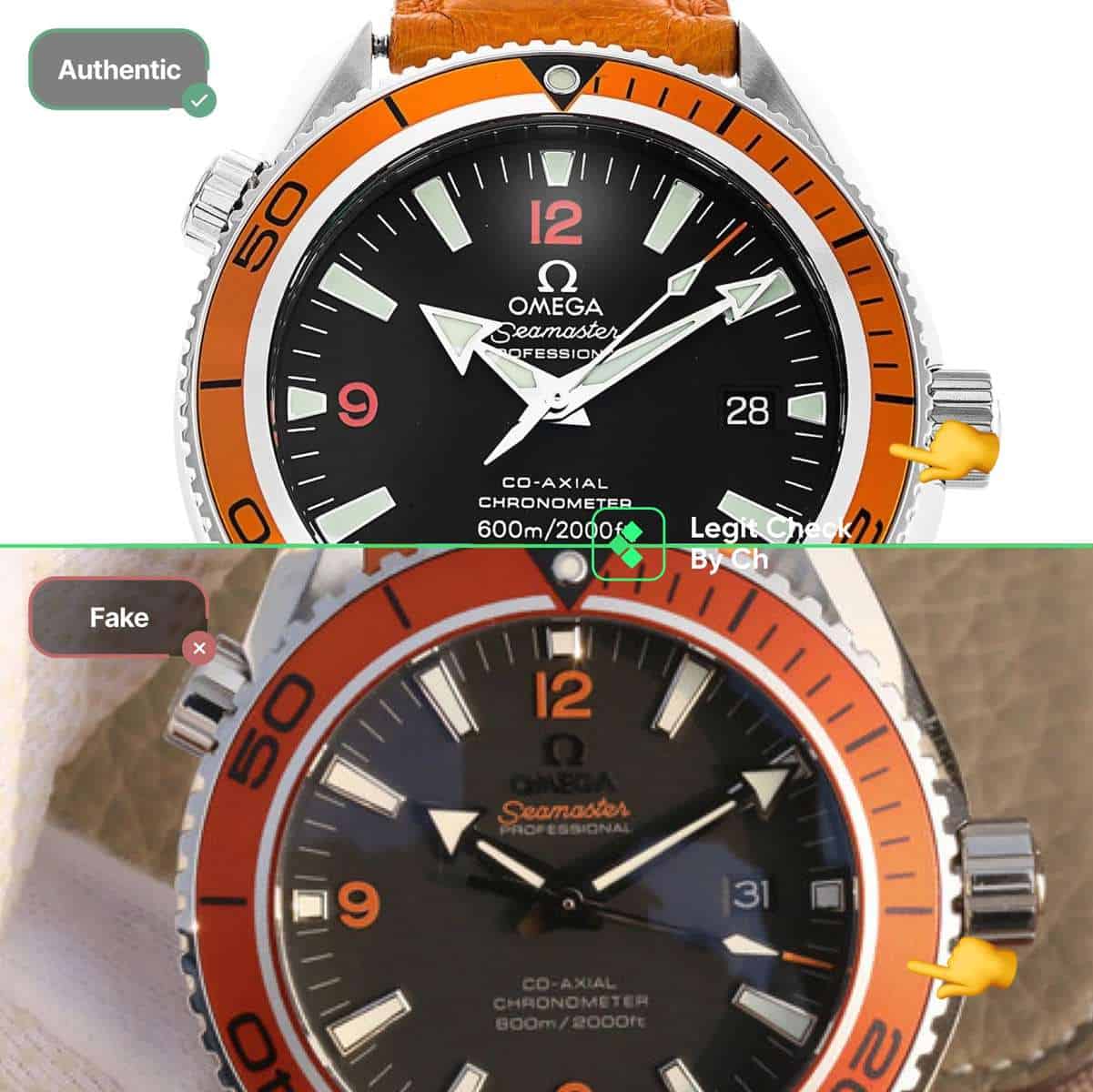
Consistency in color is one of Omega’s strengths.
On a genuine Planet Ocean, the orange ceramic bezel insert and the orange dial text share the same calibrated tone. This uniformity comes from precise pigment matching during production, resulting in a harmonious, professional look.
Counterfeit models rarely achieve this precision. The bezel often stands out in a different shade (sometimes too vivid, sometimes dull) breaking the visual balance of the watch.
This mismatch is especially noticeable when you tilt the watch under natural light, where genuine orange retains a deep, almost matte vibrancy, while the fake tends to reflect excessively or shift in hue.
See ceramic bezel depth and pip centering in the Rolex Submariner 126610 guide.

The date window is one of the most overlooked yet effective tells when verifying authenticity.
On genuine Omega Planet Ocean watches, the double-layered frame around the date creates a subtle shadow effect that enhances legibility and depth.
The finishing is immaculate: edges are smooth, and the alignment between the window and the date numerals is flawless.
Replicas simplify this construction to cut costs. The result is a single, shallow frame that lacks contrast or dimensionality.
In some cases, the printed border even appears slightly misaligned, or the date numerals sit off-center within the window. This detail may seem minor, but it’s exactly the kind of refinement that separates real Omega craftsmanship from imitation.
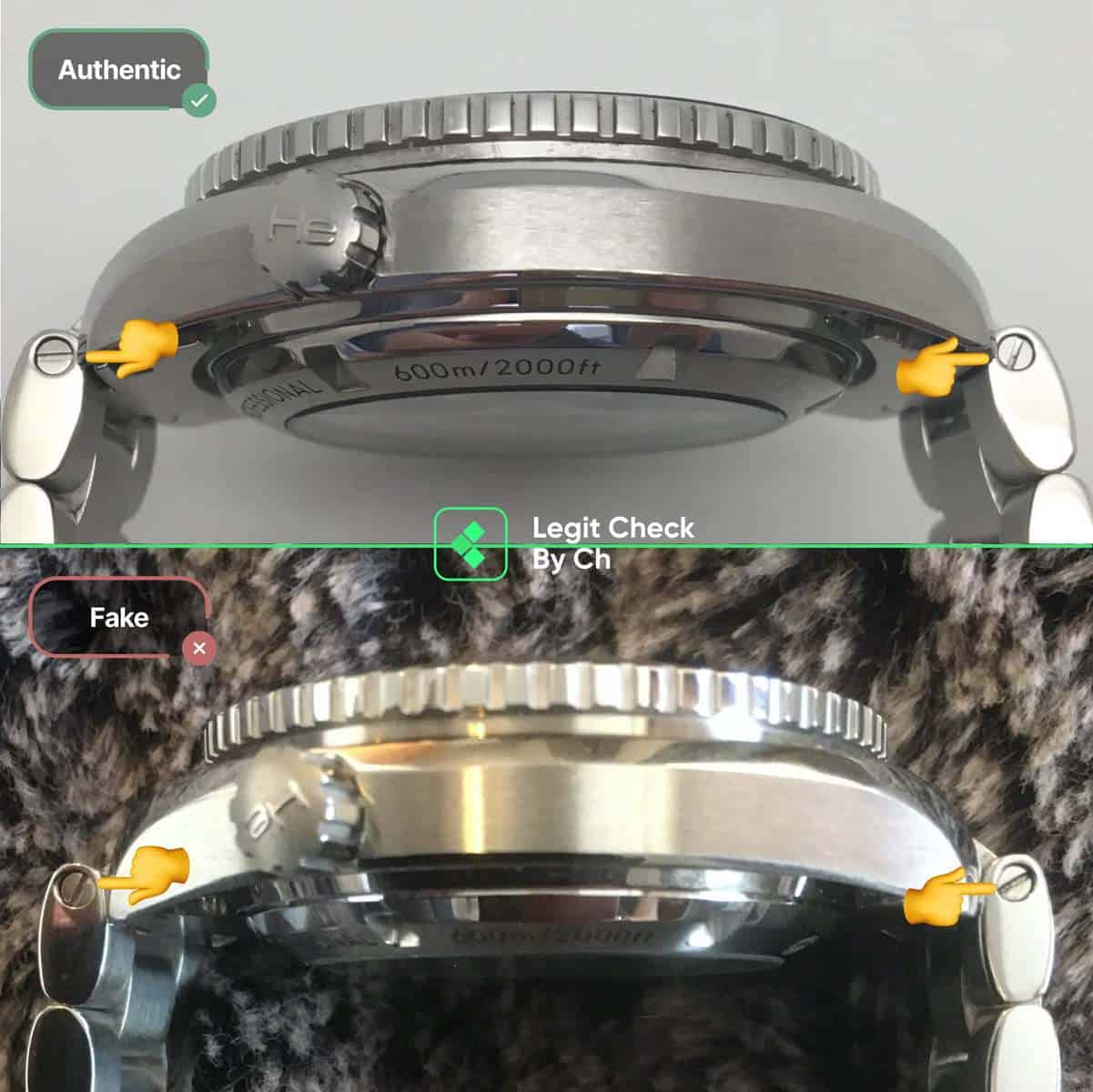
End links are critical to how the watch wears and feels.
On an authentic Planet Ocean, the links integrate seamlessly with the case, forming a tight, precise connection that feels solid in hand.
Their vertical alignment and minimal play reflect Omega’s strict machining tolerances.
Counterfeit bracelets almost always fail to replicate this precision. The end links may appear too flexible or poorly fitted, causing them to sit at an unnatural angle.
Some even have slight bending or visible gaps between the link and the case, breaking the visual continuity.
When holding the watch, an authentic bracelet feels dense and sturdy, while a fake often feels lighter and looser.
Bracelet engineering varies by brand. See our Tudor guide.
Here’s the fast track to identifying an authentic Planet Ocean. These visual and tactile cues will expose nearly any counterfeit.
These eight checks reveal 90% of counterfeit Planet Oceans at a glance. When in doubt, always cross-reference official Omega specs or have your watch authenticated by professionals.
A Planet Ocean is a serious purchase.
By the time you are wiring $10k–$15k or more, guessing is not a strategy. High-grade replicas get the photos right, then fall apart under close inspection.
That is where an expert authentication pays for itself.
Our service is fully human, handled by specialists who see Planet Oceans every day, across every reference, year, and colorway.
From stainless steel to precious-metal models, we check the watch in hand, not with software. Collectors use us before they commit so they can buy with confidence.
What we verify on a Planet Ocean:
We have completed thousands of authentications, earned rave feedback from collectors, and helped buyers avoid millions in counterfeit losses.
The goal is simple, protect your money and the integrity of your collection.
Every confirmed piece comes with our Certificate of Authenticity. It is your safety net for refunds and disputes, and clear proof at resale or for insurance.
If the watch fails the checks, you have written evidence to act on.
For more authentication guides like this, check out our watches hub.
The Omega Seamaster Planet Ocean deserves a careful inspection.
In this guide, we’ve focused on the details that truly matter: from dial color harmony and bezel engraving depth to crystal performance, pearl alignment, and bracelet geometry.
A genuine Planet Ocean feels cohesive: every surface reflects precision, every color matches perfectly, and every component sits in perfect proportion. Counterfeits almost always fail in one or more of these areas.
Treat authentication as a sequence, not a single test. Begin with the dial and crystal, move to the bezel and pearl, then check the caseback and bracelet.
When every element aligns, confidence follows. If even one detail feels off, pause and verify.
Key points to revisit
Want certainty before you buy?
When purchasing a Planet Ocean that costs thousands, guesswork isn’t an option. Our authentication service is 100% human – no automated scans, no shortcuts.
Each watch is reviewed reference by reference, under magnification, by experts who specialize in Omega models.
You’ll receive a detailed evaluation and an official Certificate of Authenticity that serves as proof for resale, insurance, or dispute resolution.
👉 Authenticate your Omega Seamaster Planet Ocean with us today and wear your investment with complete confidence.
Ocean-ready confidence, before the wire.
Photos miss the tells. We don’t. From orange-tone consistency to AR performance, pearl centering and end-link geometry – get certainty before you commit thousands.
Discreet. Expert-led. Built to protect your money – and the watch you actually want.
On an authentic Omega Seamaster Planet Ocean, the serial number is laser engraved on the case, typically on the underside of a lug or the caseback rim, and it repeats on the movement. The engraving is clean and even, with consistent depth and a crisp font. During an authenticity check, match this serial to the reference number on the card, the caseback engraving, and the movement calibre. Any mismatch, ragged lettering, or altered digits is a warning sign.
For older purchases or head-only sales, ask a watchmaker to read the movement serial directly. Photograph the serial, caseback engraving, and bracelet clasp codes, then confirm they align with the Planet Ocean’s correct specification, dial variant, and production era. This protects value and helps document provenance for resale or insurance.
It can be, but only if you replace missing paperwork with strong evidence. For a Planet Ocean, focus on the watch itself: serial number consistency, correct reference number, Co-Axial movement, caseback engraving quality, bezel and dial fonts, and bracelet quality. Ask for a recent service invoice, pressure test results, and high-resolution photos under angled light that show dial printing and AR performance. Price should reflect the lack of cards.
If you want extra certainty, request an Omega Extract from the Archives or use a reputable authenticator. A clean authenticity check, documented serials, and a service record will offset missing papers when you later sell the watch. Avoid sellers who resist an in-person inspection or a watchmaker’s opening of the case.
Well kept Planet Oceans hold value reliably, helped by strong demand for a true diver with modern Omega horology. Condition and originality matter most. Unpolished cases, correct bezel and dial color, sharp caseback engravings, and a matching serial and reference number support price. A full set increases buyer confidence, but a documented authenticity check and recent service can also sustain value.
Market preference varies by size and colorway, so keep everything period correct. Maintain the watch with timely servicing and retain invoices. When selling, include clear photos of the serial, reference, movement calibre, and bracelet codes. Buyers pay a premium for a Planet Ocean that passes a thorough authenticity check and presents a coherent history.
Most Omega Seamaster Planet Oceans use automatic Co-Axial movements, so the seconds hand appears to sweep in small steps rather than jump once per second. The motion is smooth and even, which is consistent with a mechanical movement. If a Planet Ocean’s central seconds hand ticks in full one-second jumps, you are likely looking at a quartz piece from another Omega family or at a counterfeit that hides a quartz module.
For an authenticity check, observe the chronometry and hand motion under strong light, then listen close to the case. Combine this with movement verification, caseback engraving quality, and serial number matching. Hand behavior alone is not conclusive, but it is a fast early filter that supports the rest of your inspection.
Use the Planet Ocean’s serial number to estimate production year with trusted serial-range tables, then confirm with an Omega Extract from the Archives. Cross-check the serial and reference number against the dial text, bezel style, handset, and caseback engraving to ensure all features are era-correct. Collectors also verify bracelet and clasp codes, since those should align with the timeframe of the head.
For higher confidence, have a watchmaker open the case to verify the movement calibre and serial. Keep a record of photos that show the serial, movement, and caseback together. Dating the watch accurately strengthens provenance, improves resale, and supports a clean authenticity check for your Omega Seamaster Planet Ocean.
Need our opinion in regards to the authenticity of your watch? It’s a service we provide.
Alternatively, we have free authentication resources for watches: written guides and video tutorials.
Thank you for reading this,
Ch Alex
Other authenticity-check guides for you
The guides below cover models often compared with the Planet Ocean, each offering the same detailed, step-by-step approach used by collectors and watchmakers alike.