Last Updated on November 10, 2025 by Ch David
Van Cleef & Arpels authentication has become a must for collectors and jewelry lovers alike.
The Maison’s Alhambra motifs, signature clover shapes, and timeless craftsmanship have made it one of the most coveted names in fine jewelry – which unfortunately means it’s also one of the most counterfeited.
At first glance, many replicas look close enough to fool an untrained eye, especially in photos. But when you know what to check, the differences are unmistakable.
The depth of the engravings, the precision of the chain links, the feel of the clasp, and even the sound it makes when closing – these are the subtle details that define a genuine Van Cleef & Arpels piece.
In this guide, our authenticators share how to verify your Van Cleef jewelry step by step, from serial numbers to craftsmanship cues, so you can be sure your piece is every bit as authentic as it looks.
We verify what photos can’t hide: engraving depth, hallmark pressure, clasp snap, chain weight, and motif polish. If it’s VCA, it will prove itself.
Private, expert-only review • Fast turnaround • Trusted by collectors since 2017
Answer: The best way to tell if your Van Cleef & Arpels piece is authentic is to inspect the serial number engraving.
On genuine jewelry, the engraving is fine, evenly etched, and consistent in depth. Counterfeit pieces often have thicker or uneven markings that look stamped rather than delicately engraved.
Because every authentic VCA item has its own unique serial number, this is one of the most reliable signs of authenticity.
It’s a quick first check, but you should also look at the clasp, the hallmark, and the chain finish – all of which we’ll explain in detail below.
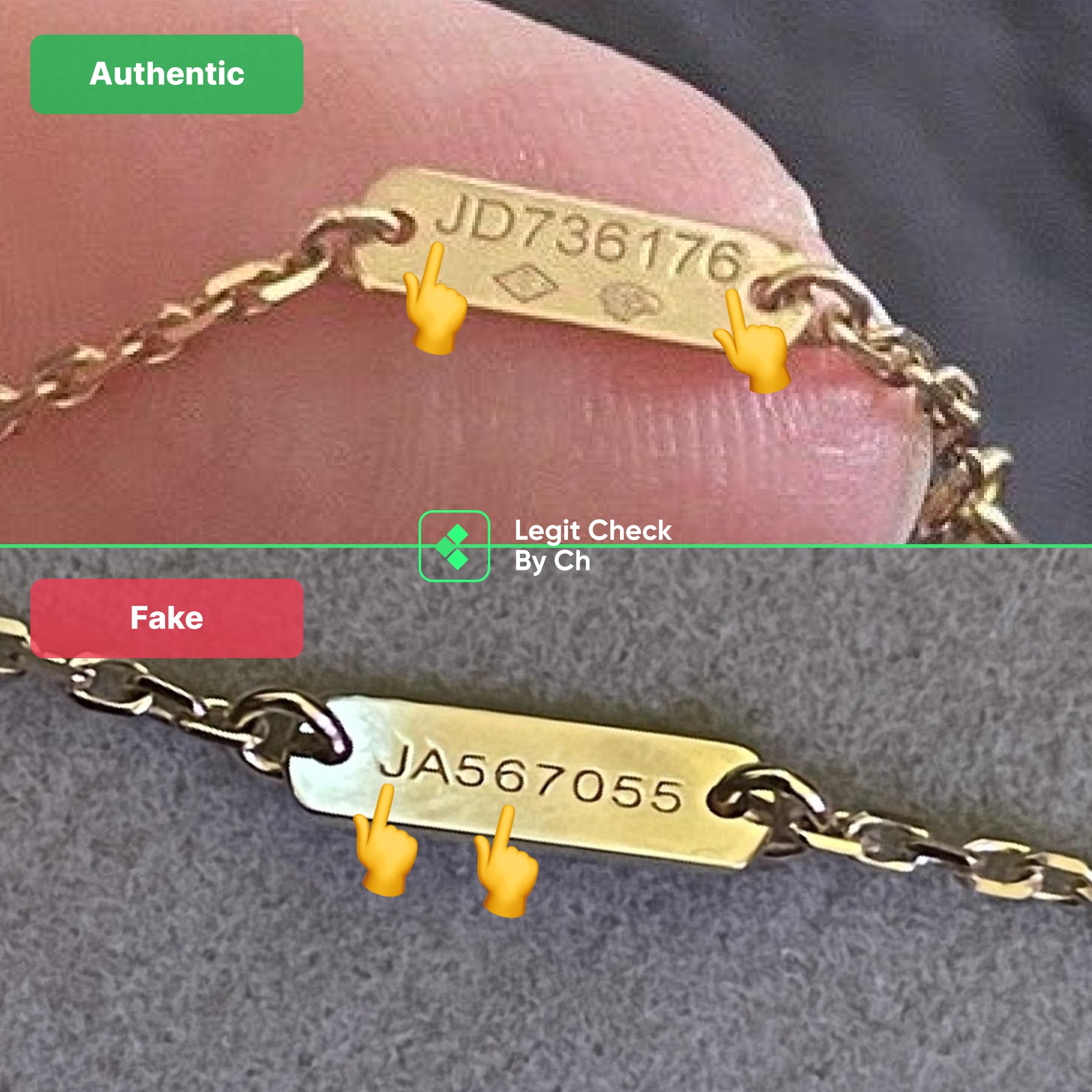
Van Cleef & Arpels stamps their serials with precision.
On a real piece, the code feels engraved into the metal – you can catch its depth with a fingernail, and the strokes look even from start to finish.
Fakes often look laser-sketched: lines are hair-thin, wobble at the corners, and fade where the tool lost pressure.
Always check that the serial is consistent in weight across the entire code and sits square to the edge (not slanted).
This is the same principle we use when checking serial alignment and depth on Cartier Love bracelets.
Too difficult? Let our team of expert Van Cleef & Arpels authenticators take a look at your jewelry:
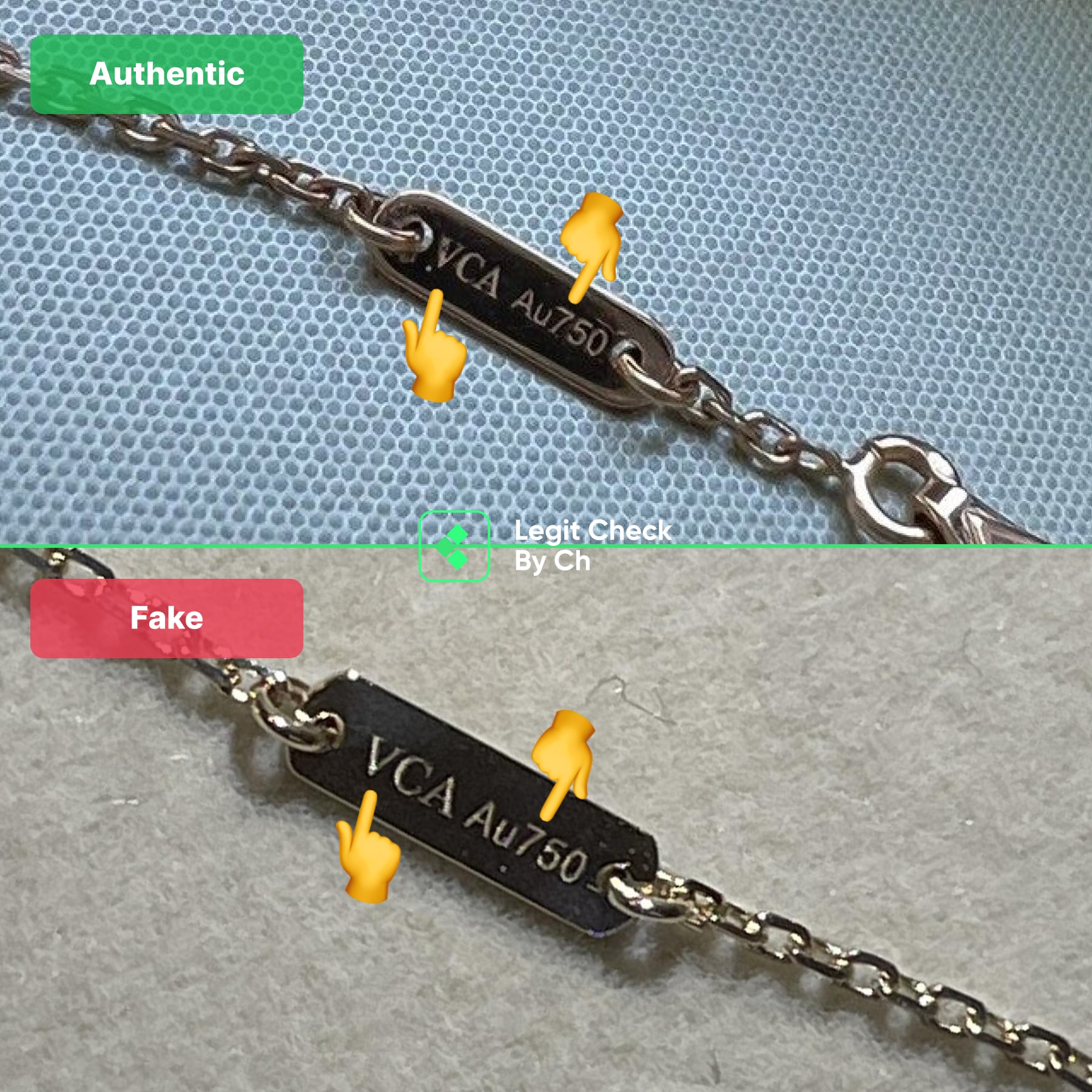
Flip the little metal tab (jump-ring plaque) and inspect the VCA Au750 line.
On genuine pieces, the “VCA” and “Au750” are sharply milled with tidy inner corners – the “A” crossbar and the “7” serif are crisp. Counterfeits usually show skinny, low-contrast marks that blur under light or look grey rather than dark in the recess.
If the hallmark vanishes at certain angles, it’s likely too shallow.
For comparison, see how gold purity markings appear on genuine Cartier Juste Un Clou Bracelets – both maisons engrave their metal codes with identical precision.
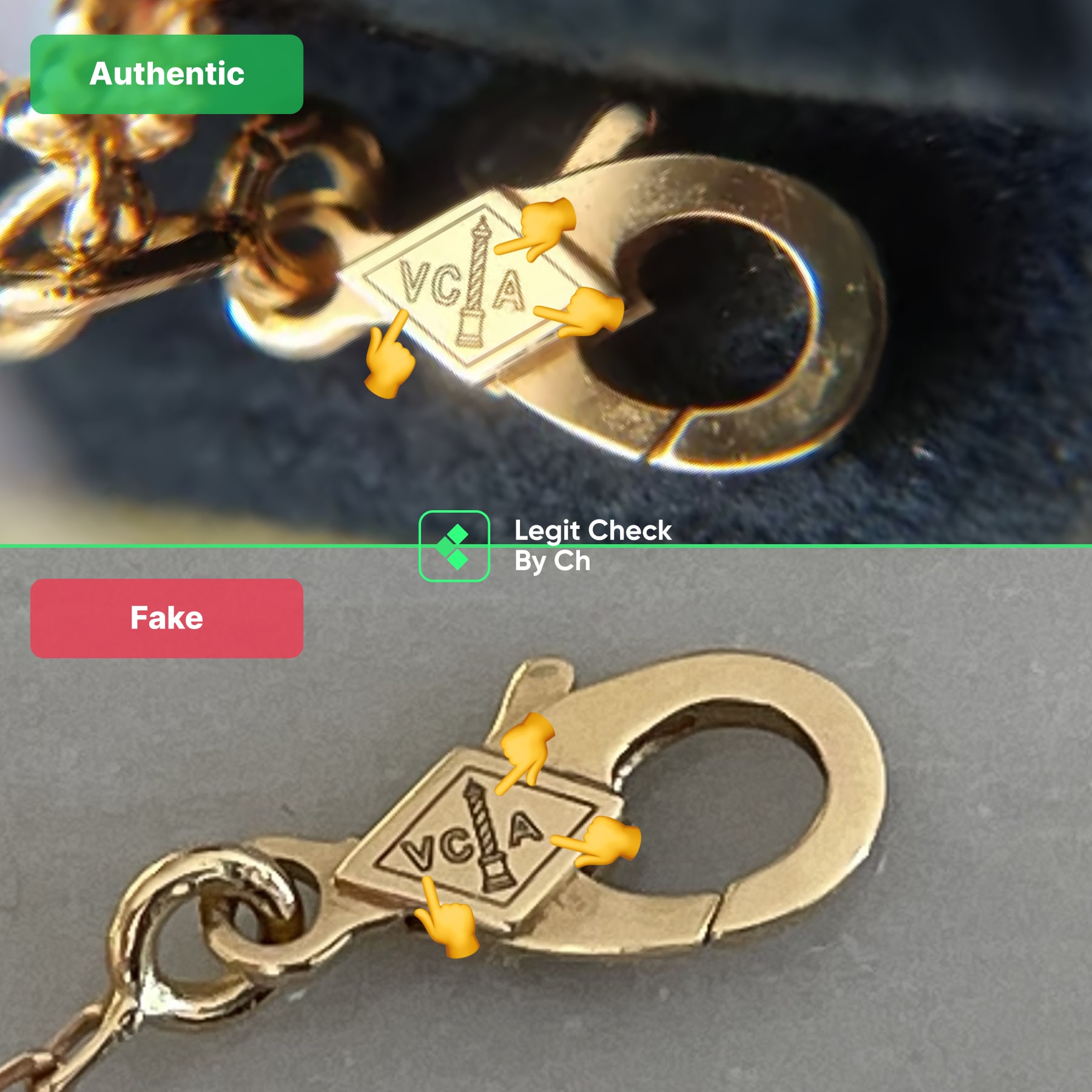
The clasp is a high-precision part on real VCA Alhambra chains and bracelets.
The VCA + tower mark should be delicate, evenly spaced, and perfectly centered on the clasp tongue. On fakes, the letters are heavy and crowded; the tower loses its silhouette and spreads at the base.
Also feel the clasp action: the snap on a genuine piece is crisp and confident, with no side play. Sloppy stamping often comes with a mushy or gritty closure.
The crisp letter spacing and centered hallmark echo the stamping quality found on the Cartier Love Ring.

A quick mention:
If in doubt, we recommend double-checking the steps we’ve explained above this line.
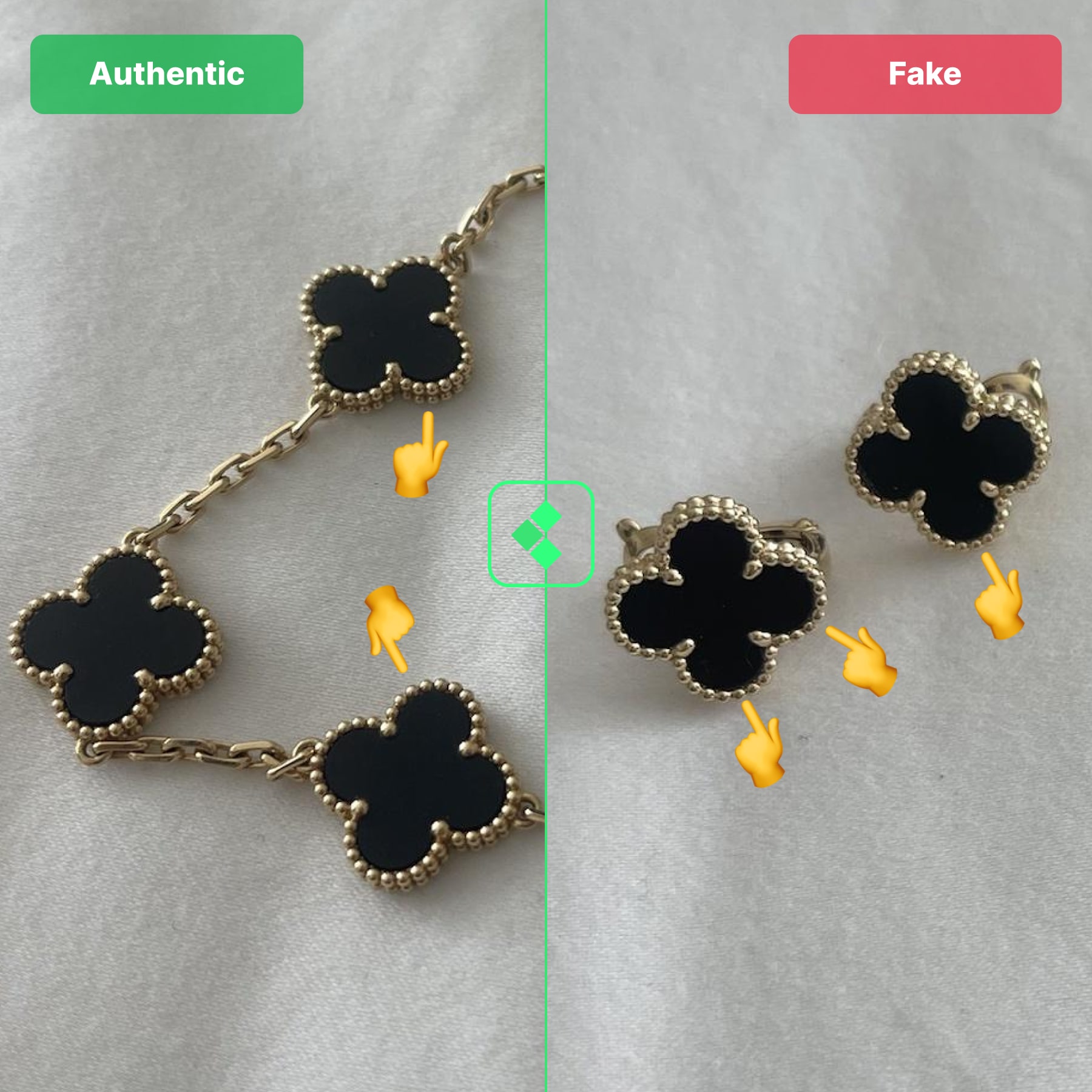
The motif is the soul of every Van Cleef & Arpels piece – whether it’s the clover of the Alhambra or the butterfly of the Frivole line, the contour tells everything.
On an authentic piece, the outline feels crisp and deliberate, with symmetrical petals and perfectly balanced curvature. Each edge catches light evenly, giving off a soft metallic glow.
Counterfeits, on the other hand, often lack definition. Their motifs look overly shiny or uneven in tone, with blurred edges and a hollow sound when tapped.
→ When inspecting, tilt the jewelry under bright light: real motifs mirror light softly, while fake ones scatter it harshly, betraying the low-quality polish and cheap metal blend beneath.
Motif symmetry and polish quality mirror the refined curvature and metal finish seen on Cartier Juste Un Clou Rings.
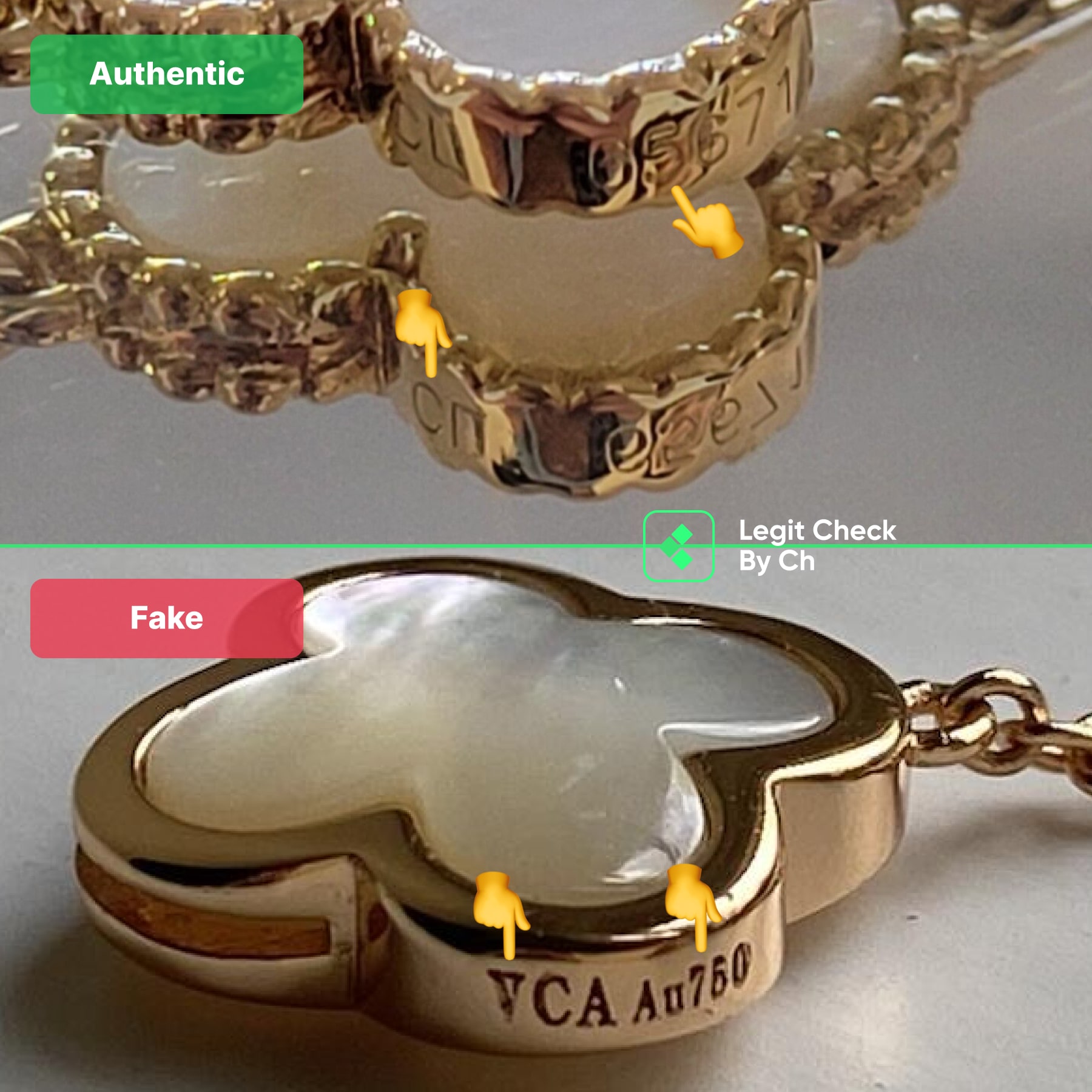
Every authentic Van Cleef motif bears a side engraving that is as elegant as it is subtle.
You’ll typically find inscriptions like “VCA,” the metal purity mark, or a serial number on the side rim. These are cut so finely they seem almost handwritten under magnification.
On replicas, the same markings are clumsy: letters appear swollen or unevenly pressed into the metal, and spacing varies from one character to the next.
If you gently glide your fingertip over the engraving, the genuine mark feels precise yet shallow, like a smooth indentation.
Fake pieces often feel gritty or raised, as if the mark was etched by acid instead of laser-cut.
Consistent lettering and spacing are similar to the hardware markings found on Gucci Marmont Bags.
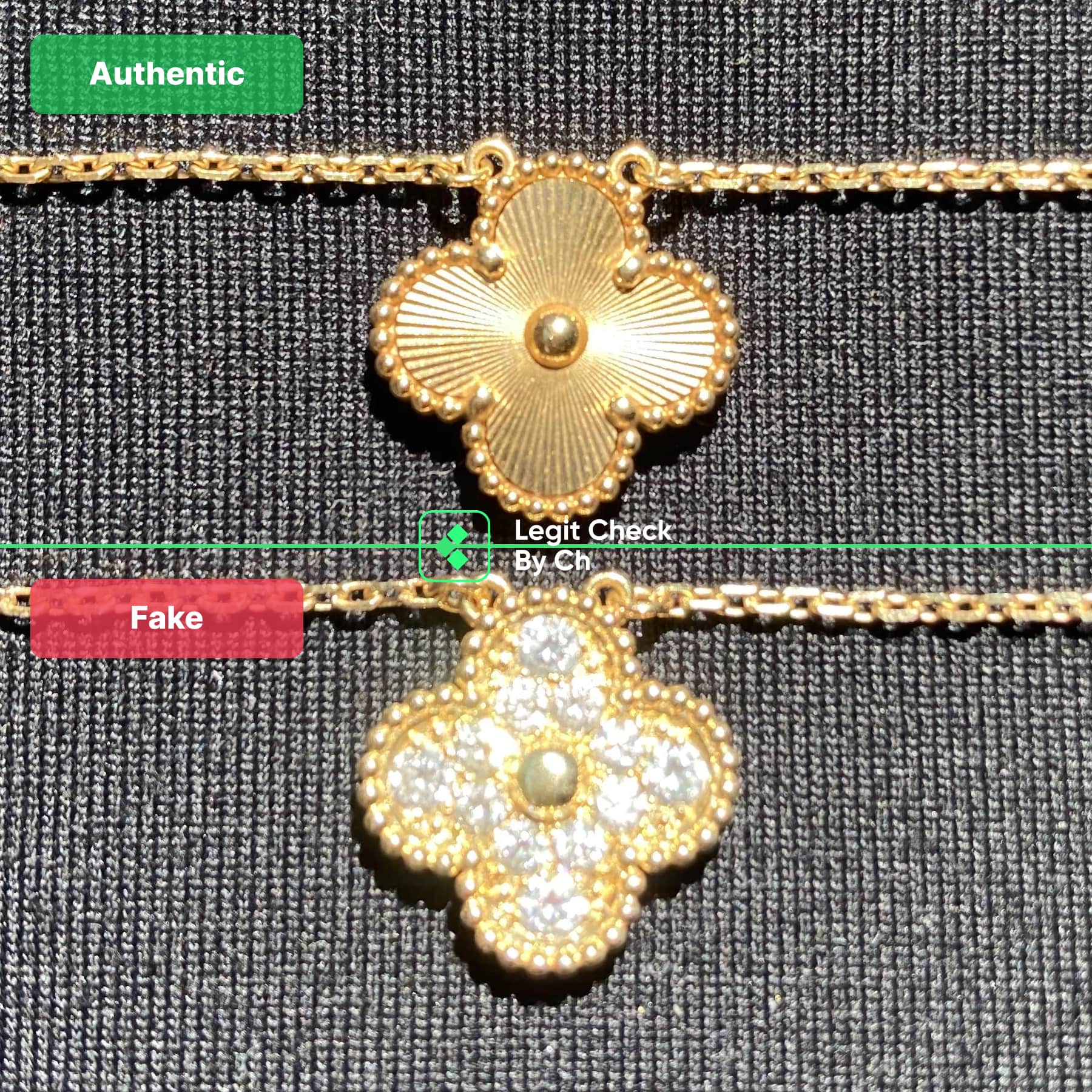
One of the hallmarks of true Van Cleef craftsmanship lies in the polish.
Real pieces have a controlled luster, which looks luxurious but never overly bright. Under daylight, authentic motifs and chains reflect light like liquid metal, creating soft highlights without glare.
Fake jewelry, however, often has a mirror-like gloss that looks artificial and uneven. The plating can appear too yellow (especially on fake “gold” pieces) or even slightly greenish under LED light.
Hold the jewelry close to a window or under a white light source. If the shine feels too “loud” or shows patchy reflections, it’s almost always an imitation finish rather than genuine solid gold or expertly polished precious metal.
If the gold tone feels overly bright or patchy, that same issue often appears on fake Louis Vuitton Bags, where poor plating exposes replica metals.
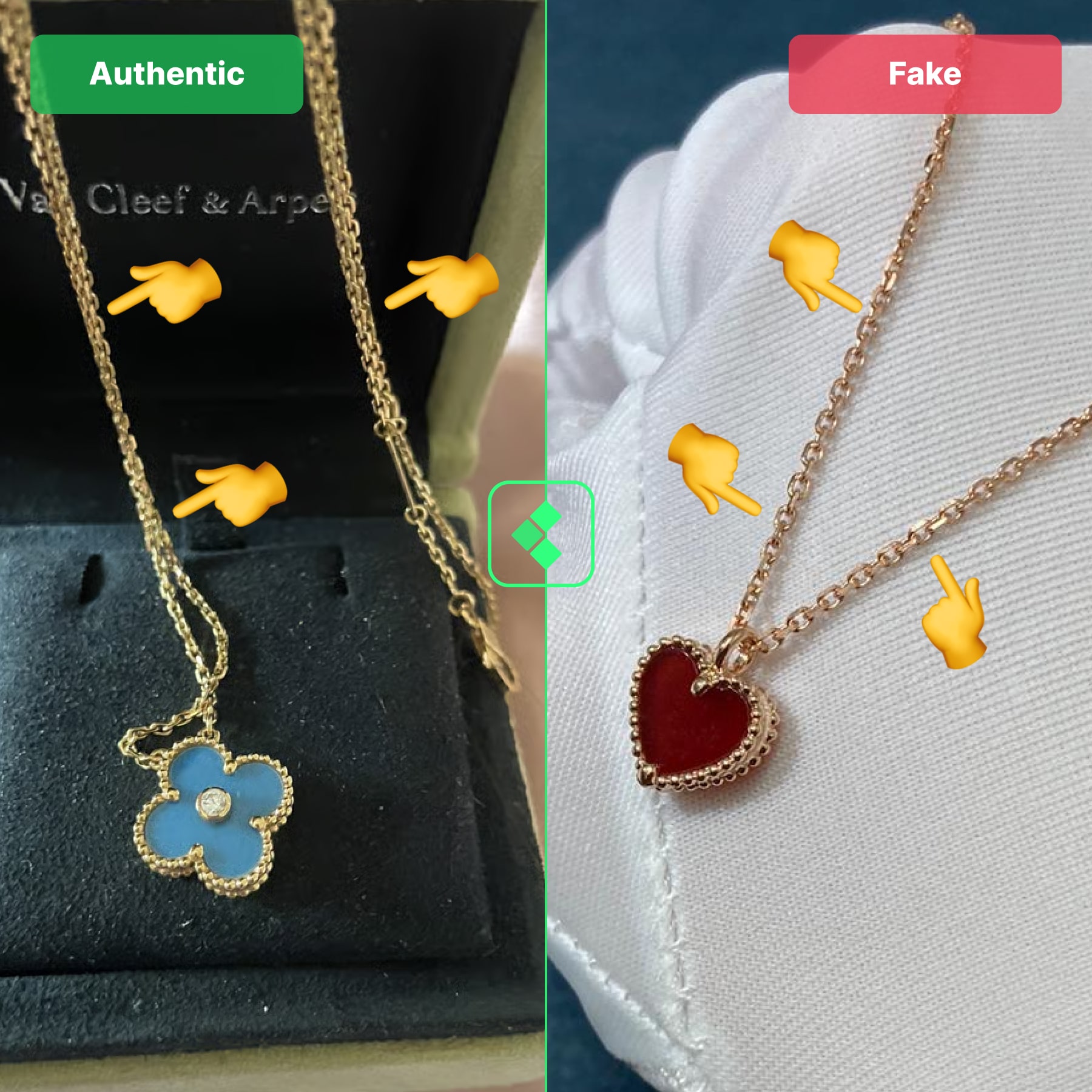
The chain is one of the easiest places to detect authenticity – real Van Cleef & Arpels chains are carefully engineered for both beauty and durability.
Each link is perfectly oval, symmetrical, and polished to match the rest of the jewelry. When held, the chain hangs straight without kinks and has a pleasant, weighty feel.
In contrast, fake chains tend to twist or tangle easily. Their links look irregular, sometimes unevenly cut, and they lack the balanced proportions of a genuine VCA piece.
A quick test: gently run your fingers along the chain. A real VCA chain feels silky and substantial, while a fake one feels scratchy or “tinny.”
Authentic gold also emits a soft, muted sound when moved, unlike the high-pitched clink of imitation alloys.
Weight and chain tension are similar cues we analyze on Chanel Classic Flap Bags to spot low-quality metal imitation.
We’ll first begin outside the box, and then we’ll look inside it.
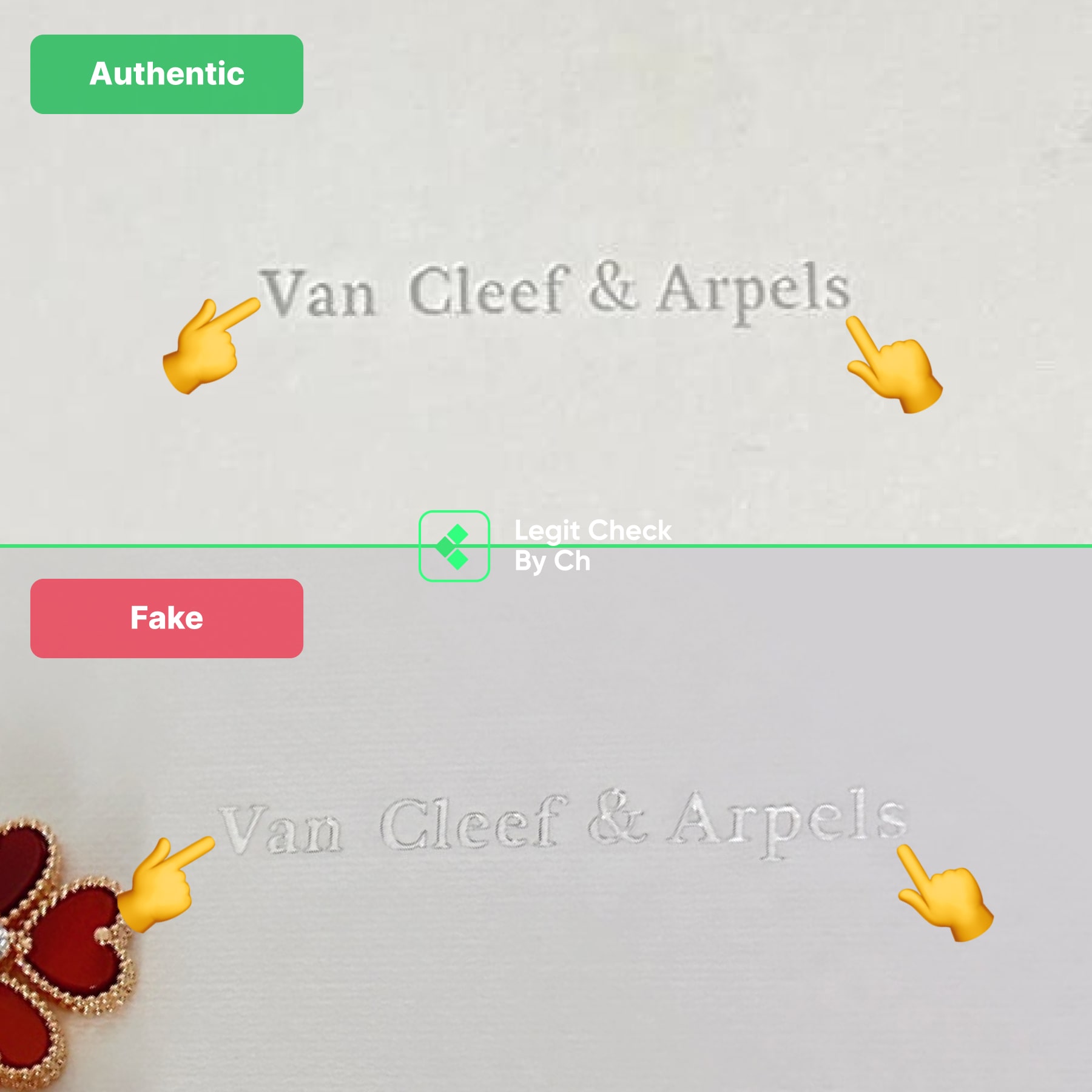
When you compare the boxes side by side, the difference in craftsmanship becomes obvious.
A genuine Van Cleef & Arpels box feels velvety, with rich, uniform coloring and neatly embossed text that catches light subtly.
Each letter is spaced perfectly, and the printing has depth rather than sitting flat on the surface. The hinge opens and closes smoothly, and the lid aligns flawlessly with the base.
Meanwhile, fake boxes feel lighter, with rougher suede and dull color tones. Their text is printed unevenly (the letters might sit too close or too far apart) and the hinge often feels stiff or squeaky when handled.
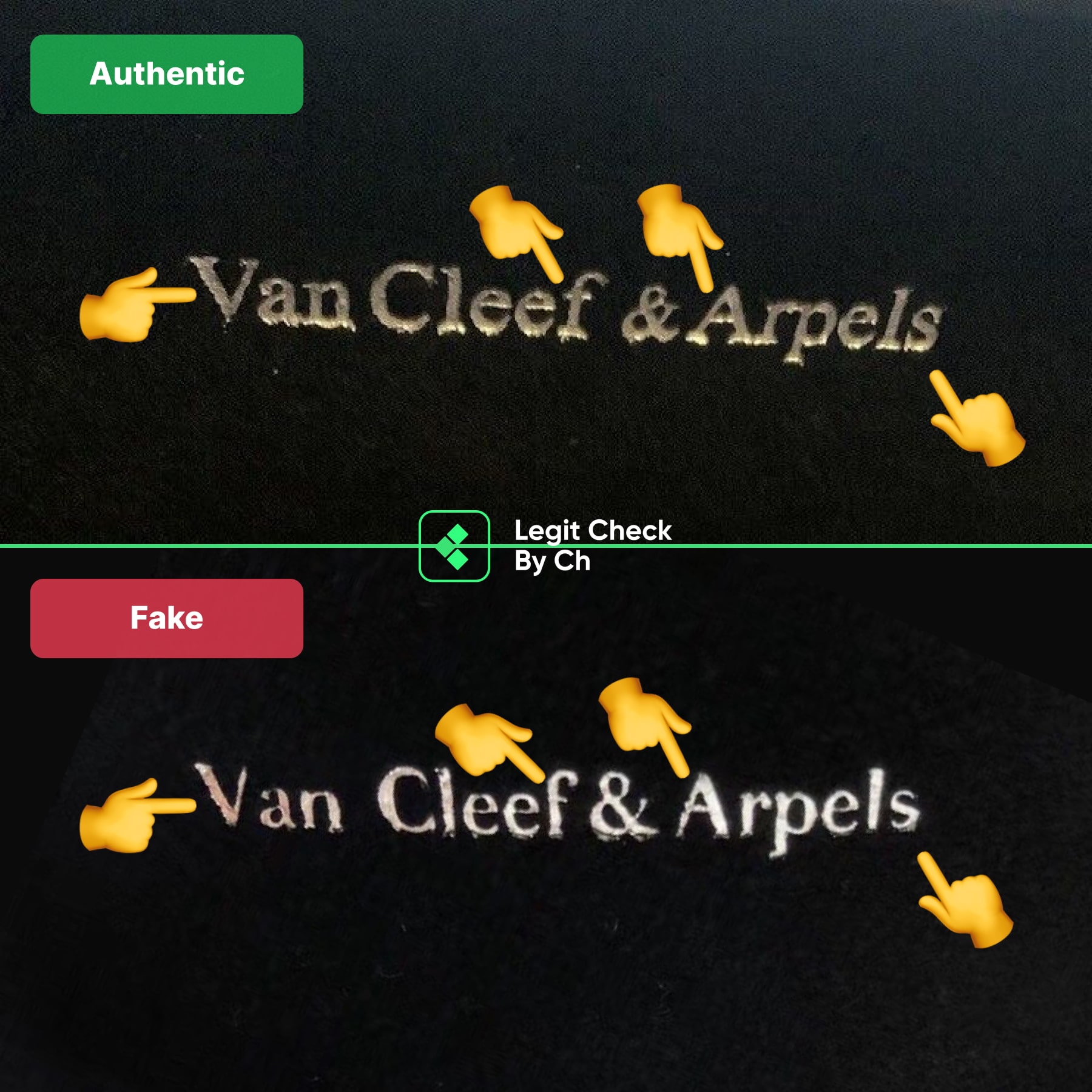
Inside, the quality gap widens. The genuine interior is lined with soft, dense suede that feels plush and evenly colored.
The logo inside the lid is embossed deeply and centered precisely, maintaining the same tone and clarity across all authentic boxes.
Fake interiors, on the other hand, often use cheaper, shiny fabric that wrinkles or lifts at the edges. The logo is usually printed instead of embossed – it looks pale, crooked, or slightly off-center.
When pressed lightly, the authentic cushion holds firm, while the fake one feels hollow or uneven beneath the jewelry piece.
Box texture and font embossing consistency are identical checks to what we use for Louis Vuitton Keepall Bags.
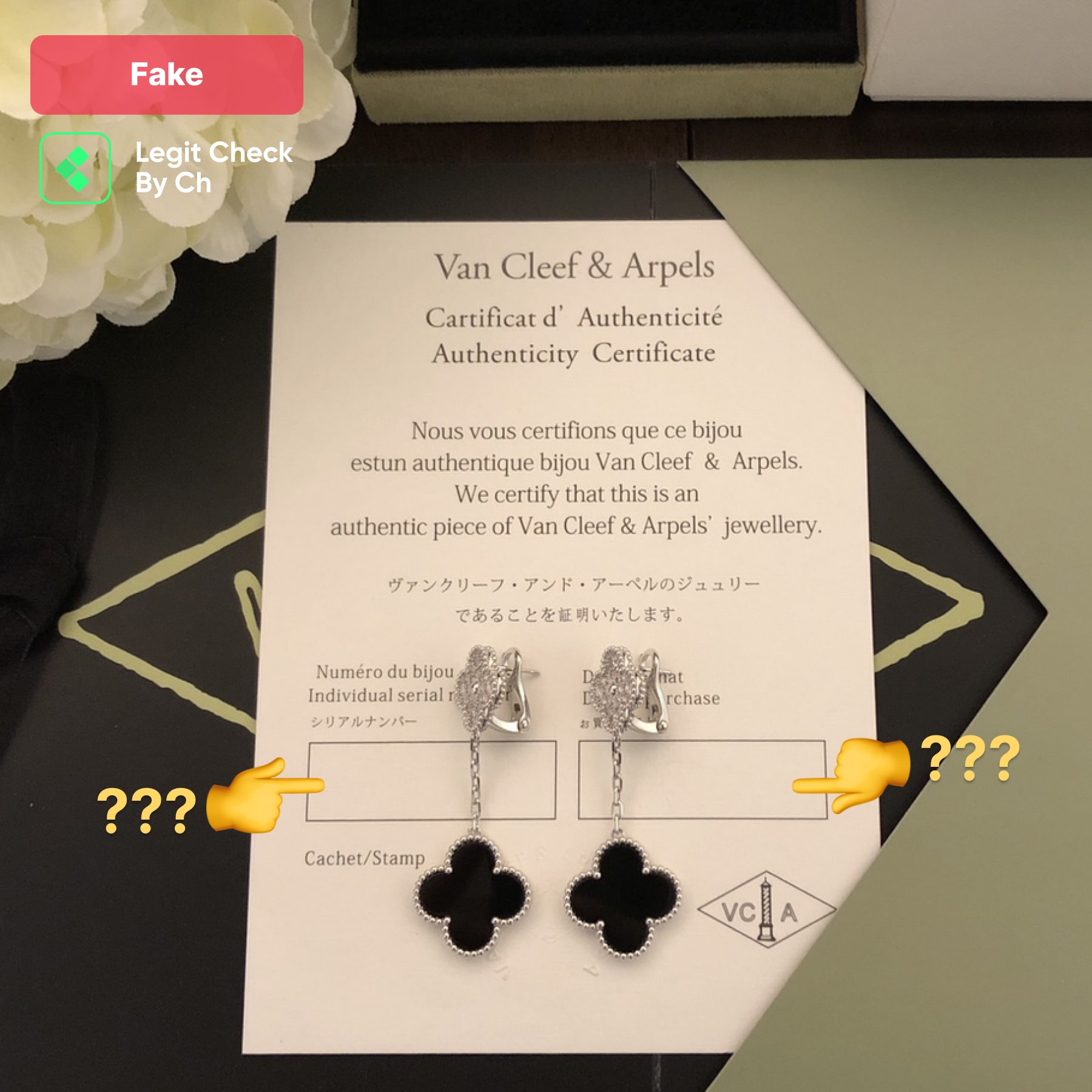
Every authentic Van Cleef & Arpels certificate carries specific identifiers that match your jewelry – not only the serial number but also the boutique name and purchase date.
The font is crisp, and the ink doesn’t smudge when touched. Fakes, however, tend to use cheaper cardstock, glossy finishes, or incorrect formatting.
Many omit the serial entirely or use vague descriptions like “VCA necklace” without referencing the actual model.
Always verify that the serial number on the certificate matches the engraving on your jewelry. If the card lacks a serial or looks overly generic, it’s a strong sign that the item is not genuine.
Authenticity paperwork from Van Cleef is as detailed and precise as their craftsmanship – replicas rarely get it right.
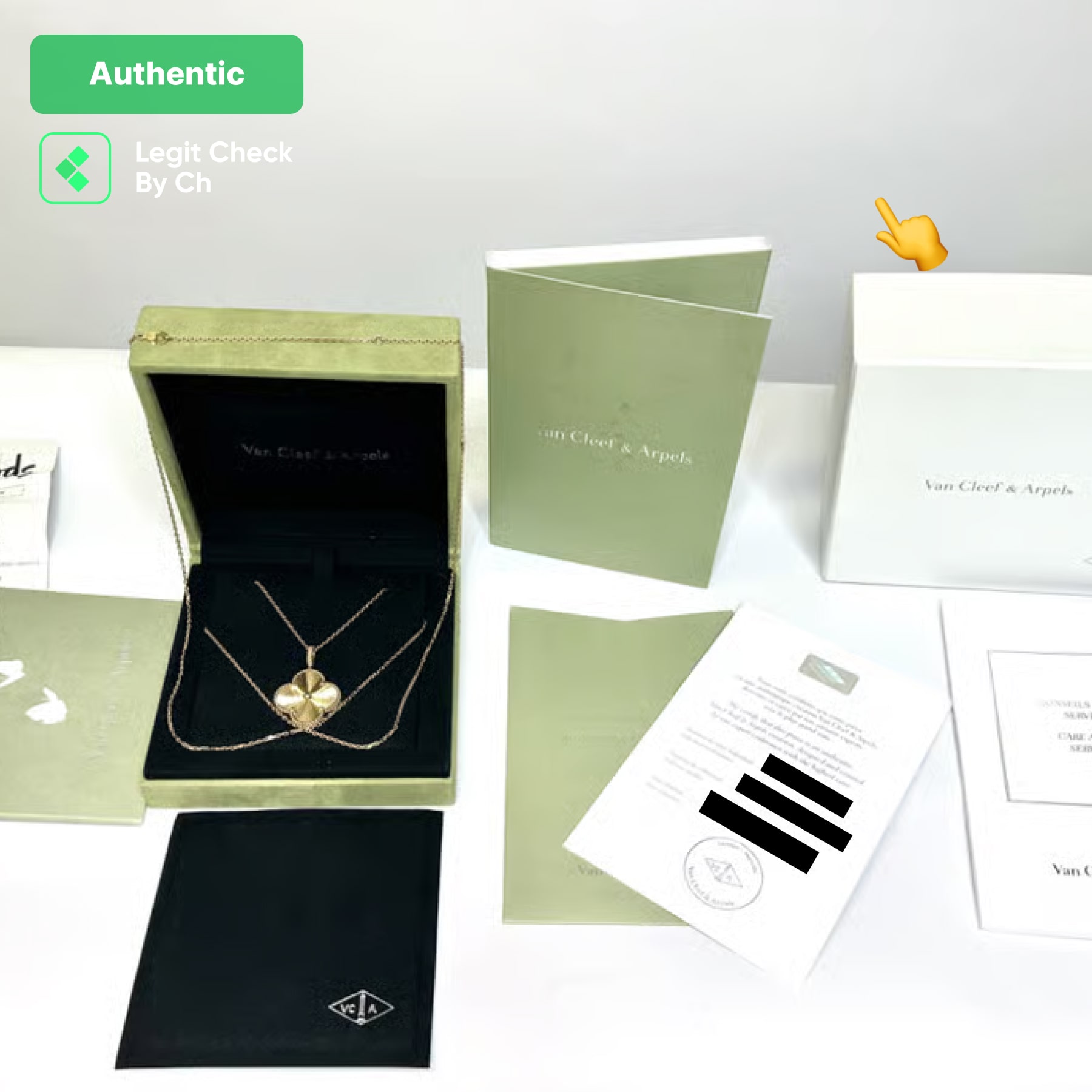
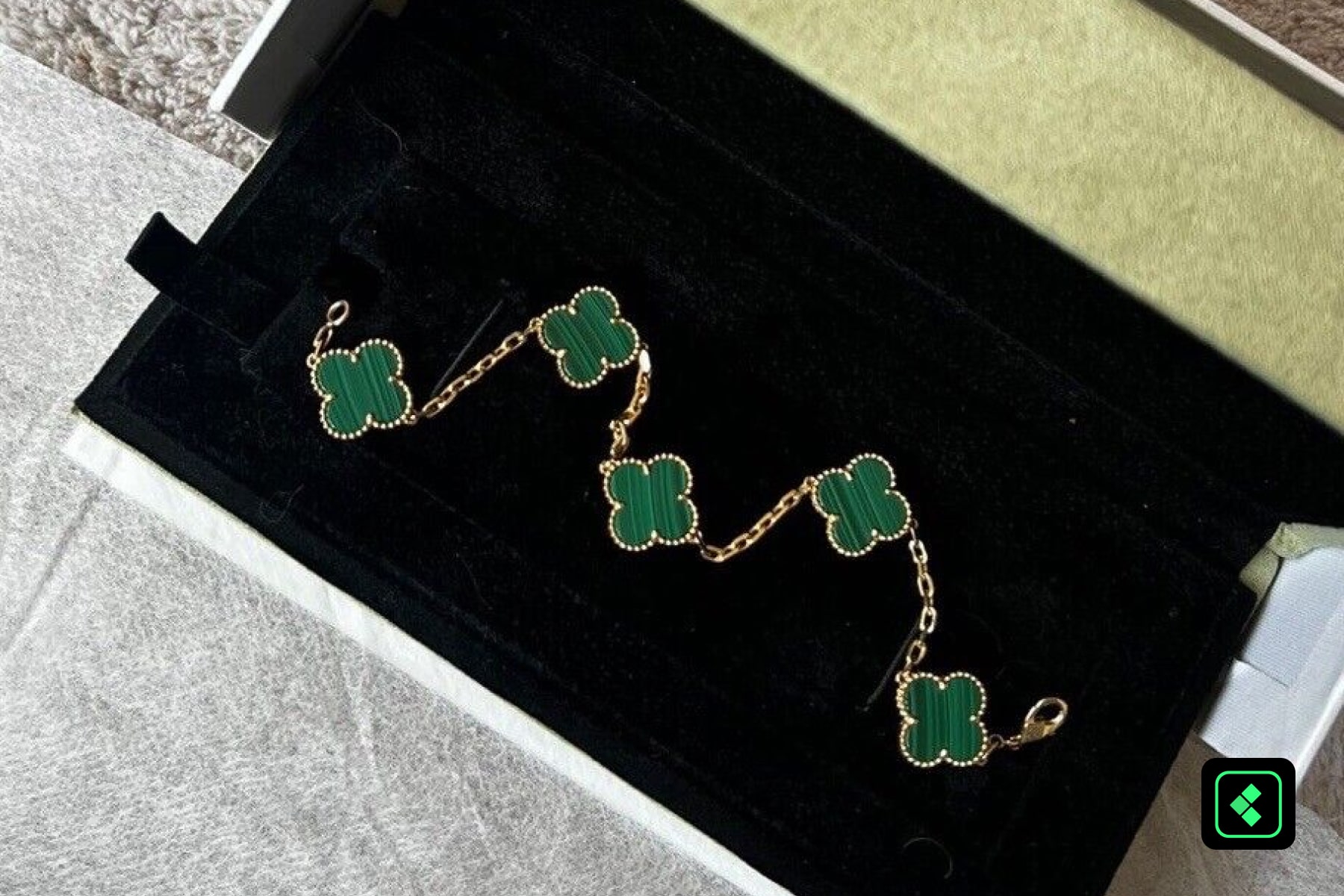
The authentic Van Cleef & Arpels packaging radiates refinement from the first glance.
Every component feels intentional, from the weight of the box to the texture of the suede. The green tone is rich and deep, the seams are perfectly aligned, and the logo embossing is clean and centered.
When you open the box, the certificate slot fits precisely, the papers rest flat, and even the typography matches the brand’s signature aesthetic.
The set feels balanced, solid, and built to last – a physical extension of Van Cleef’s luxury craftsmanship.
By contrast, fake packaging often feels hollow or unfinished. The green color is slightly off (sometimes too pale, sometimes too glossy) and the logo may be printed instead of embossed.
Inside, the papers might be misaligned or missing entirely, and the fabric lining feels rough or overly shiny. While replicas can mimic the overall layout, they can’t replicate the harmony of design and precision found in genuine packaging.
Authentic Van Cleef packaging always feels heavy, soft, and perfectly proportioned – unmistakable when seen in person.
Note: Blurred is sensitive information of the picture’s owner. Over there, you’ll find a valid date of purchase and serial number.
Van Cleef & Arpels is synonymous with elegance and perfection – and that’s exactly what counterfeiters struggle to reproduce.
While fake pieces might look convincing online, they always miss the Maison’s signature refinement in texture, proportion, and finishing.
Here’s a quick 10-step authenticity checklist trusted by professional authenticators and collectors alike:
Once you know these cues, spotting a fake Van Cleef & Arpels piece becomes second nature. Real ones feel substantial, harmonious, and flawlessly finished – a balance replicas can’t fake.
Van Cleef & Arpels pieces are often beautifully deceptive when counterfeited – the shine, weight, and finish can look convincing at first glance.
In this video, we’ll take you through a detailed process for authenticating them properly. From serial engravings and gold stamps to clasp precision, chain consistency, and certificate quality – you’ll see exactly how genuine craftsmanship reveals itself.
Watch closely, pause when needed, and compare these details with your own piece.
are you wondering if your van cleef and arpel jewelry is the real deal? well in this guide we’ll walk you through the essential steps to determine its authenticity. let’s get right into it and make sure your precious piece is genuine.
1. Serial number
start with the serial number engraving. authentic van cleef and arpel pieces have finely detailed, thicker letters and numbers that are deep and clear. use good lighting and a magnifying glass to inspect it closely. authentic engravings are uniformly well spaced, showing the high-quality craftsmanship of the brand. compare it with authentic examples from reliable sources.
2. VCA Au750 (Gold)
look for the VCA Au 750 text on the metal tab. authentic pieces feature thick, deeply engraved characters that are uniform and precise. even minor inconsistencies can signal a fake. fakes typically have shallow and uneven inscriptions. check carefully with a magnifying glass to ensure the markings are clear and well crafted.
3. Clasp
examine the clasp closely. authentic clasps have thinner, precisely engraved VCA letters and a distinctive tower design in the middle. the clasp should both look and feel robust, operating smoothly with a firm click. fakes often feel loose or stiff, lacking the refined finishing of authentic clasps. if you’re unsure, watch comparison videos from reliable sources to see how the authentic clasp should function.
4. Motifs
inspect the motifs carefully. authentic motifs are detailed with solid, heavy edges made from high-quality materials. the craftsmanship should be evident – authentic pieces feel substantial and luxurious. fakes usually lack this detailed craftsmanship and can have plastic-like edges that feel lighter. the difference in weight and detail of the motifs is often one of the clearest indicators of authenticity.
5. Side motif engravings
authentic pieces have thin, precise characters that are easy to read even when small. this level of detail is achieved only through meticulous crafting processes. blurry or thick characters typically indicate a fake. ensure the spacing and alignment reflect high-quality craftsmanship by comparing them to known authentic pieces.
6. Shininess
observe the shininess of your piece. authentic van cleef & arpels jewelry is made from high-quality materials that offer a consistent, luxurious shine, reflecting light in a distinctive way. fakes often appear dull and have an uneven finish. inspect the piece under various lighting conditions to verify its luster and quality of finish.
7. Chain
examine the chain meticulously. authentic chains are thicker, sturdier, and feel weighty. each link should be perfectly soldered, smooth, and consistent in size and shape. authentic chains flow naturally without any kinks or irregularities, showcasing impeccable craftsmanship. fakes tend to have thinner, lightweight chains that can feel flimsy, with noticeable imperfections. run your fingers along the chain to check for smoothness and consistency.
8. Box
inspect the box. authentic van cleef & arpels boxes use high-quality materials with consistent character thickness in the lettering. the texture, weight, and finish of the box should reflect the brand’s luxurious standards. inside, the lettering should be thick and aligned, indicating precise manufacturing. fake boxes often use cheaper materials and display inconsistencies in the text, font, and thickness. compare it to examples from authentic sources.
9. Authenticity Certificate
look at the certificate provided with your piece. authentic certificates include a serial number and a date of purchase that meticulously match the number on your piece. the certificate should be printed on high-quality paper, and holograms or embossed logos should be clear and very difficult to replicate. if you’re in further doubt, verify these details with van cleef & arpels or an authorized dealer to ensure the document’s authenticity.
10. Packaging
inspect the overall packaging. authentic van cleef & arpels packaging includes all necessary components and is made from premium materials with meticulous craftsmanship. pay close attention to the logos, text, and symbols – they should all reflect the high standards of the brand itself. every detail from the outer box to the internal compartments should exude luxury and quality. if anything feels slightly off, compare it to official packaging photos or examples from verified sources.
VCA Authentication Service
if you’re still unsure about your piece’s authenticity, our expert authentication service is available to you. simply send us a high-quality photo, and we’ll provide a detailed report within 24 to 48 hours. for more assistance, check out our free resources including written guides and video tutorials. these are designed to help you stay informed and confident when buying high-end jewelry. always verify before purchasing – your peace of mind is absolutely paramount. thanks again for watching, and happy staying authentic.
Counterfeit Van Cleef & Arpels pieces have become so convincing that even experienced collectors hesitate – especially with high-value lines like Alhambra, Frivole, or Vintage motifs.
That’s why a professional authentication is no longer optional; it’s essential.
Our Van Cleef & Arpels authentication service is performed by human experts who specialize in fine jewelry verification.
Every piece is examined under magnification, lighting, and macro photography to confirm both craftsmanship and origin.
Here’s what our experts check during authentication:
After a full inspection, you’ll receive a Certificate of Authenticity confirming whether your Van Cleef & Arpels piece is genuine – a document you can use for insurance, resale, or peace of mind.
👉 Authenticate your Van Cleef & Arpels jewelry now and get a professional verdict before you buy, sell, or wear it.
Authenticating a Van Cleef & Arpels piece isn’t about one single detail, it’s about how all of them come together.
The engraving depth, the precision of the hallmark, the smooth clasp action, and the balanced shine – each element tells a story of craftsmanship that counterfeits can’t replicate.
This guide covered the essential checkpoints collectors and jewelry lovers rely on to separate genuine Van Cleef & Arpels creations from imitations.
When inspected closely, every authentic piece reveals a harmony of proportion, polish, and engraving quality that defines the Maison’s reputation for excellence.
If you’re ever in doubt, take a moment to compare your piece under proper light, feel its weight, and listen to the clasp. True Van Cleef jewelry feels effortless, while fakes always seem to try too hard.
Key Points to Remember
Still Unsure About Your Piece?
If you’re not fully confident after checking your jewelry, our Van Cleef & Arpels authentication service can confirm its authenticity for you.
Each evaluation is carried out by human jewelry experts, never automated tools. Your piece is inspected under magnification, photographed, and compared against verified factory standards before you receive your written Certificate of Authenticity.
For collectors and buyers, this document brings peace of mind and proof – whether you’re investing, insuring, or reselling.
👉 Authenticate your Van Cleef & Arpels jewelry now and secure confirmation from experts who specialize in luxury craftsmanship.
We verify what photos can’t hide: engraving depth, hallmark pressure, clasp snap, chain weight, and motif polish. If it’s VCA, it will prove itself.
Private, expert-only review • Fast turnaround • Trusted by collectors since 2017
Van Cleef & Arpels jewelry commands high prices because of its exceptional craftsmanship, rare gemstones, and labor-intensive production. Each piece is made in France by master artisans who hand-polish, hand-set, and individually assemble every motif.
The brand also uses premium 18k gold and platinum alloys that resist tarnish and retain color for decades.
Beyond materials, much of the cost lies in artistry – for example, achieving perfect symmetry in the Alhambra clover motifs or mirror-polishing the gold edges without losing curvature. You’re not just buying jewelry, but a piece of haute joaillerie heritage that holds cultural and collectible value.
Yes, every authentic Van Cleef & Arpels bracelet has a unique serial number engraved with precision.
The code helps trace production origin, collection type, and authenticity verification.
It’s usually found on the small metal plaque near the clasp or along the motif’s edge, depending on the collection.
Counterfeits often include serials that are shallow, misaligned, or randomly generated.
If your bracelet lacks one altogether, it’s likely not genuine – even vintage models from earlier decades include properly stamped identification numbers.
Van Cleef & Arpels and Cartier are both part of the Richemont Group, a Swiss luxury conglomerate that owns several prestigious watch and jewelry houses. However, they remain separate brands with distinct design philosophies.
Cartier is known for architectural and panther-inspired creations, while Van Cleef & Arpels is celebrated for nature-inspired motifs like clovers, butterflies, and flowers. Both share similar quality standards but target slightly different aesthetics and emotional appeal within the fine jewelry world.
You can, but daily wear should be done mindfully. While authentic Van Cleef pieces are built for longevity, materials like malachite, onyx, or mother-of-pearl are sensitive to water, perfume, and heat.
If you plan to wear your jewelry daily, rotate between pieces, avoid contact with lotion or chlorine, and store it flat in its suede box when not worn. Regular cleaning with a soft, lint-free cloth helps maintain shine without scratching the surface. With proper care, Van Cleef jewelry can last for generations.
Yes, many Van Cleef & Arpels pieces hold or even increase in value over time, particularly limited editions and discontinued collections like the vintage Alhambra.
The brand’s strong secondary market and enduring global demand make it one of the few jewelry houses whose pieces are actively collected and resold at a premium.
Collectors often favor neutral-toned stones such as onyx, mother-of-pearl, or carnelian, as these pair easily with any wardrobe and maintain long-term desirability.
That said, like any luxury asset, resale value depends on condition, provenance, and documentation – keeping your certificate and box significantly enhances investment potential.
Need our opinion on your item’s authenticity? It’s a service we provide.
Get a fully-detailed report for why you have a real or fake item. Takes less than 48 hours!
Alternatively, use our free resources: written guides and video tutorials.
Thank you for reading this,
Ch Daniel and Ch David
Other authenticity-check guides for you
The guides below follow the same detailed, step-by-step approach and cover other high-jewelry pieces frequently collected alongside Van Cleef & Arpels creations.