Last Updated on January 13, 2026 by Ch David
This Breitling authentication guide is essential for anyone looking to buy or collect one of the brand’s signature chronographs.
Known for their aviation roots and precise craftsmanship, Breitling watches have a reputation for bold design and technical reliability.
That popularity has also led to a flood of replicas. Some crude, others convincing enough to fool casual buyers.
While many fakes capture the overall look, they rarely reproduce the fine mechanical and visual details that define a true Breitling.
Features like the date wheel depth, dial texture, and engraving quality are often the easiest giveaways once you know where to look.
This guide walks you through the key steps to verify your Breitling’s authenticity, helping you recognize the differences that separate the real watch from even the best-made counterfeits.
Flight plan first. Purchase second.
We validate what photos miss (slide-rule alignment, date-wheel height, logo engraving, sub-dial geometry and case profile) so your Breitling decision is clear and defensible.
Discreet. Expert-led. Built to protect your money and your reputation as a collector.
Answer: One of the quickest ways to spot a fake Breitling is to check the depth and printing of the date wheel.
On a genuine watch, the date sits perfectly centered and flat, with clean, crisp numerals. Replica date wheels often appear sunken, with thick or uneven numbers that catch too much shadow.
This detail might seem minor, but it’s one of the easiest tells once you’ve seen the difference in person.
Still, it’s only a starting point. A complete authentication should also include the dial markings, case engravings, and movement, which we’ll cover in the sections below.
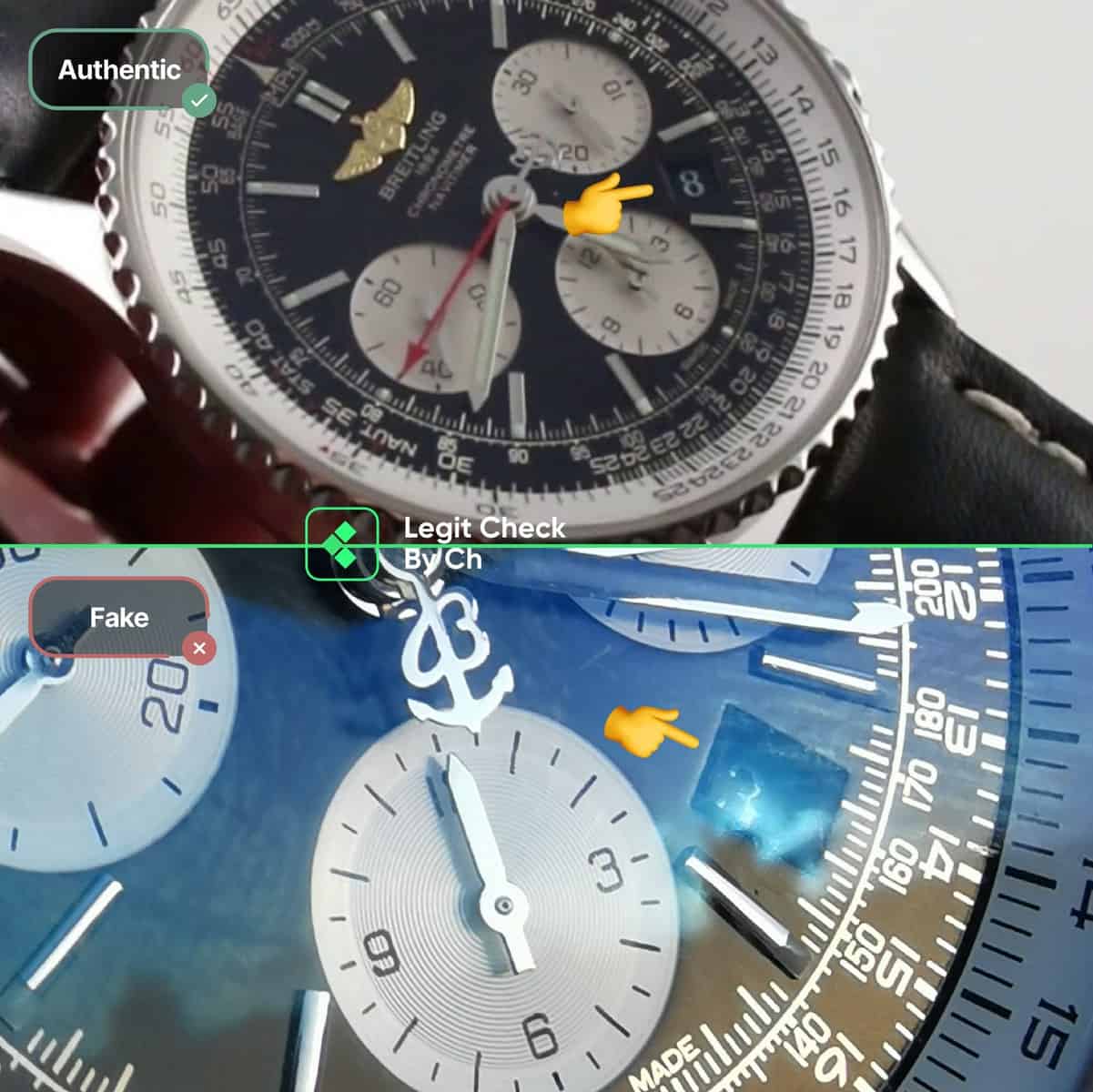
One of the easiest ways to catch a counterfeit Breitling Navitimer is to examine the depth of the date window.
The genuine model integrates the date disc almost flush with the dial, ensuring harmony across all elements. This seamless look is the result of a perfectly matched movement-to-case fit.
Fakes, however, often rely on cheaper movements that don’t align correctly inside the Navitimer’s case.
→ The result is a visibly lower date wheel, which makes the dial appear thicker and uneven.
When moving the sub-dial layout from 12 o’clock to 3 o’clock, this imbalance becomes even more apparent. If the date display looks like it’s sitting in a crater, you’re likely looking at a replica.
Let’s look at another comparison:
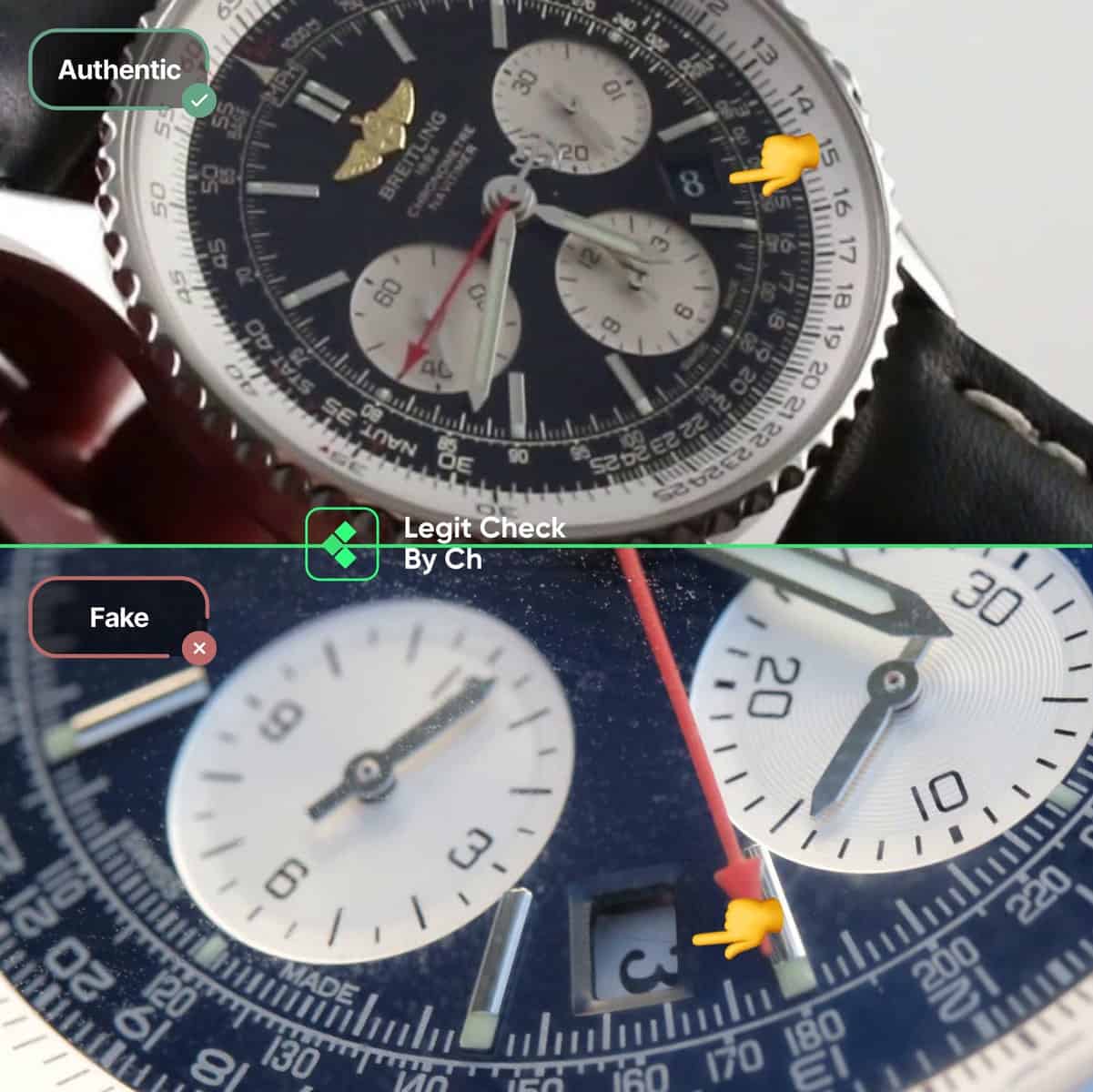
On a genuine Breitling Navitimer, the date wheel sits close to the dial window, allowing the date numerals to appear crisp, bright, and easy to read.
The positioning ensures perfect legibility from any angle, reflecting the brand’s precise engineering.
In fake versions, however, the date wheel is set too deep within the dial, creating a shadowed or recessed look.
This excessive depth makes the date text appear smaller and harder to read, especially when light hits the dial at an angle – a subtle but reliable sign of a counterfeit.
→ Breitling is a respectable brand in the watch industry, so know that an authentic watch has to be flawless.
Get the expert's opinion: Let us legit check your Breitling.
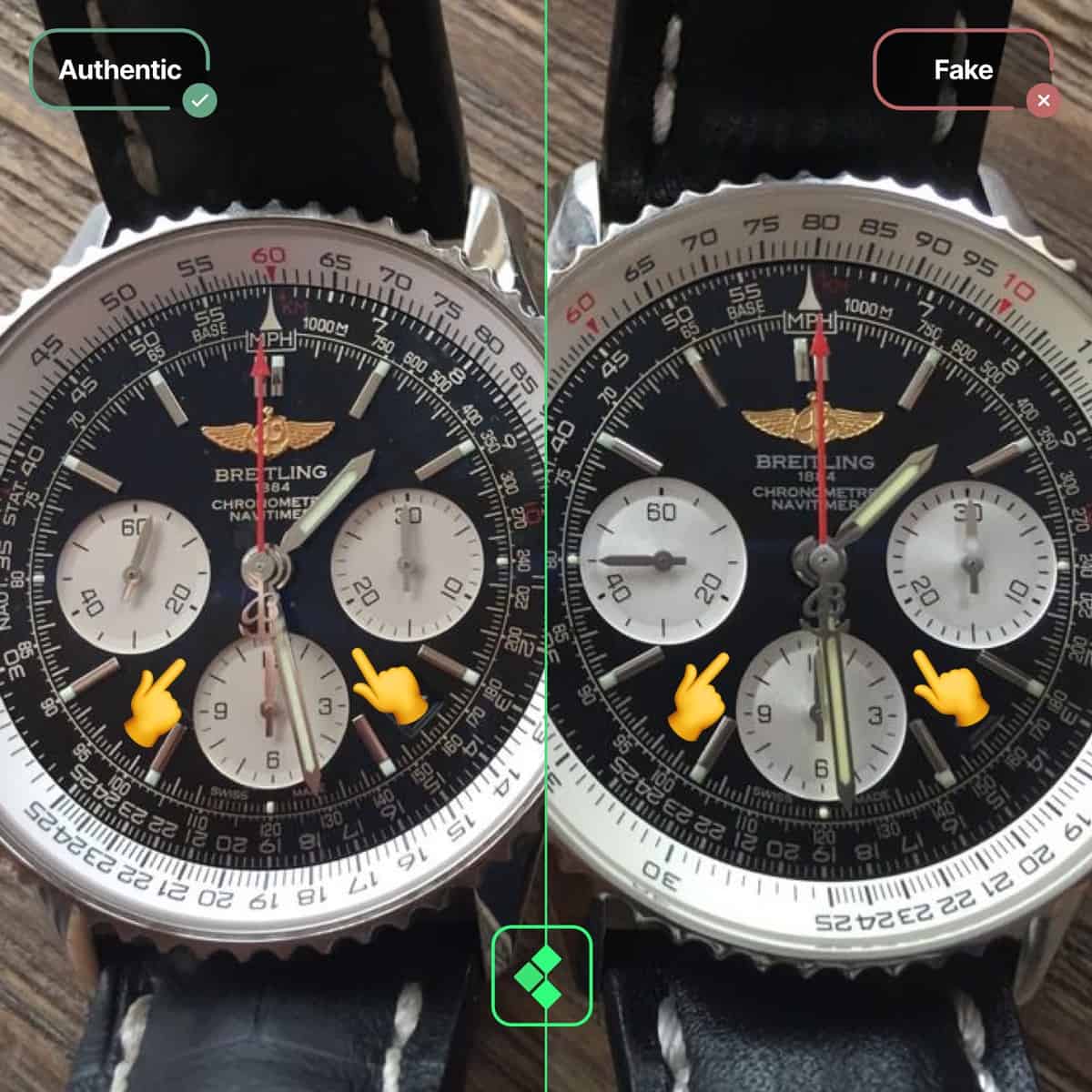
The Navitimer’s sub-dial arrangement is one of its signature design traits, and Breitling executes it with mathematical precision.
On authentic pieces, the spacing between the sub-dials and the surrounding markers is identical, preserving a clean, symmetrical look across the dial.
Counterfeit models usually reveal their flaws here. The sub-dials may appear too large or shifted outward, nearly touching the outer track or even merging with the indices.
This happens because replica manufacturers use generic chronograph movements that don’t perfectly match Breitling’s unique dial layout.
It’s a small misalignment, but once you see it, you can’t unsee it.
See how mechanical sweep and recessed registers should look in our Omega Speedmaster guide.
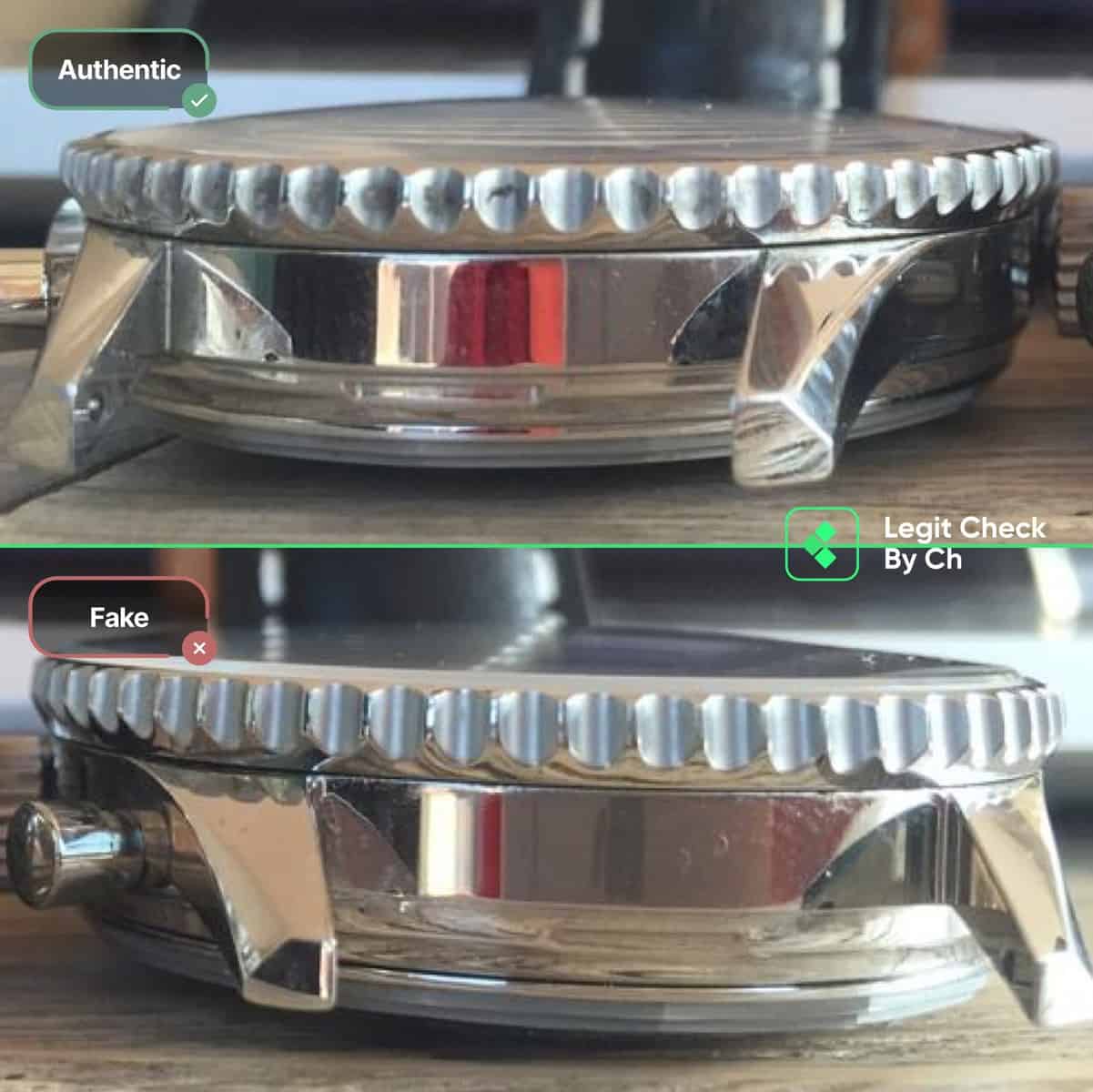
A real Breitling Navitimer is known for its elegant proportions – a technical chronograph that still wears comfortably on the wrist.
Its case is carefully engineered to house a complex movement without excess bulk.
Replicas tend to get this wrong. Their cases look bloated because the copied movement doesn’t fit the housing as precisely as Breitling’s original calibre.
As a result, the entire watch appears chunkier when viewed from the side.
Checking the official specifications of your model (available on Breitling’s site) can help confirm if your piece’s thickness is within authentic tolerances.
→ Anything noticeably larger is likely a fake.
Pilot chronographs with tight tolerances are covered in our IWC authentication guide.
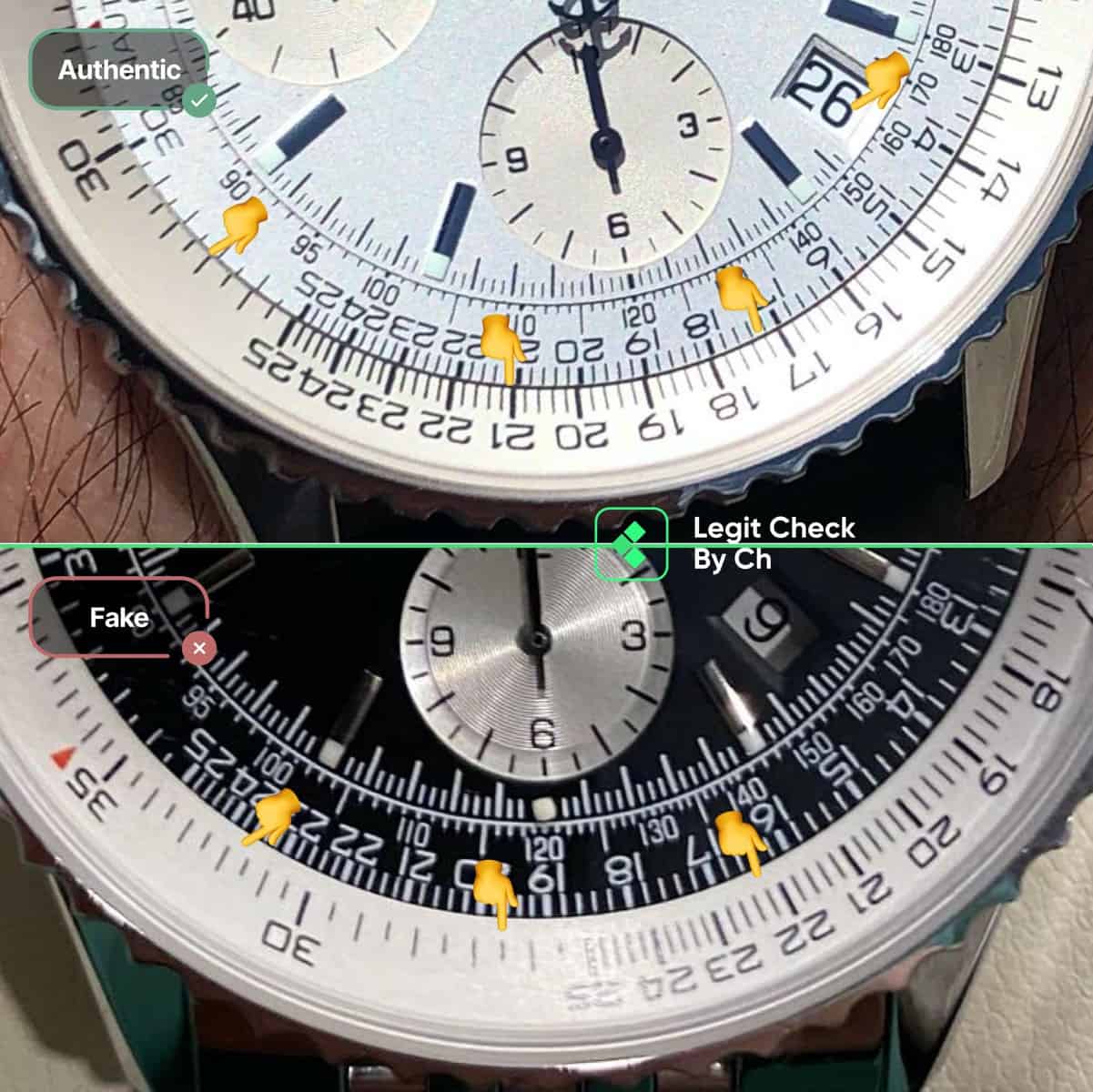
The Navitimer’s slide rule bezel is not just decorative, it’s a functional flight instrument.
On authentic watches, the connection between the white outer scale and the inner black dial is flawless. Each marker aligns precisely, creating a continuous circular track with no spacing errors.
Counterfeits often miss this alignment. The bezel markers may stop short of the edge, breaking the flow between the scales. This subtle spacing error might seem minor, but for collectors, it’s a clear sign the printing was done without the technical precision Breitling applies.
→ If the “ruler” looks like it’s floating away from the dial instead of merging with it, that’s a red flag.
Detailed look:
Focus Area: Edge between the white bezel and the black dial.
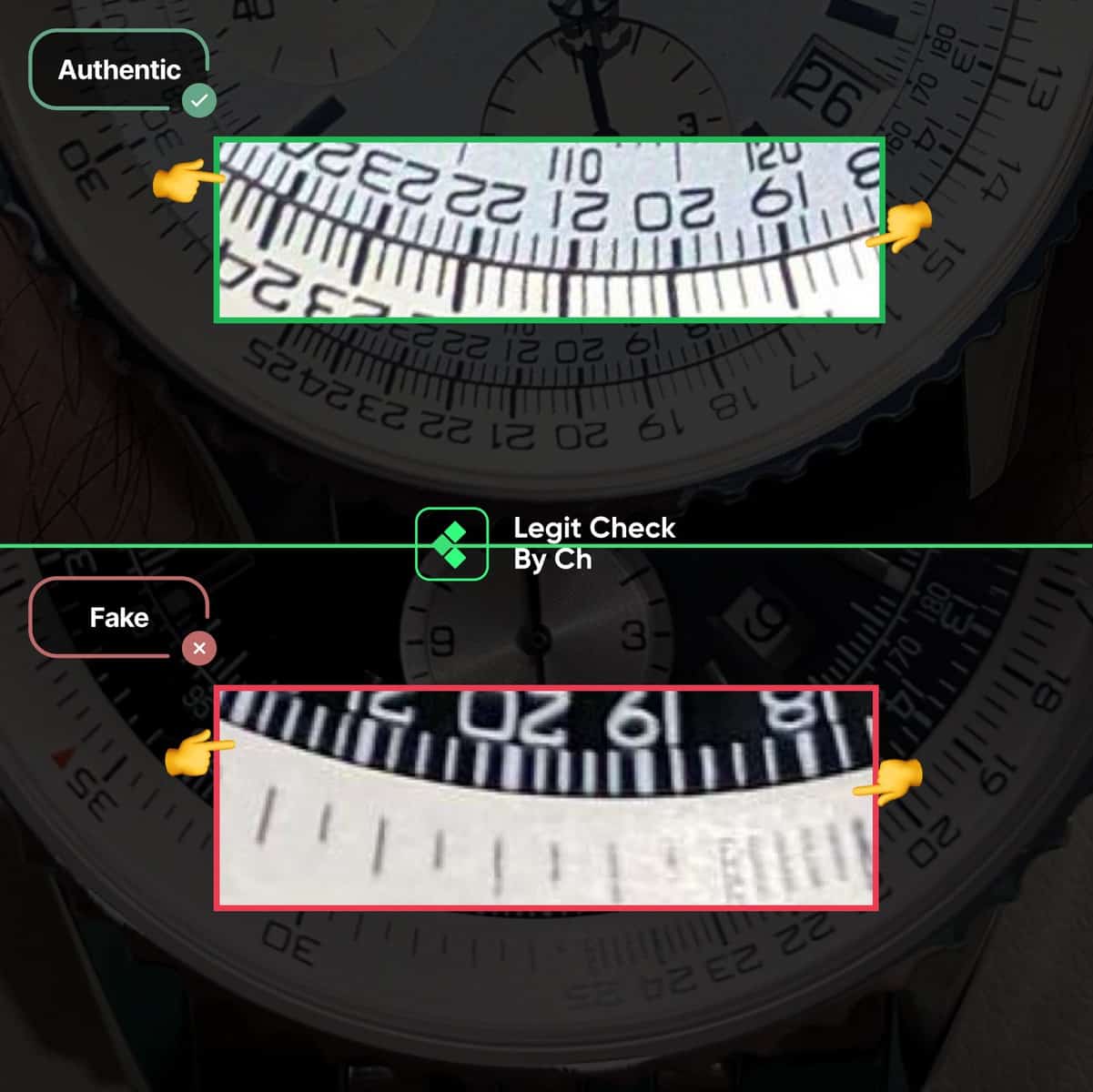
Markers on the fake watch are too far from the edge of the white bezel. On the genuine watch, they are precisely at the edge of the white bezel.

A quick mention:
If in doubt, we recommend double-checking the steps we’ve explained above this line.
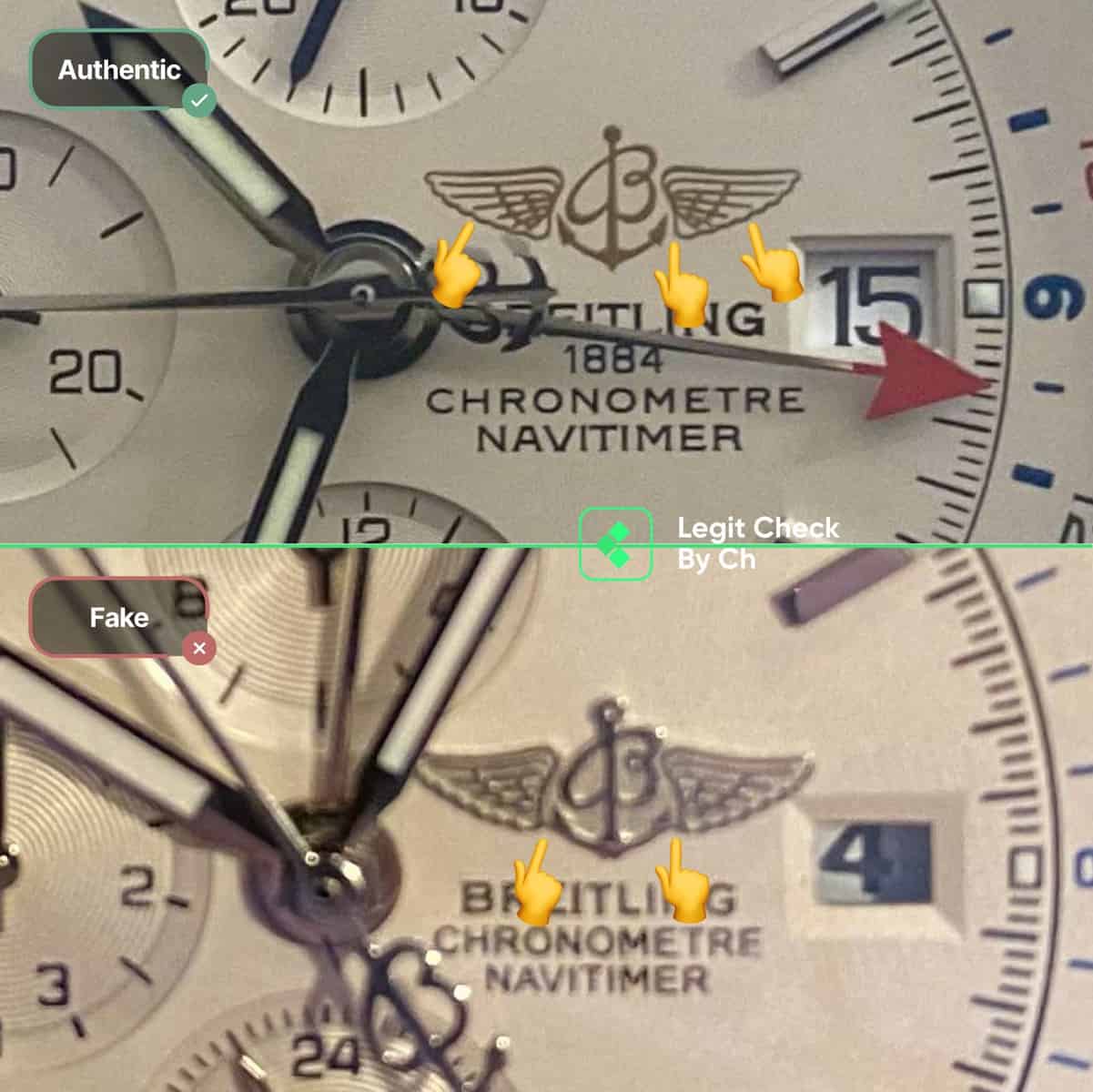
Breitling’s emblem is a delicate blend of engineering and artistry.
On genuine Navitimers, every curve, feather, and gap within the wings is cut with laser precision.
The design maintains clear separation between the anchor and wings, producing an embossed look with sharp dimensionality.
Replicas rarely reproduce this correctly. The anchor tip often fuses with the wings, flattening the logo. Inner details, like the feather lines, are either too long or too shallow, giving the impression of a stamped pattern instead of a cleanly machined emblem.
→ Under magnification, the genuine logo has crisp contours, and the fake one looks muddy and crowded.

The Navitimer’s bi-directional bezel isn’t just about looks – its alignment reflects the exacting tolerances of Breitling’s machining.
On authentic watches, every element is centered: the arrowheads mirror one another, and the numerals are positioned to maintain perfect vertical and horizontal balance.
In replica versions, the bezel components don’t sit as cleanly. The arrows often appear slightly tilted or displaced relative to the “10,” ruining the mirror effect.
→ This small but obvious flaw highlights the difference between Breitling’s controlled manufacturing process and the rushed assembly of counterfeit pieces.
Bezel printing and clasp engraving standards are clear in our Rolex Daytona guide.
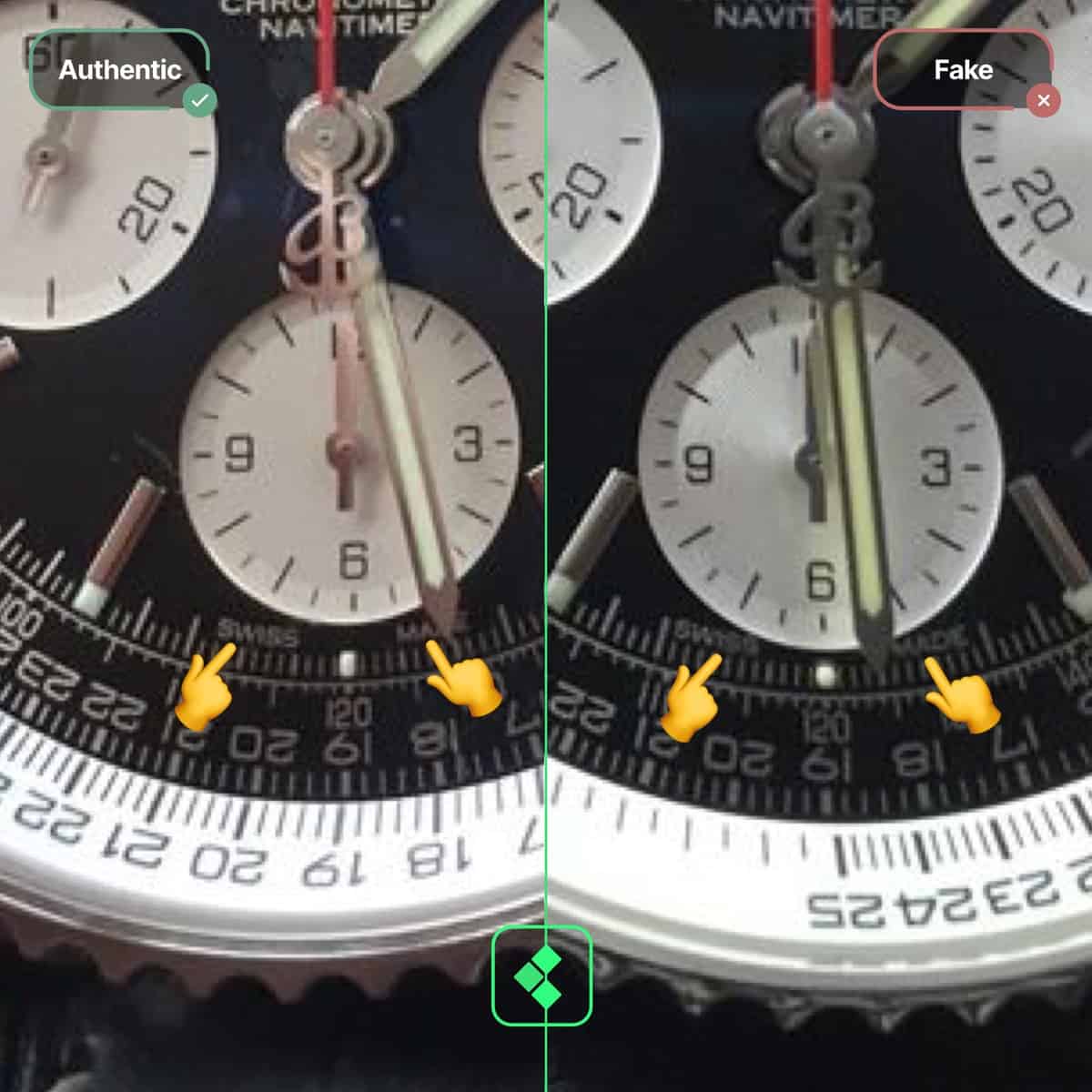
This small inscription may look insignificant, but it’s a critical sign of quality control.
On a genuine Navitimer, the “SWISS MADE” text maintains ideal spacing and alignment – crisp, square, and centered precisely within the limited space beneath the 6 o’clock sub-dial.
Counterfeits struggle to maintain that balance. The text often appears elongated or flattened due to poor scaling during dial printing.
In many cases, it looks as though the lower sub-dial is pressing against it, leaving no breathing room.
That crowding effect never happens on a genuine Breitling, where proportions and dial layout are calibrated to the tenth of a millimeter.
Date and footer-text alignment issues are shown in our Tag Heuer guide.
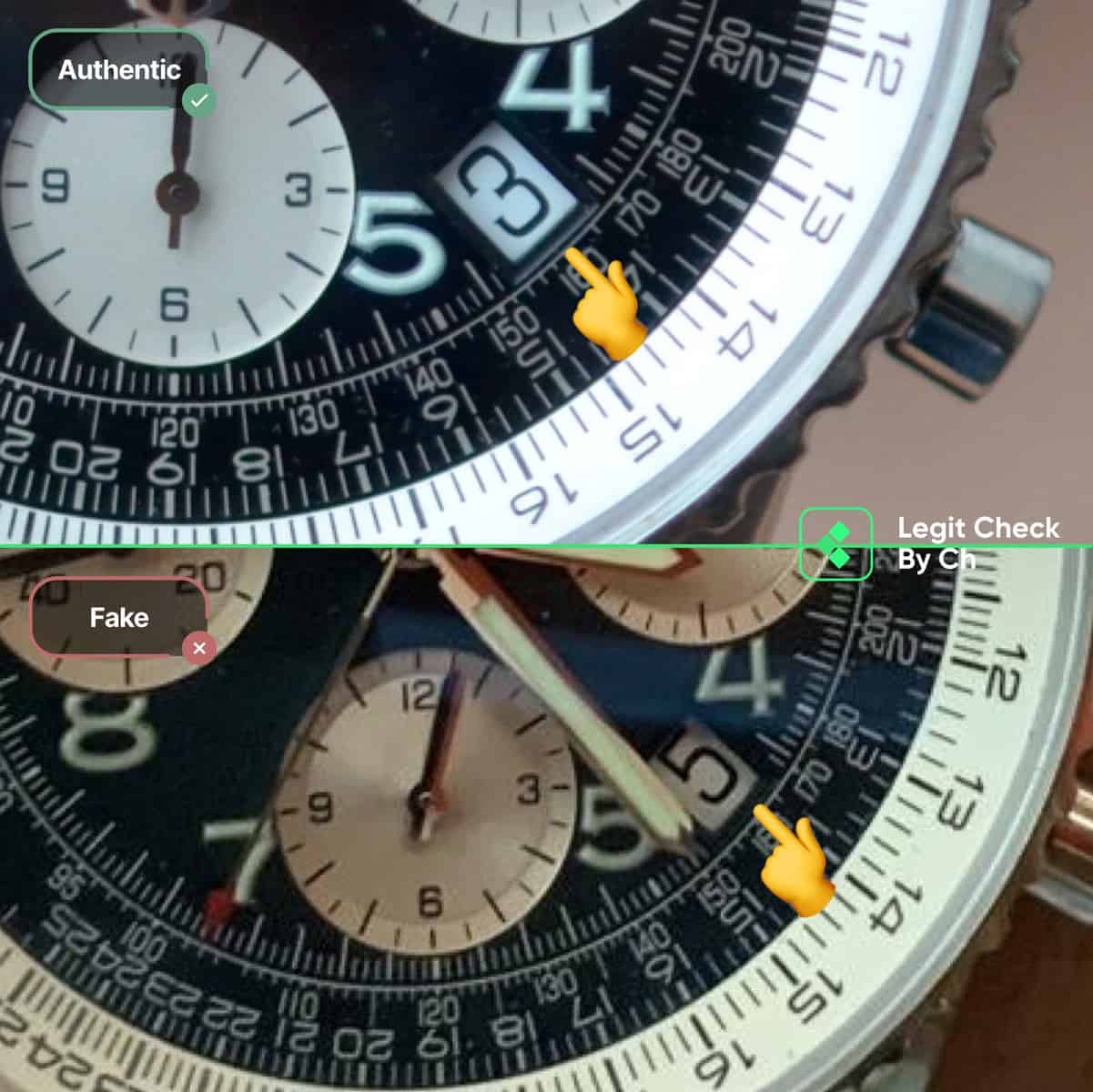
This is one of those subtle details that reveals how well the movement fits the case.
Breitling’s manufacturing ensures that the date aperture aligns perfectly within the dial’s geometry – evenly spaced between numerals, with equal distance to the surrounding markers.
Fake watches tend to misplace the window by a fraction of a millimeter, but that’s enough to throw off the balance of the dial.
The continuous line of the minute track often looks broken or irregular around the date. When comparing side by side, the genuine Navitimer’s symmetry feels natural; the fake feels slightly off-center, even if you can’t immediately tell why.
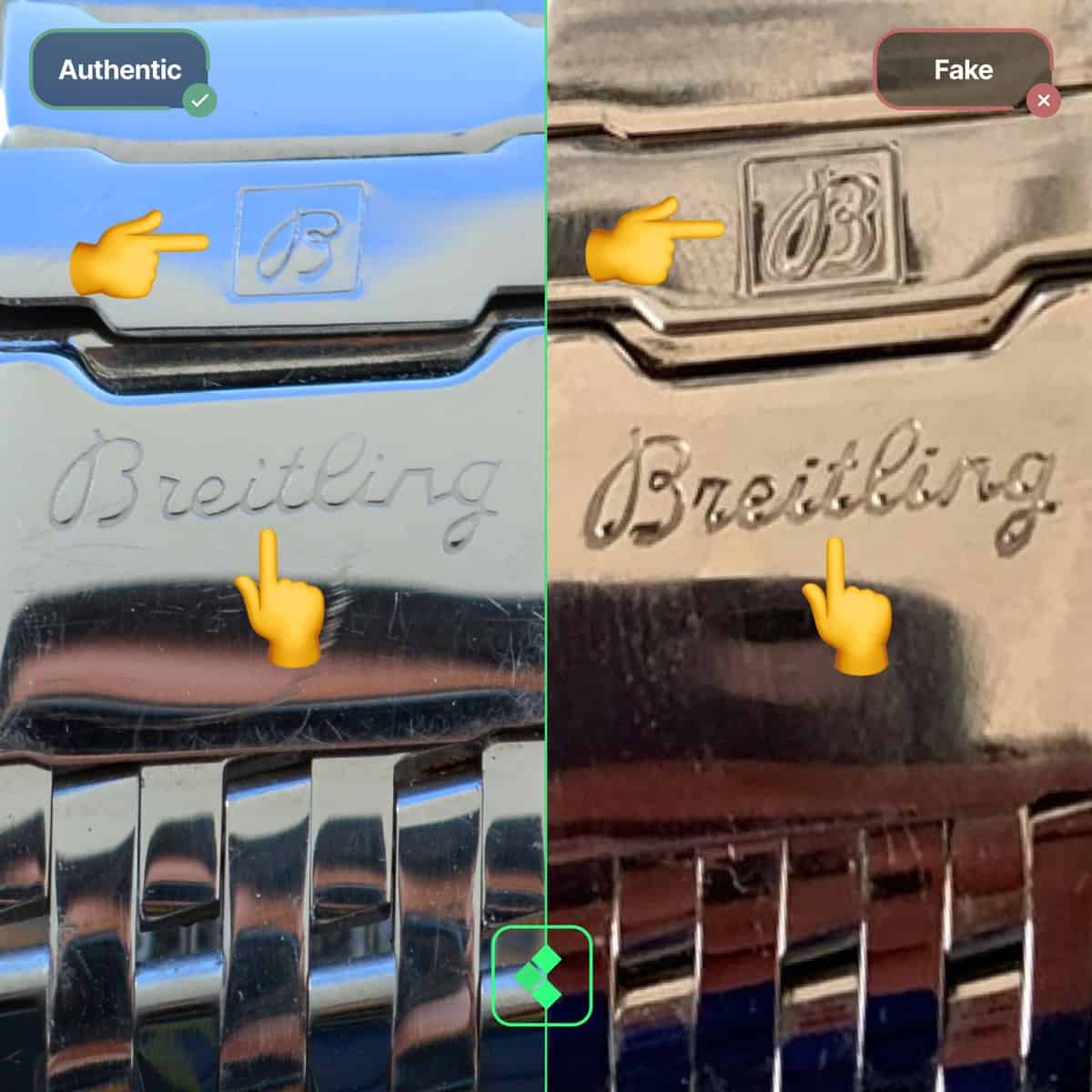
The clasp on a genuine Navitimer feels solid and smooth, with every engraving executed to perfection.
The depth, texture, and polish of the markings show Breitling’s attention to both engineering and aesthetics.
The “B” logo should sit gracefully within the clasp’s surface, not sunken or bulky.
On replicas, engravings are often overdone. The logo appears deeper than it should, sometimes casting unwanted shadows, and the text feels roughly milled rather than laser-precise.
These are clear giveaways that the watch wasn’t finished under Breitling’s tight quality standards.
→ Running your finger lightly across the clasp should feel smooth – if you can feel the grooves distinctly, it’s probably not real.
High-end engraving balance and case finishing appear in our Audemars Piguet Royal Oak guide.
Here’s the fast authenticity-check for Breitling’s flagship chronograph. Use these tells to separate a genuine Navitimer from a convincing replica without reading the whole guide.
These checks catch most counterfeits fast. For peace of mind, compare against high-resolution reference images or have a professional authentication done before you buy.
Find more guides like this one here.
A Navitimer is a serious buy. Many transactions sit in the $10k–$15k range, and once money moves, there is no room for guessing.
High-grade replicas copy the silhouette, then fall short on the details that matter to collectors.
Our authentication is 100% human. Specialists handle every Breitling reference and year, from vintage AOPA dials to modern B01 chronographs.
We check the watch in hand, compare it to factory specs and known production traits, and document what we find so you can move forward with confidence.
What we verify on a Breitling Navitimer:
Collectors trust this service because it works. We have completed thousands of authentications, earned consistent five-star feedback, and helped buyers avoid millions in counterfeit losses.
Every pass or fail comes with a Certificate of Authenticity. It is peace of mind and a safety net.
Use it for refunds, disputes, insurance, or resale. If the watch is fake, you have formal proof in hand.
👉 Get your Breitling Navitimer authenticated today and protect your purchase.
The Breitling Navitimer is more than an aviation chronograph, it’s a precision instrument that embodies decades of engineering heritage.
Because of that reputation, it’s also one of the most counterfeited luxury watches on the market. Authenticating one requires attention to proportion, printing, and finishing. Every line, engraving, and marker tells a story about the craftsmanship behind it.
Throughout this guide, we’ve focused on the traits that define a real Breitling: the flush date wheel, balanced sub-dials, sharp engravings, and crisp logo details.
A genuine Navitimer feels cohesive, nothing stands out or feels forced. Replicas, on the other hand, reveal themselves through imbalance: sunken dates, misaligned markings, or clumsy case thickness.
Before buying or selling, take a structured approach. Start with the date wheel and sub-dials, then inspect the ruler bezel, logo, and clasp.
Each element either confirms or questions the watch’s legitimacy. And if even one feels off, take the time to verify.
Key points to revisit
Want certainty before you buy?
When spending thousands on a Breitling, guesswork isn’t worth the risk. Our authentication process is fully human – no automation, no shortcuts.
Each Navitimer is examined reference by reference, under magnification, by experts who specialize in Breitling’s design language and mechanical traits.
You’ll receive a detailed evaluation and a Certificate of Authenticity – valid for resale, insurance, or dispute protection.
👉 Authenticate your Breitling Navitimer with us today and fly with confidence knowing your watch is 100% genuine.
Flight plan first. Purchase second.
We validate what photos miss (slide-rule alignment, date-wheel height, logo engraving, sub-dial geometry and case profile) so your Breitling decision is clear and defensible.
Discreet. Expert-led. Built to protect your money and your reputation as a collector.
On a genuine Breitling Navitimer the serial number is laser engraved on the case, most often on the caseback rim or between the lugs, and it is duplicated on the movement. The engraving should be crisp, even in depth, and perfectly aligned with nearby caseback text. Compare that serial to the reference number on the warranty card to confirm the correct dial, bezel, and bracelet configuration for the period.
For an authenticity check, photograph the serial, the model or reference number, and any clasp or end-link codes. A watchmaker can open the case to verify the movement serial directly. If the caseback engraving looks shallow, irregular, or the serial does not match the paperwork or the calibre, pause the purchase and get a professional authenticity check.
A real Breitling Navitimer with a mechanical movement shows a smooth, multi-step sweep of the seconds hand, not a one-second jump. The chronograph seconds should start, stop, and reset cleanly to zero, with sub-dials advancing evenly. Quartz Breitlings exist, and they can tick in one-second steps, but those models are documented and will match their stated reference and calibre.
During an authenticity check, watch the central chronograph hand and the running seconds register under bright light. Listen near the case for the even cadence of a mechanical movement. If a supposed mechanical Navitimer ticks once per second, or the reset does not hit zero precisely, you are likely dealing with a wrong movement or a counterfeit.
Record the serial number, then search stolen-watch databases and insurer registers. You can also ask your local police to run a property check using the serial, and request written confirmation. When possible, ask the seller for purchase history, service invoices, and the original warranty card, then ensure those numbers match the caseback engraving and the movement.
For higher-value Navitimers, include a bill of sale that lists the full serial and reference number, and verify the seller’s identity. A clean paper trail, consistent serials, and a professional authenticity check protect you in disputes and help with future resale and insurance.
Yes. For a Breitling Navitimer, plan on routine service every 5 to 7 years under normal wear. A chronograph has additional components that require fresh lubrication and regulation. Signs that service is due include poor timekeeping, a heavy or gritty winding feel, or chronograph hands that fail to reset to zero.
During service, ask the watchmaker to pressure-test the case, replace gaskets, confirm the reference number and movement calibre, and note the serial on the invoice. Keeping service records with the watch strengthens its provenance and supports value during an authenticity check or resale.
Breitling produces Navitimer references in stainless steel, two-tone, and solid precious metals, including 18-karat gold. On genuine gold models, hallmarks and caseback engravings are sharp and consistent, and bracelet quality matches the case material. Plating or uneven color suggests a swap or a counterfeit.
When authenticity matters, verify the material with a jeweler’s test and compare the reference number to Breitling’s documented specifications. The weight of a solid-gold Navitimer, the feel of the bracelet links, and the clarity of the caseback engraving are all part of a proper authenticity check, alongside serial and movement verification.
Need our opinion in regards to the authenticity of your watch? It’s a service we provide.
Alternatively, we have free authentication resources for watches: written guides and video tutorials.
Thank you for reading this,
Ch Alex
Other authenticity-check guides for you
The guides below explore similarly respected chronograph and pilot-watch references, each following the same structured, step-by-step process trusted by serious collectors.