Last Updated on October 31, 2025 by Ch David
Tag Heuer authentication has become increasingly important as modern replicas grow more convincing. Known for its mix of motorsport heritage and precision engineering, Tag Heuer produces watches that combine style, durability, and performance – traits counterfeiters have tried to copy for decades.
Today’s replicas can look close to the real thing, especially from a distance, but they rarely capture the brand’s level of finishing. The difference lies in the details: the way the dial is printed, how the logo sits, and the crispness of the hour markers. These small imperfections are what reveal a fake long before you even open the caseback.
In this guide, we’ll show you how to spot those flaws and confirm your Tag Heuer’s authenticity. Whether you’re checking a Carrera, Aquaracer, or Monaco, these steps will help you tell genuine craftsmanship from imitation with confidence.
If you collect watches like the Breitling Navitimer or Rolex Submariner, you’ll notice the same meticulous attention to alignment and finishing that separates genuine pieces from replicas.
Confidence runs on precision.
We verify what replicas can’t imitate: alignment, movement behavior, and micro-finishing. Real proof, before your money moves.
Trusted by collectors • Expert-led analysis • Fast, defensible results
Answer: A simple but reliable way to spot a fake Tag Heuer is to examine the dial details carefully.
On an authentic watch, the logo, numerals, and sub-dials are sharply printed and perfectly aligned. Counterfeits often show thicker fonts, uneven spacing, or slightly misplaced elements that break the watch’s symmetry.
Tag Heuer’s dial work is one of its strongest quality markers – clean, consistent, and flawless under magnification.
When a watch fails to meet that standard, it’s usually not the real thing. The next sections cover additional checks like case engraving, movement behavior, and bracelet quality to help you verify authenticity step by step.
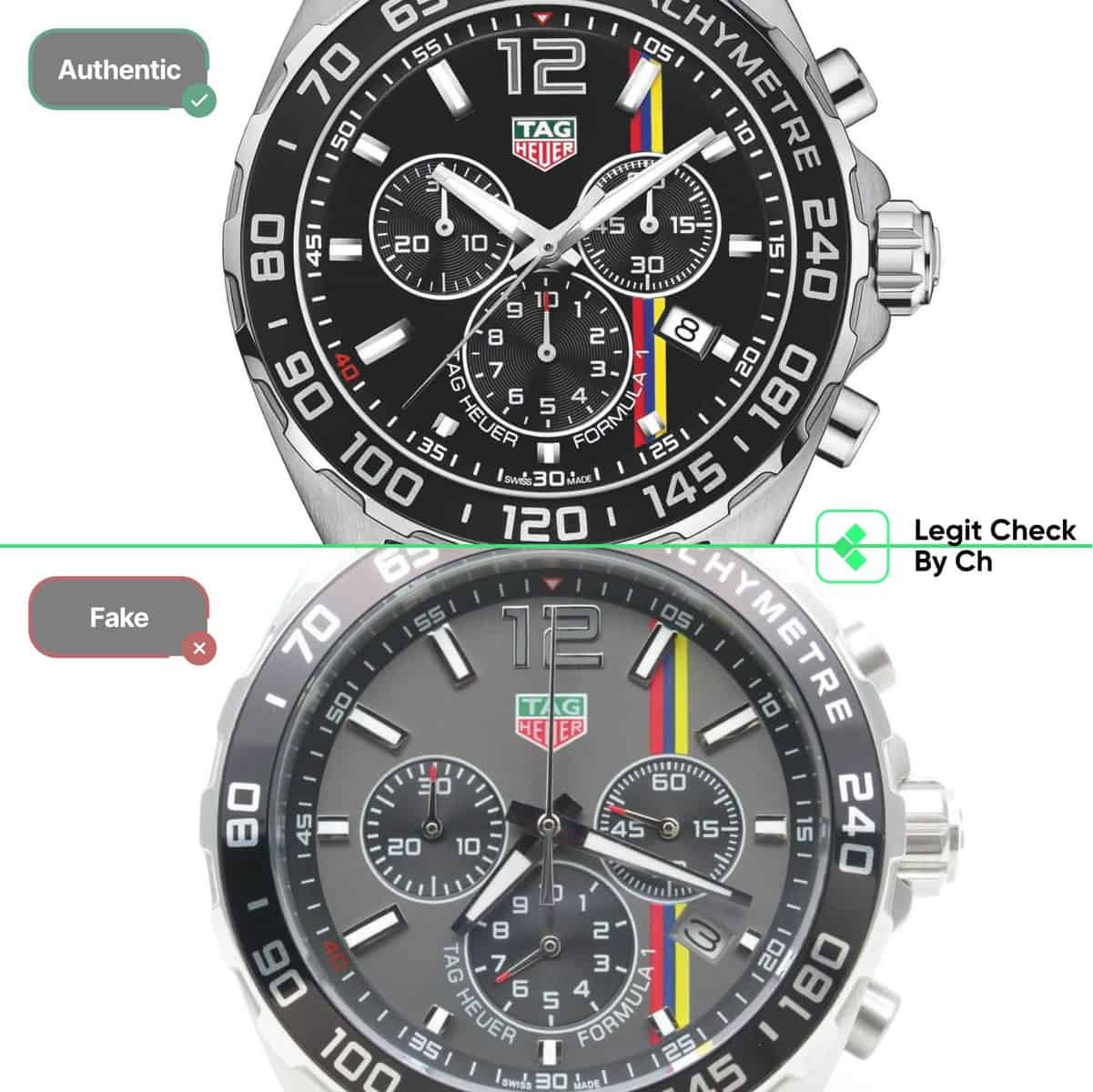
Tag Heuer is known for its geometric precision, so even a slight deviation stands out immediately.
The hour markers on genuine watches are applied evenly with clean edges, while fake ones often appear loosely attached or misaligned under magnification.
Tilt the watch under light; authentic markers will reflect evenly, whereas fake ones show irregular reflections caused by uneven mounting.
→ Always cross-check the marker layout against official reference images for your specific model, as Tag Heuer’s alignment tolerances are extremely tight.

The 12 o’clock hour marker on the replica Tag Heuer watch is badly attached to the dial. It isn’t perfectly aligned to be in the middle of the triangle above it.
In fact, the big 12 o’clock hour marker from above is tilted too much to the left side.
Want the expert's opinion? Let our Tag Heuer authenticators check your watch:
Just like the Rolex Daytona, you’ll see three sub-dials on your Tag Heuer.
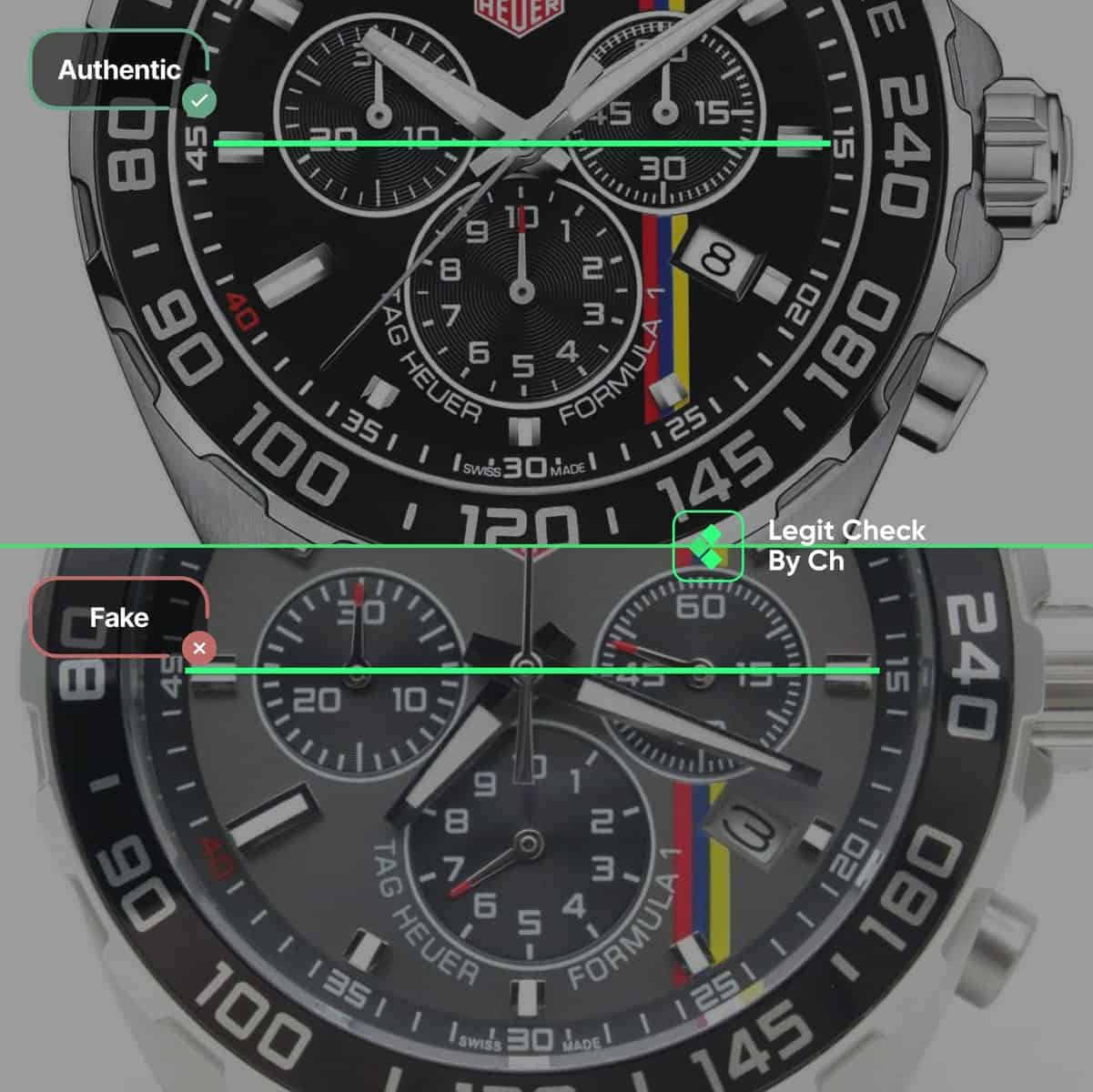
Just like the Rolex Daytona, Tag Heuer’s chronograph layout relies on precision.
In genuine models, all three sub-dials are aligned in a straight line, sitting higher on the dial and balanced with the surrounding indices.
The chronograph hands move smoothly and reset perfectly to zero. Counterfeits often fail here – their sub-dials sit too low, appear tilted, or have misaligned markers.
The quickest authenticity test is to engage the side pushers: if the sub-dials don’t respond or reset inconsistently, you’re dealing with a fake.
The same rule applies to the Omega Speedmaster, where functional sub-dials and perfect alignment are crucial authenticity indicators.
Some watches also have a day window. This step goes for both the day + date windows.
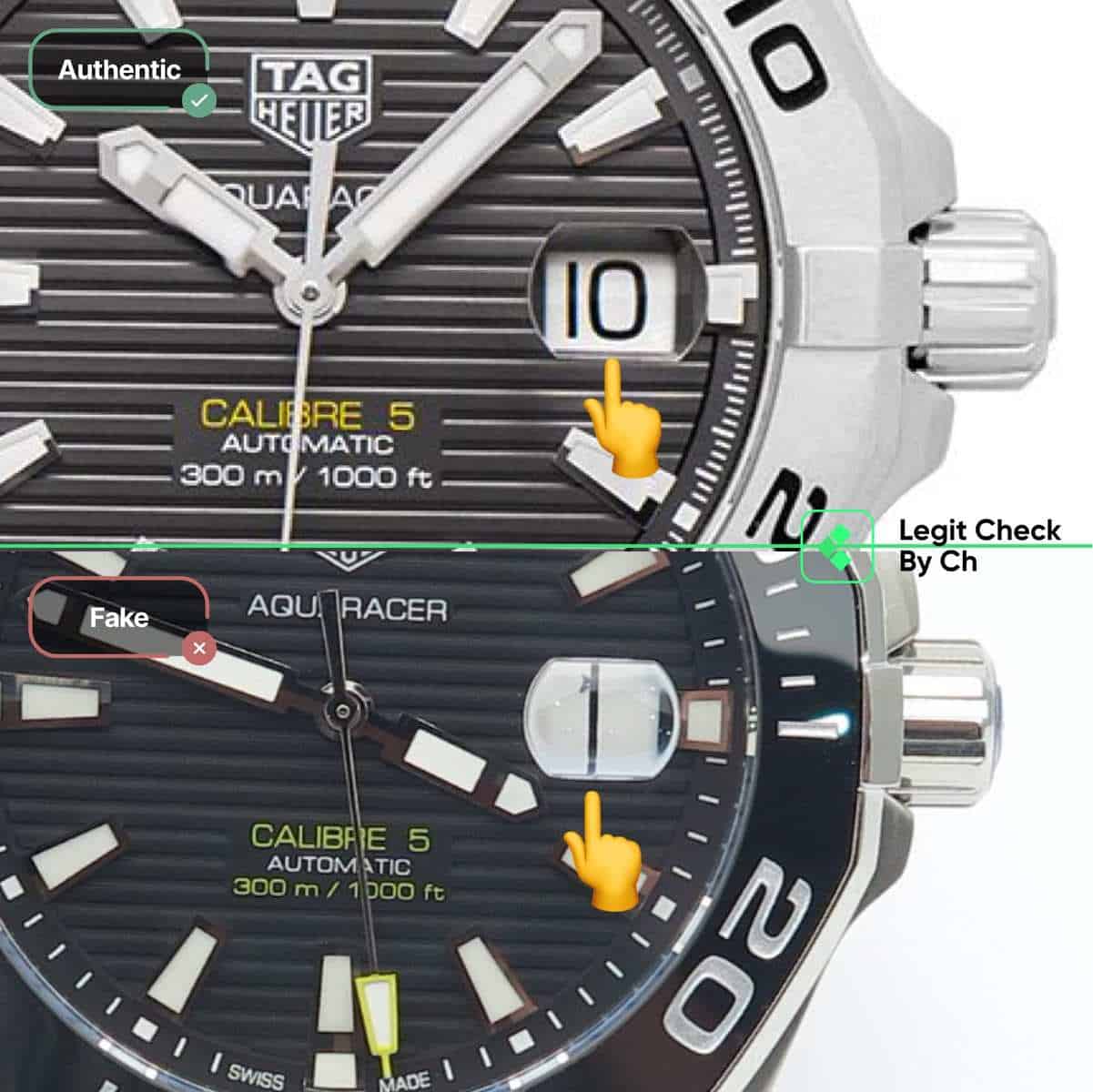
When examining the date display, pay close attention to font proportions and alignment within the frame.
On a genuine Tag Heuer, each numeral is identical in size and spacing, maintaining a perfect distance from the edges of the window.
The printing is crisp and even under magnification, with no bleeding or fading. Replicas, on the other hand, often use cheaper pad-printing techniques that result in slightly distorted digits – especially the number “1,” which frequently sits too high or too close to the upper edge.
→ This subtle misalignment instantly breaks the visual harmony of the dial and is a telltale sign of a fake.
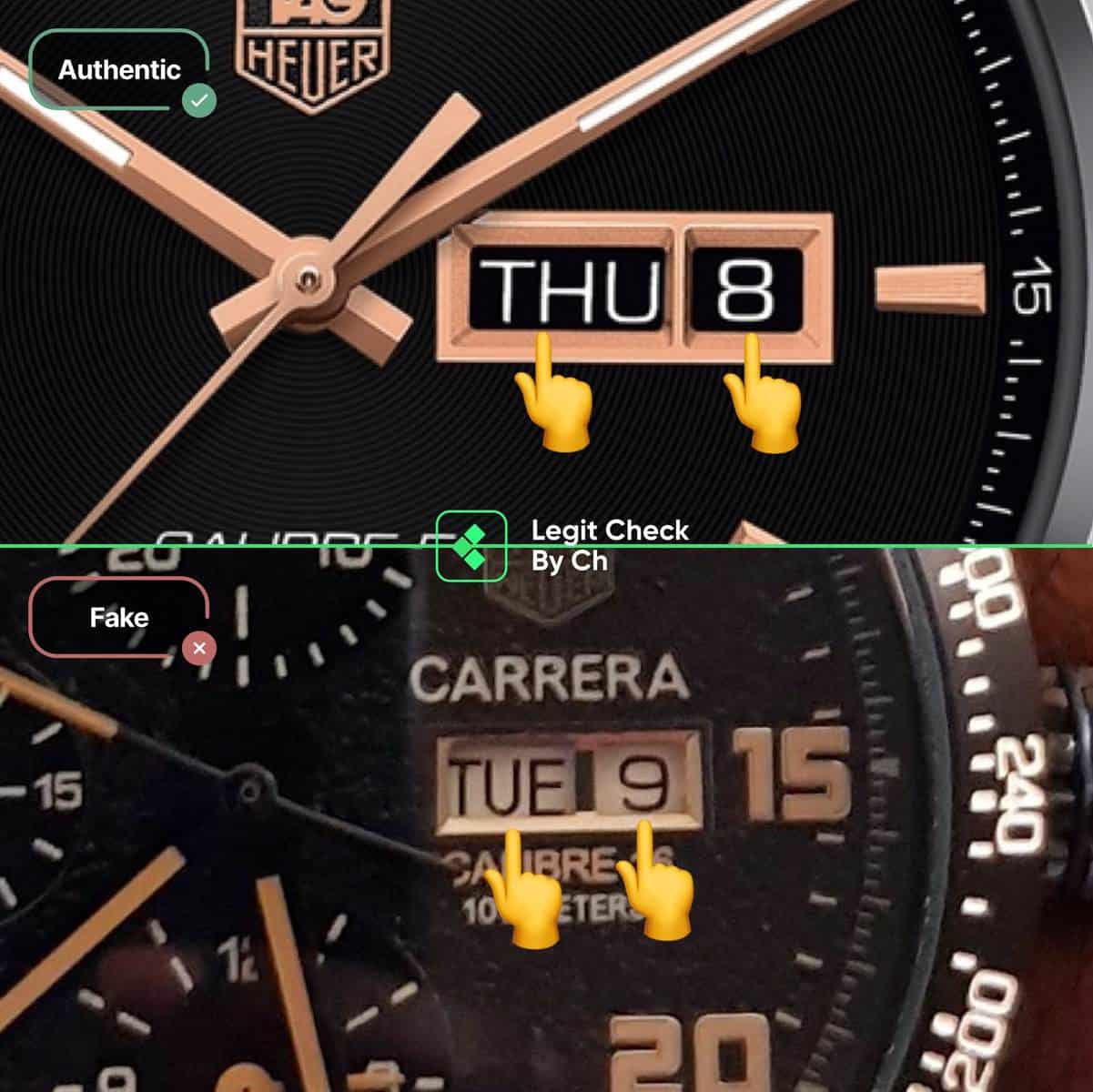
On a real Tag Heuer, the typography inside the day-date window is a masterclass in precision.
The letters remain sharp, uniformly weighted, and perfectly aligned throughout the calendar cycle. The rectangular patch frames the text symmetrically, with equal spacing above and below each line.
Counterfeits, however, rarely match this standard. Their letters might appear thicker, off-centered, or slanted, while the numbers are often faint or irregular in size.
Let’s check out another comparison:
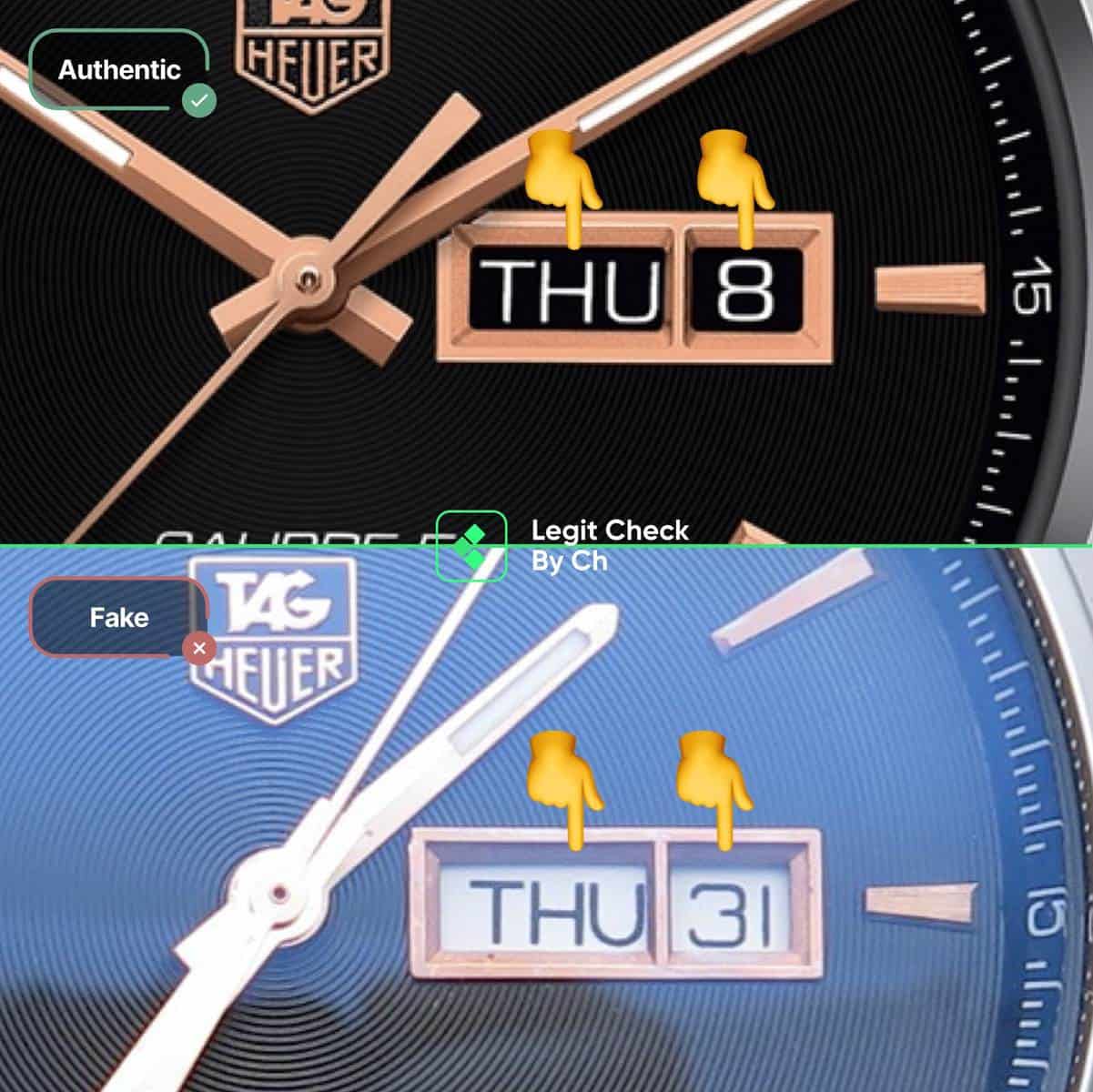
When both elements, day and date, appear uneven or lack sharp contrast, you’re almost certainly looking at a replica.
→ Always compare your piece against official Tag Heuer product photos to confirm text placement accuracy.
You’ll notice a similar precision in the date typography of the Omega Speedmaster, where even a millimeter of misalignment can reveal a fake.
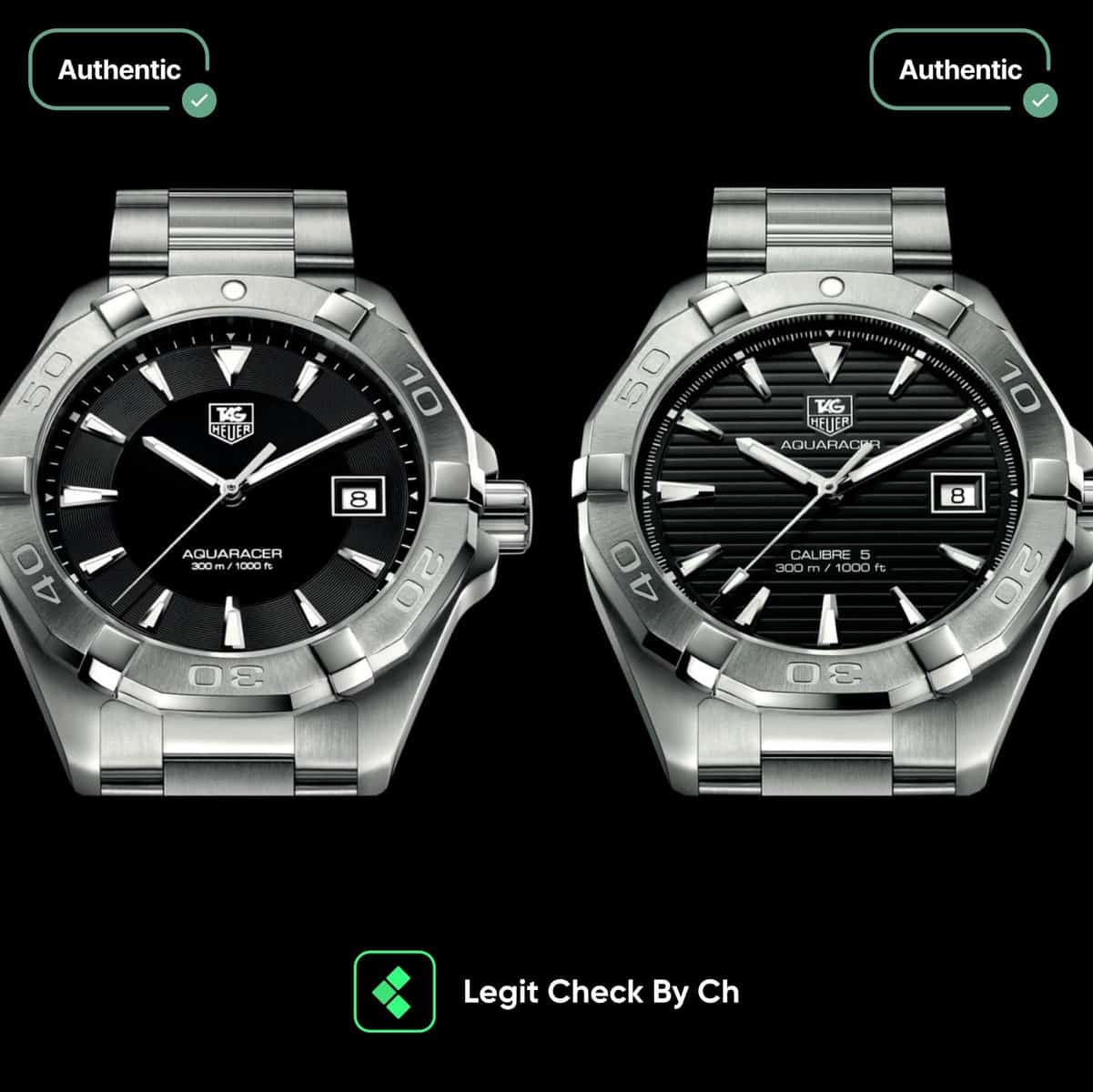
Before judging authenticity, identify the exact reference number of your Tag Heuer and confirm the correct mechanism listed on the brand’s website or with a certified dealer.
Genuine automatic versions have a fluid second-hand motion powered by the in-house or Swiss ETA movement, while quartz models produce a clean, single “tick” per second.
Fakes often get this wrong: you may see a ticking hand on a model that should sweep smoothly, or vice versa.
Additionally, the rotor inside real automatic models feels weighted and rotates silently when the watch is tilted – another detail most replicas fail to replicate convincingly.
This movement distinction also plays a major role in the IWC Portuguese, another chronograph often counterfeited due to its recognizable dial and rotor design.

A quick mention:
If in doubt, we recommend double-checking the steps we’ve explained above this line.
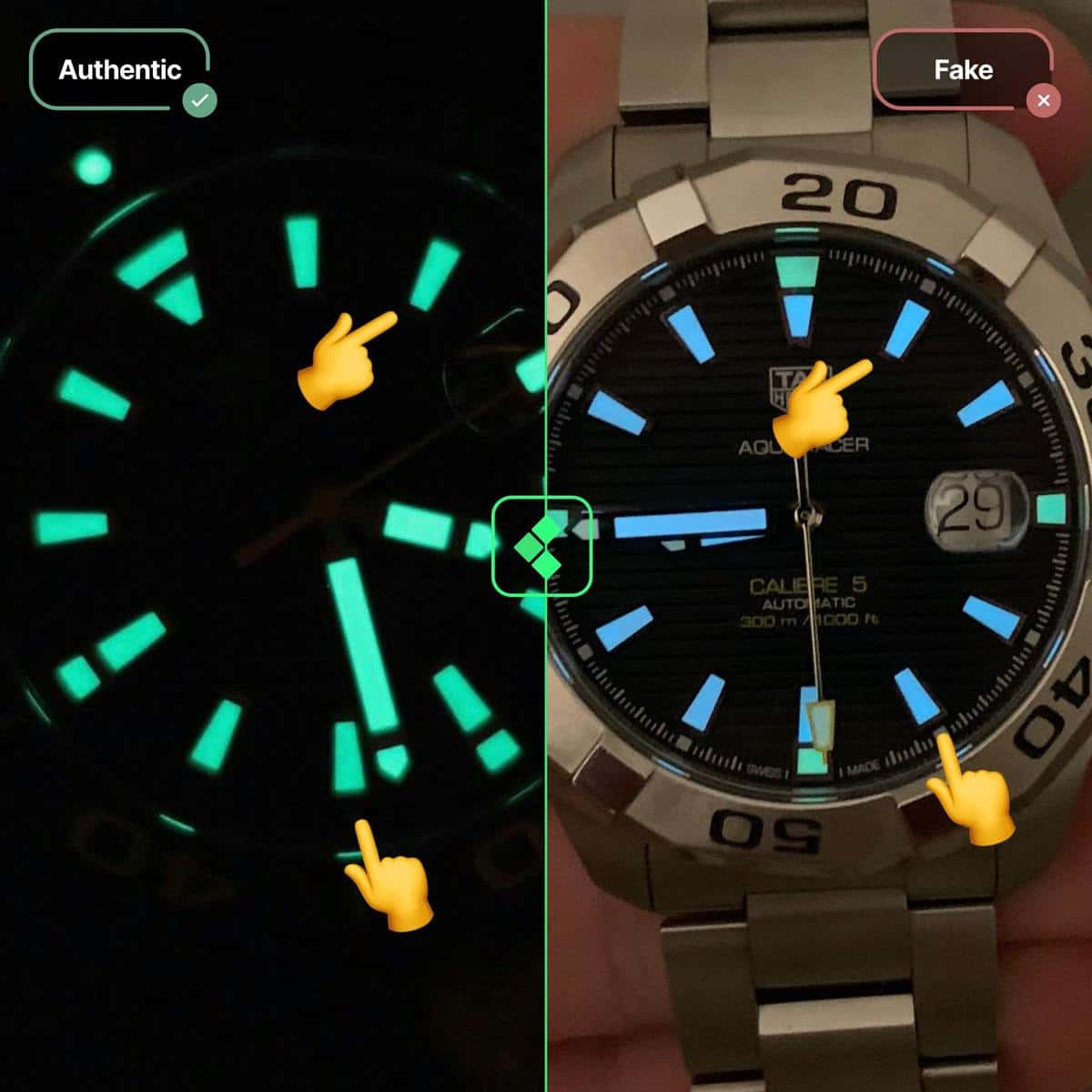
The lume is one of the easiest tells once you test it properly.
Expose the watch to bright light for about 30 seconds, then move to a dark room. Genuine Tag Heuer lume glows with a vibrant green color, illuminating evenly across all indices and the hour, minute, and seconds hands.
Replica models, however, often produce an uneven or weaker shine with patches that fade faster or glow in an incorrect blue tone.
The difference isn’t just brightness but also quality: authentic lume maintains its intensity for several minutes, while fake lume dies out in seconds due to poor-quality phosphorescent materials.
For comparison, see how the lume performs on the Rolex Submariner 126610 – one of the best examples of consistent brightness and longevity under darkness.
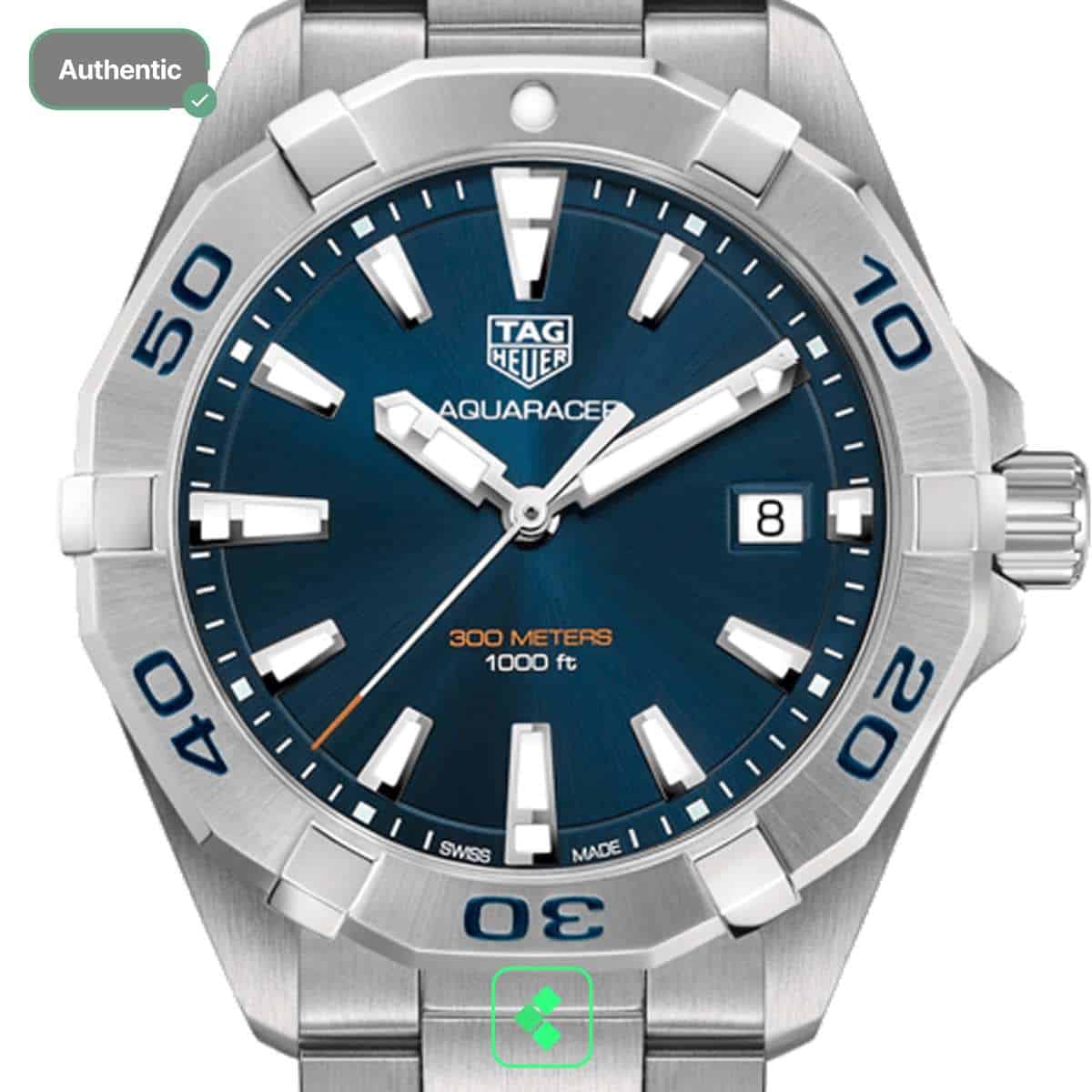
Above you can see what the bezel of an authentic Tag Heuer has to look like.
The bezel is a key quality checkpoint. On an authentic Tag Heuer, every engraved numeral looks machine-perfect. The paint filling is uniform, and there are no stray marks around the digits.
The rotation feels firm but smooth, producing distinct clicks that align precisely with the minute markers.
Below is a comparison between a real and a fake Tag Heuer:
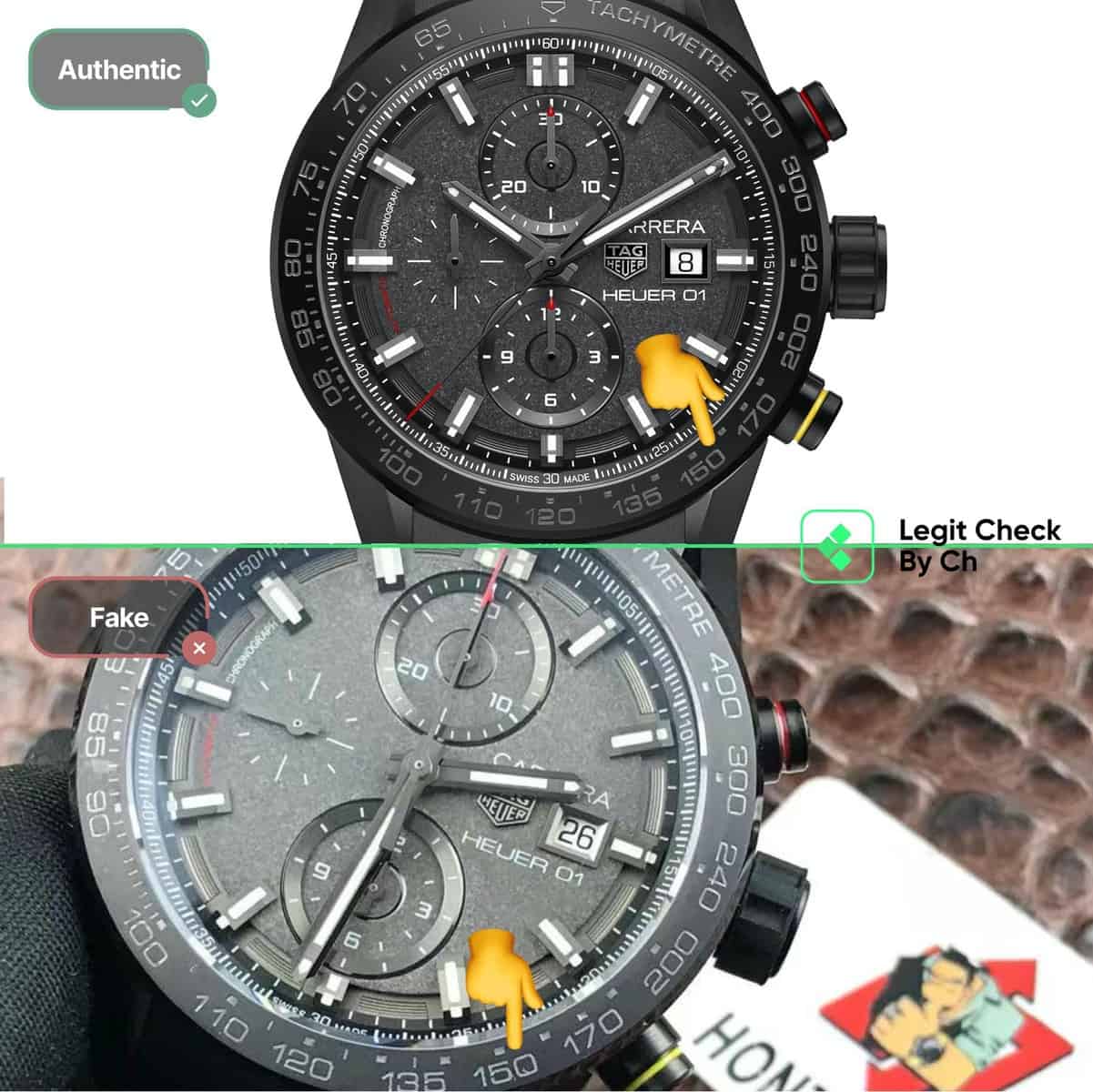
Fakes typically have bezels that rotate too loosely or stiffly, and the paintwork is inconsistent – especially visible when zooming into numbers like “150.”
Even a single off-center or smudged numeral is enough to indicate a counterfeit.
On the other hand, the authentic Tag Heuer watch has all of its numbers placed at the same level, without any sort of imperfections.
You can see similar bezel precision checks in our Omega Seamaster Diver guide, where incorrect numeral placement is one of the easiest tells of a replica.

Genuine packaging always conveys a sense of consistency and craftsmanship. The materials are durable, the stitching around the box is tight, and the logo embossing appears clean and perfectly centered.
Each paper document is printed on thick matte paper, never glossy or uneven, and fits neatly into its slot. The box lid also closes flush without wobbling, which is another subtle sign of quality.
Here’s a comparison between fake and real Tag Heuer packaging:
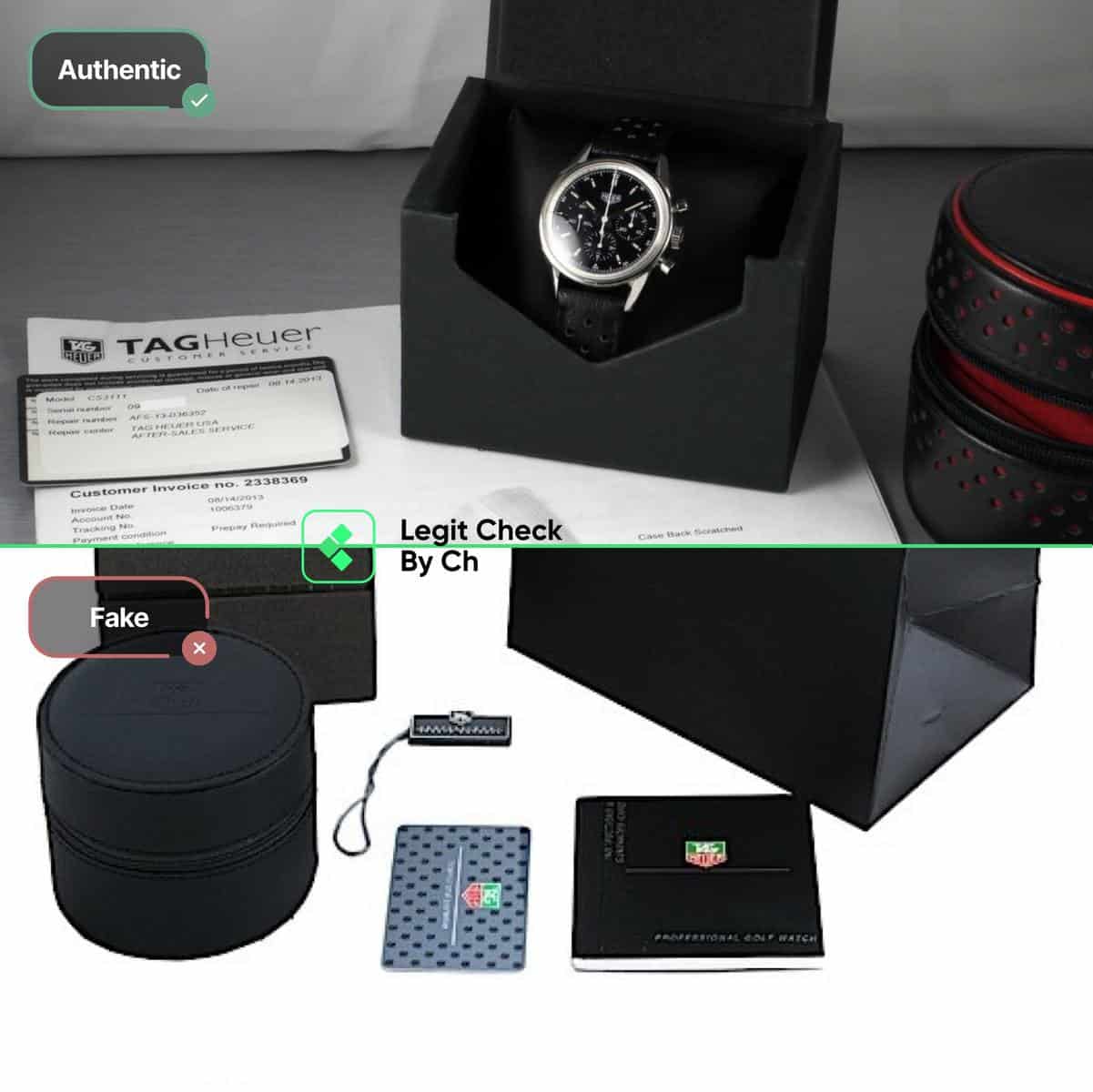
When comparing side-by-side, the difference becomes clear.
The fake box often looks “off” in shade and structure – the colors may be slightly warmer, the logo smaller or misplaced, and the cushioning inside poorly aligned.
Authentic Tag Heuer packaging, in contrast, feels heavier, more refined, and balanced in proportion. If the serial numbers don’t match or the card looks poorly printed, that’s a definitive red flag for a replica.
Packaging quality can also be cross-checked against high-end brands like the Patek Philippe Nautilus or even Hublot Big Bang, which follow strict serial and material consistency across their boxes and papers.
Tag Heuer is one of the most copied Swiss watch brands, but the truth is – no fake can match its level of precision once you know where to look.
Every genuine Tag Heuer reflects perfect alignment, clean printing, and finely tuned mechanical behavior.
Counterfeits might look close in photos, but they miss the details that make a real one unmistakable. Here’s a quick breakdown of what to check when verifying your Tag Heuer:
Run through these quick checks and you’ll instantly see the difference – a real Tag Heuer feels engineered, while a fake only imitates the surface.
More authentication guides like this one are available here.
Counterfeit Tag Heuer watches have evolved dramatically – some even mimic automatic movements or use refurbished genuine parts from older models.
That’s why a proper authentication isn’t just about spotting a few surface flaws, it’s about understanding how the real thing is built.
Our Tag Heuer authentication service is handled entirely by human experts who specialize in Swiss timepieces.
Every watch is reviewed across multiple checkpoints (dial structure, case engravings, serial consistency, and mechanical behavior) before issuing a verified conclusion.
Here’s what our experts check during authentication:
After a full inspection, you’ll receive a Certificate of Authenticity confirming whether your Tag Heuer is genuine or not – a document accepted for refunds, resale listings, and insurance claims.
👉 Authenticate your Tag Heuer now to confirm its originality and protect your investment before you buy or sell.
A real Tag Heuer isn’t just clean at a glance – it’s consistent under scrutiny.
When the dial alignment is perfect, the sub-dials respond precisely, the date sits dead-center, and the bezel clicks land exactly on index, replicas run out of places to hide.
Stack these checks and you’ll separate “Tag Heuer look” from Tag Heuer quality in minutes.
Key points to revisit
Still unsure? Our specialists verify references, mechanics, engravings, and serial formatting, then issue a Certificate of Authenticity for resale, insurance, or refunds.
👉 Authenticate your Tag Heuer today and turn a quick inspection into total certainty.
Confidence runs on precision.
We verify what replicas can’t imitate: alignment, movement behavior, and micro-finishing. Real proof, before your money moves.
Trusted by collectors • Expert-led analysis • Fast, defensible results
Every genuine TAG Heuer has a unique serial number engraved on the caseback – usually between the lugs or beneath the model reference. The number is typically 4 to 6 digits long and appears in a clean, deep engraving with even spacing and sharp edges.
Avoid confusing it with the reference number, which often includes letters (like “WBP201A”). The serial should also match the one printed on your warranty card and purchase receipt.
If it’s missing, poorly engraved, or laser-printed with a thin font, that’s a major red flag. You can verify it by contacting an authorized TAG Heuer dealer or service center, who can confirm if the number exists in TAG Heuer’s production database.
TAG Heuer watches generally retain 50–70% of their retail value, depending on the model, movement, and condition. Iconic series such as the Carrera, Monaco, and Aquaracer perform best on the resale market, especially when they include the original box, warranty card, and service history.
Quartz models tend to depreciate faster than automatics, while limited editions or vintage pieces may appreciate over time. To preserve value, keep all documentation and have the watch serviced only by TAG Heuer-certified technicians.
TAG Heuer is recognized as an entry-level Swiss luxury brand, bridging the gap between premium and high-end watchmaking. It’s part of LVMH (Louis Vuitton Moët Hennessy), alongside Zenith, Hublot, and Bulgari.
While not in the same tier as Rolex or Patek Philippe, TAG Heuer offers Swiss-made quality, precision movements, and robust craftsmanship. Its designs blend motorsport heritage with modern innovation, making it a popular choice for both enthusiasts and first-time luxury buyers.
A standard service for a TAG Heuer costs $250 to $700, depending on the model and movement. Quartz watches fall on the lower end, while mechanical chronographs or automatic divers cost more due to their complexity.
Authorized TAG Heuer service centers provide a full maintenance routine (cleaning, lubrication, movement regulation, pressure testing, and polishing) using genuine factory parts. It’s recommended to service your watch every 5 to 7 years to maintain peak performance and water resistance.
Both are Swiss luxury watchmakers, but they focus on different strengths.
TAG Heuer excels in sporty chronographs, modern styling, and motorsport-inspired designs, while Omega leads in precision engineering, heritage, and certified chronometer accuracy.
If you want a bold, performance-driven everyday watch, go with TAG Heuer. If you prioritize technical mastery, long-term value, and vintage prestige, Omega edges ahead. Ultimately, the choice depends on whether you prefer cutting-edge style or timeless refinement.
Other authenticity-check guides for you
The guides below follow the same step-by-step structure and are ideal if you’re comparing Hublot to other modern luxury icons in the same price and prestige range.