Last Updated on November 17, 2025 by Ch David
Patek Philippe authentication is a serious matter for anyone considering a purchase.
With prices for many models exceeding $60,000, even experienced collectors can fall victim to high-quality fakes that cost only a few hundred dollars to produce.
The market is filled with replicas that capture the elegance of a genuine Patek at first glance, but none manage to reproduce the brand’s precision, finishing, or understated balance.
Every genuine Patek tells its own story through perfect proportions, sharp typography, and mechanical excellence.
Counterfeits always stumble on one of these points, often in ways that only become obvious once you know what to check.
This guide covers the nine most reliable ways to spot a fake Patek Philippe, based on the standards used by professional authenticators and auction specialists. Whether it’s a Calatrava, Nautilus, or Aquanaut, these checks will help you verify what you’re truly holding.
Elegance deserves evidence.
We verify what replicas fake and photos flatter (date-aperture geometry, dial gradient & typography, crown/case finishing, movement engraving, hallmarks and metal) so your Patek comes with proof, not hope.
Quiet, thorough, defensible – the way Patek should be verified.
Answer: A quick way to identify a fake Patek Philippe is to look closely at the date window.
On genuine models, the date is perfectly centered within the frame, and the numerals are evenly spaced with crisp edges. Counterfeits often miss this, showing off-center dates or thicker, uneven numbers that break the symmetry of the dial.
It’s a small detail, but one that speaks volumes. Patek Philippe’s attention to balance and alignment is unmatched, and even the best replicas rarely get it right.
This is a reliable first indicator, but a complete authentication also involves inspecting the dial texture, case finishing, and movement engraving – all covered in the steps below.
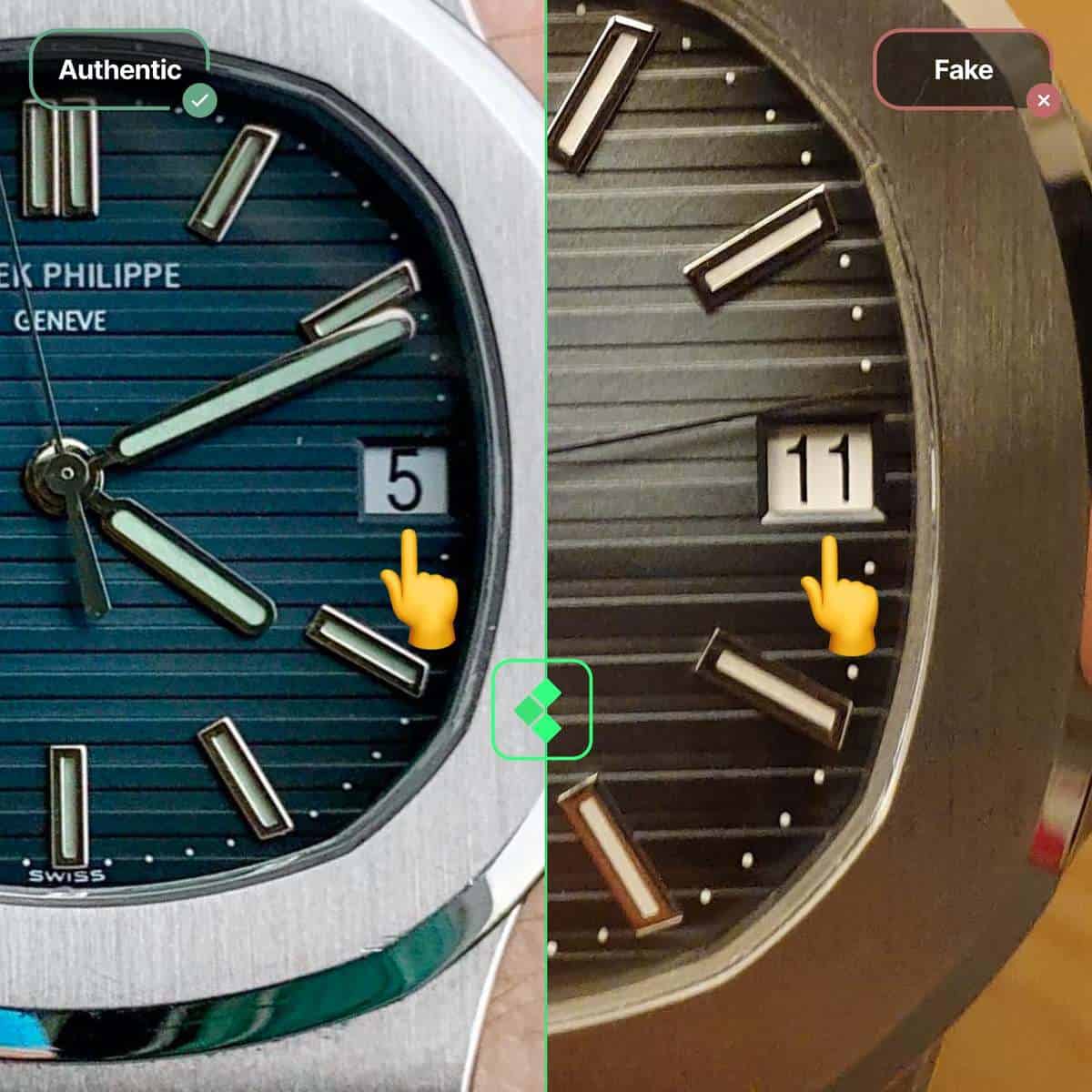
On an authentic Patek Philippe Nautilus, the date wheel embodies the brand’s obsession with micro-level precision.
The numerals are printed with identical thickness and height across the entire sequence, and the alignment is always flawless. When you look closely, the date sits squarely in the middle of the window – perfectly parallel and visually balanced.
Let’s have a look at another comparison:
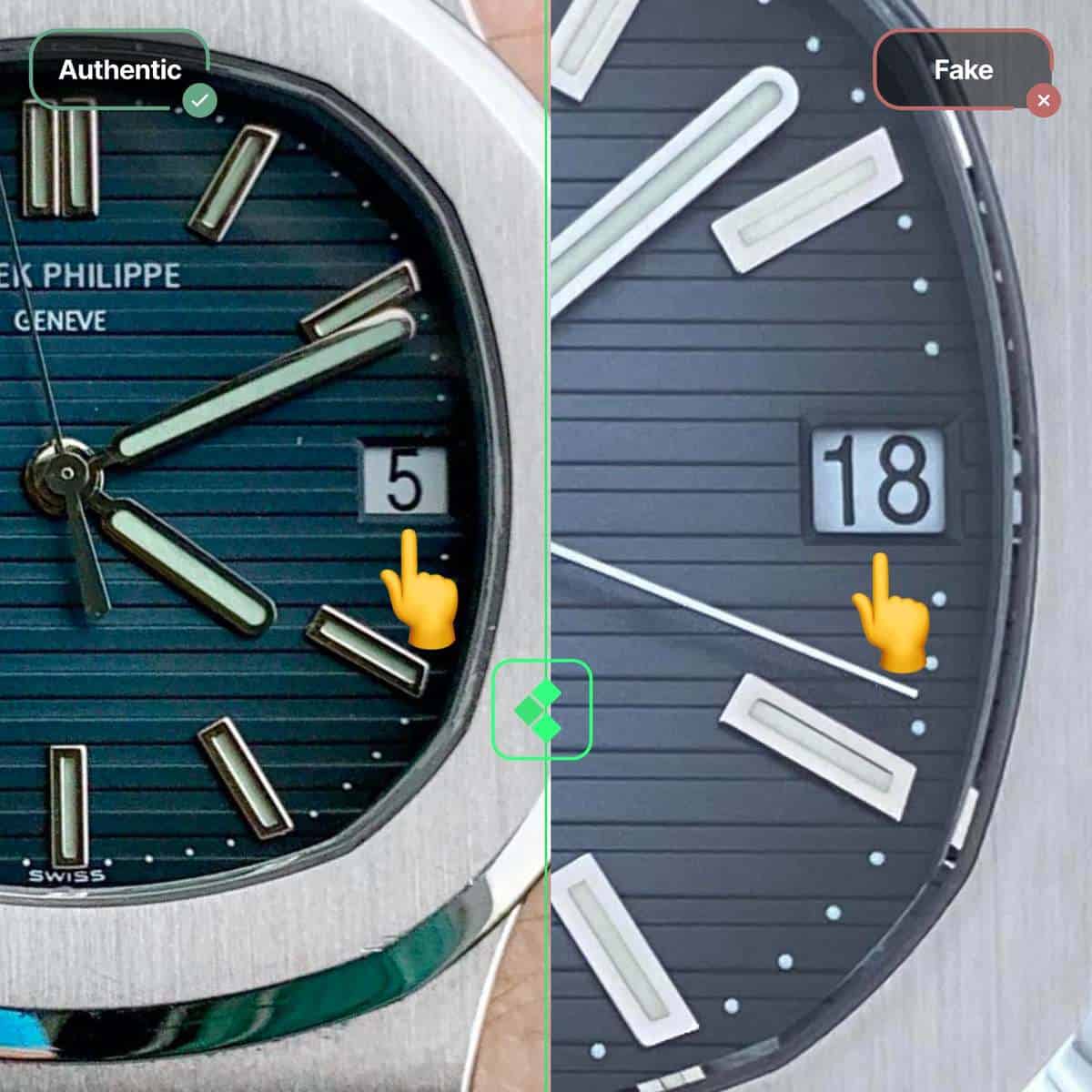
Counterfeits struggle with this detail. Some replicas feature numerals that are noticeably too small or too light, while others print the digits too close together, creating a cramped look.
Crooked alignment is another giveaway. For example, the “18” might lean to one side, or the “1” might sit closer to the edge than the “8.”
These inconsistencies are almost never found on genuine Patek Philippe watches, where every millimeter is controlled with surgical precision.
Date typography symmetry is compared in our Rolex Datejust guide.
Want the expert's opinion? Let our Patek Philippe authenticators check your watch:
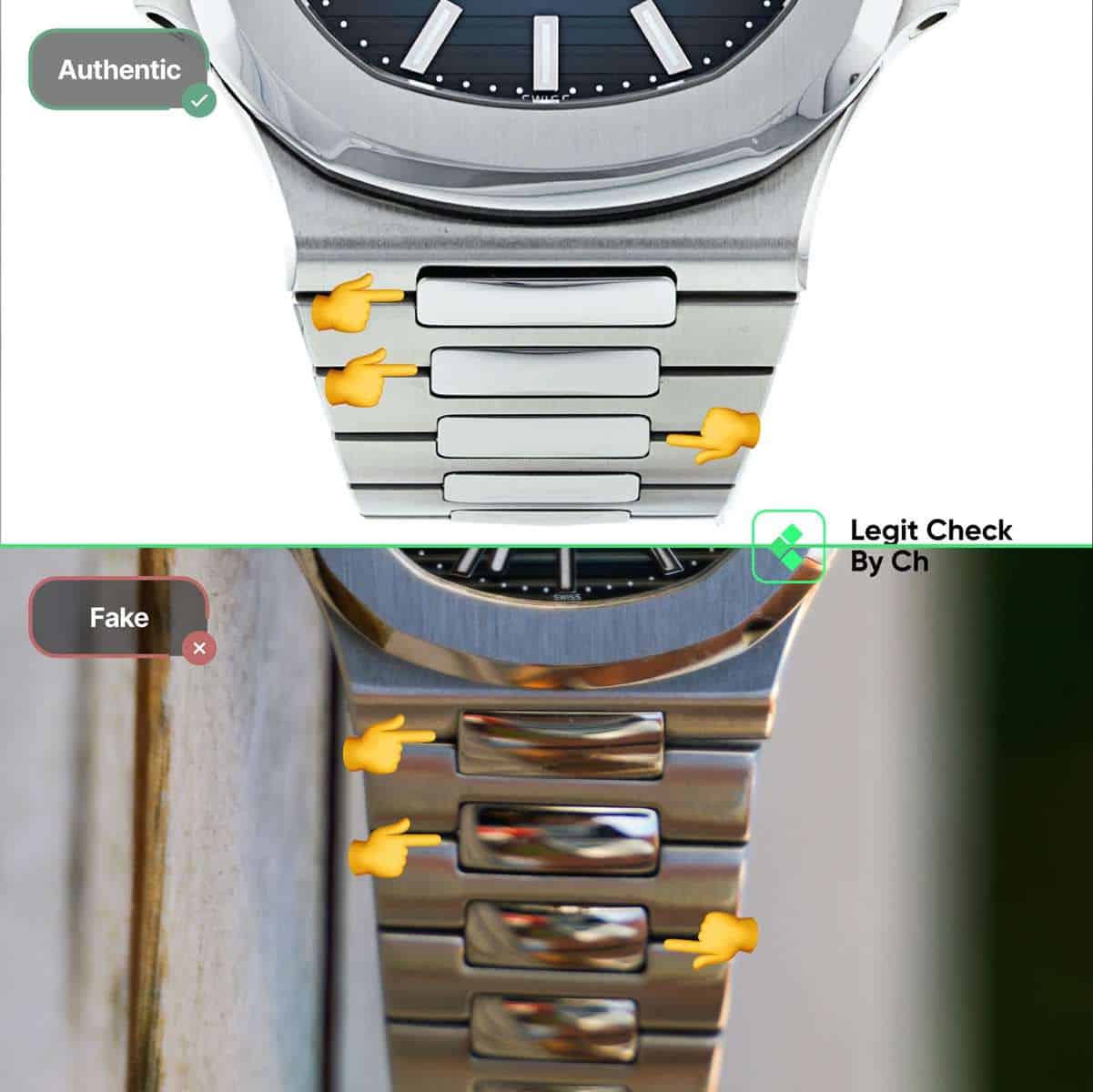
The lugs and connecting links are one of the defining features of the Nautilus.
On an authentic watch, the transition from case to bracelet feels organic. Each piece flows naturally into the next, maintaining both comfort and symmetry.
The first small link beneath the 6 o’clock position is especially important, acting as a bridge that helps the bracelet drape perfectly on the wrist.
Counterfeit bracelets, however, often lack this refinement. They may use identical link sizes throughout, or their end links sit awkwardly against the case, leaving small gaps.
Missing or uneven connecting links give the bracelet a stiff, mechanical appearance – the opposite of the fluid integration that defines a real Patek Philippe Nautilus.
Integrated-bracelet tolerances are shown in our Audemars Piguet Royal Oak guide.
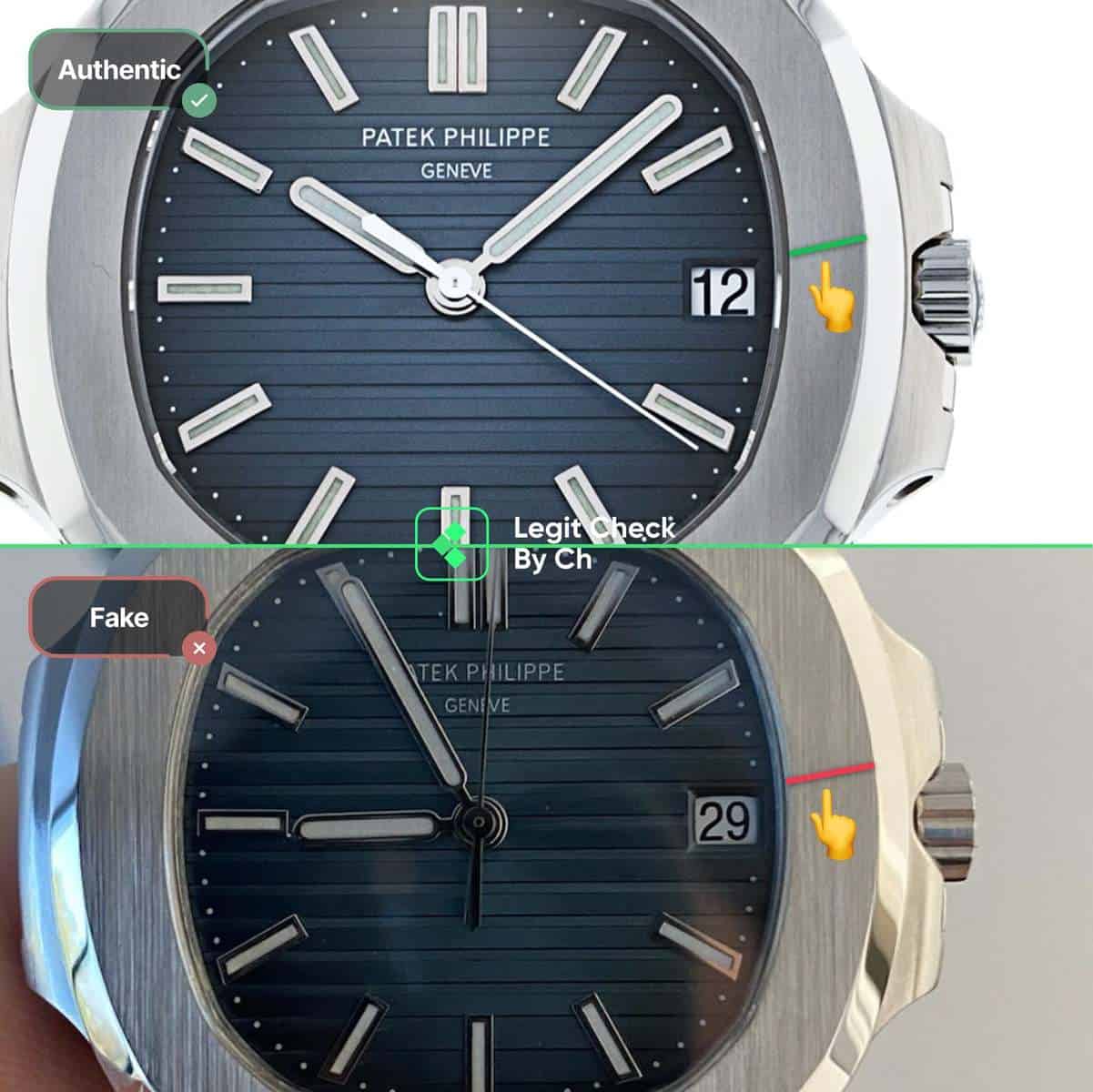
When viewed from the front, a genuine Nautilus bezel has perfect symmetry.
Its narrow design enhances the watch’s understated luxury; one of the reasons the Nautilus remains instantly recognizable. The edges are polished to a mirror finish, while the flat surfaces have an even, fine-brushed texture.
Replica bezels tend to exaggerate the dimensions. They look bulkier, with edges that feel less refined. The difference may seem subtle in pictures, but on the wrist, it changes the proportions entirely.
The fake watch often feels heavier visually, while the authentic Nautilus maintains effortless balance.
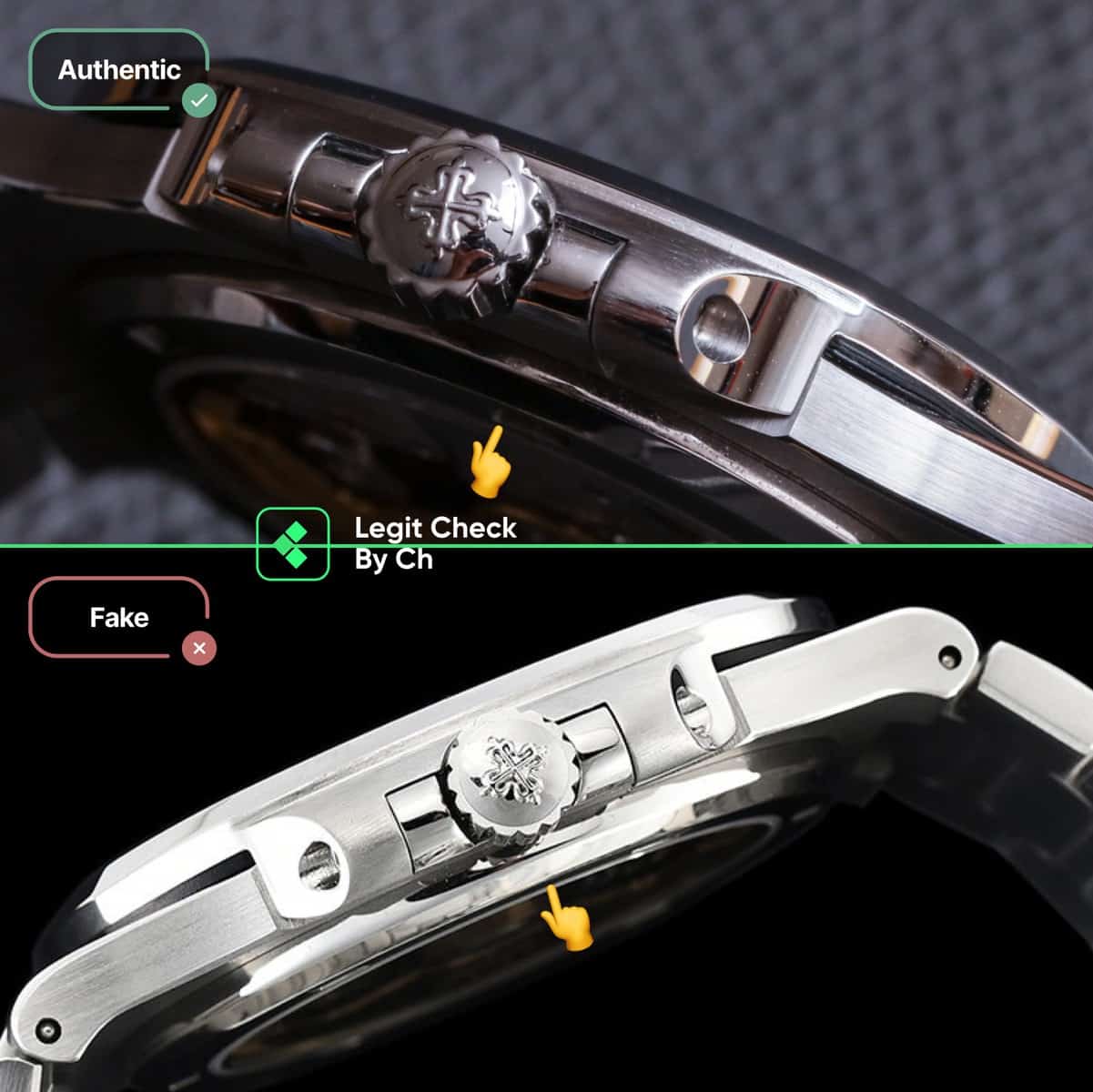
From a profile view, the thickness becomes even more telling. Patek Philippe’s case design is remarkably thin given its water resistance, making the watch feel sleek and compact.
Counterfeits, however, tend to be thicker because they house cheaper or mismatched movements that require more vertical space.
The difference is particularly obvious near the caseback, where replicas often look uneven or slightly inflated.
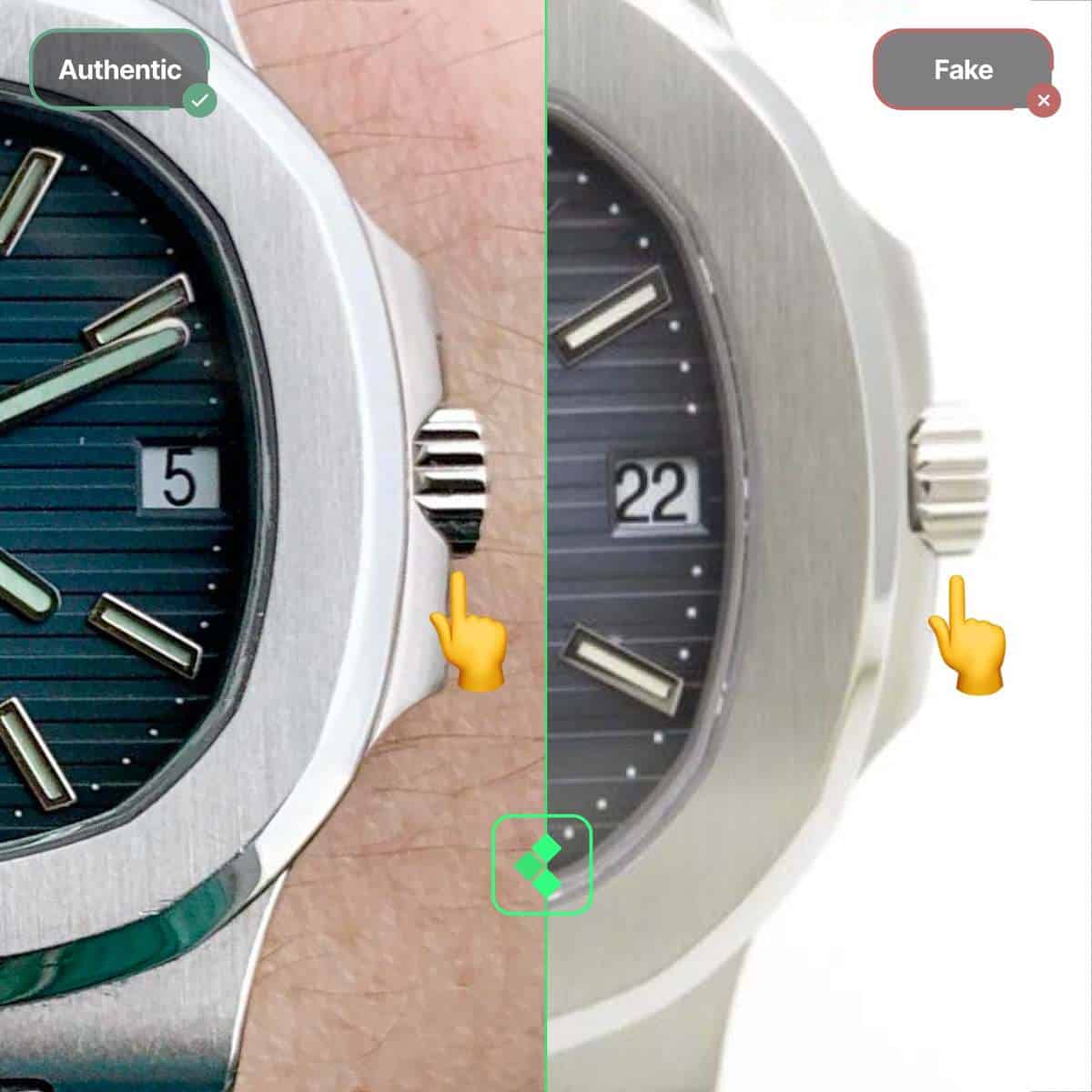
The crown guard design on the Patek Philippe Nautilus is an architectural detail that blends aesthetics with practicality.
On authentic pieces, it forms a subtle curve that hugs the crown tightly, providing full protection while maintaining the iconic porthole-inspired shape of the case.
The proportions are perfect – sturdy enough to serve its function, yet elegant enough to keep the watch’s refined profile.
Counterfeit models tend to misjudge this geometry. Their crown guards are often too slim, leaving uneven spacing between the crown and the guard edges.
From the front view, this creates an awkward gap that throws off the Nautilus’s symmetry.
It’s a small but significant flaw. On a true Patek Philippe, every line aligns with intent.

A quick mention:
If in doubt, we recommend double-checking the steps we’ve explained above this line.
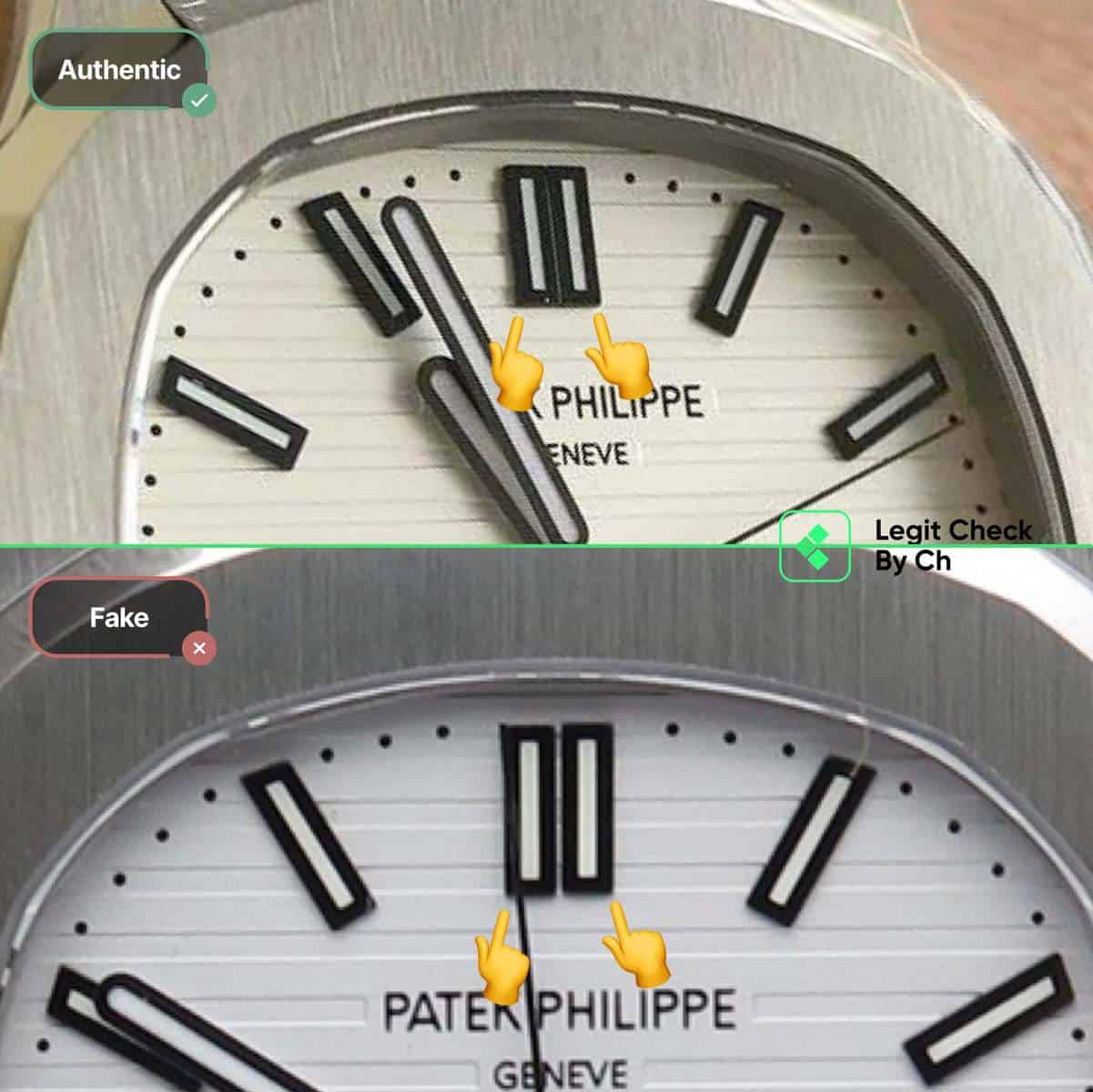
On genuine Patek Philippe Nautilus watches, the indexes are aligned with mathematical precision.
Each one is applied by hand under magnification, ensuring perfect positioning relative to the minute track. The 12 o’clock double marker, in particular, is a hallmark of symmetry and craftsmanship.
Fake dials often fail to maintain this level of accuracy. One of the two lines at 12 o’clock might sit slightly off-axis or at a lower height, creating a subtle imbalance that becomes obvious under direct light.
While a casual glance may miss it, trained eyes (or even a macro photo) can expose this instantly.
Micro-printing standards are contrasted in our Omega Speedmaster guide.
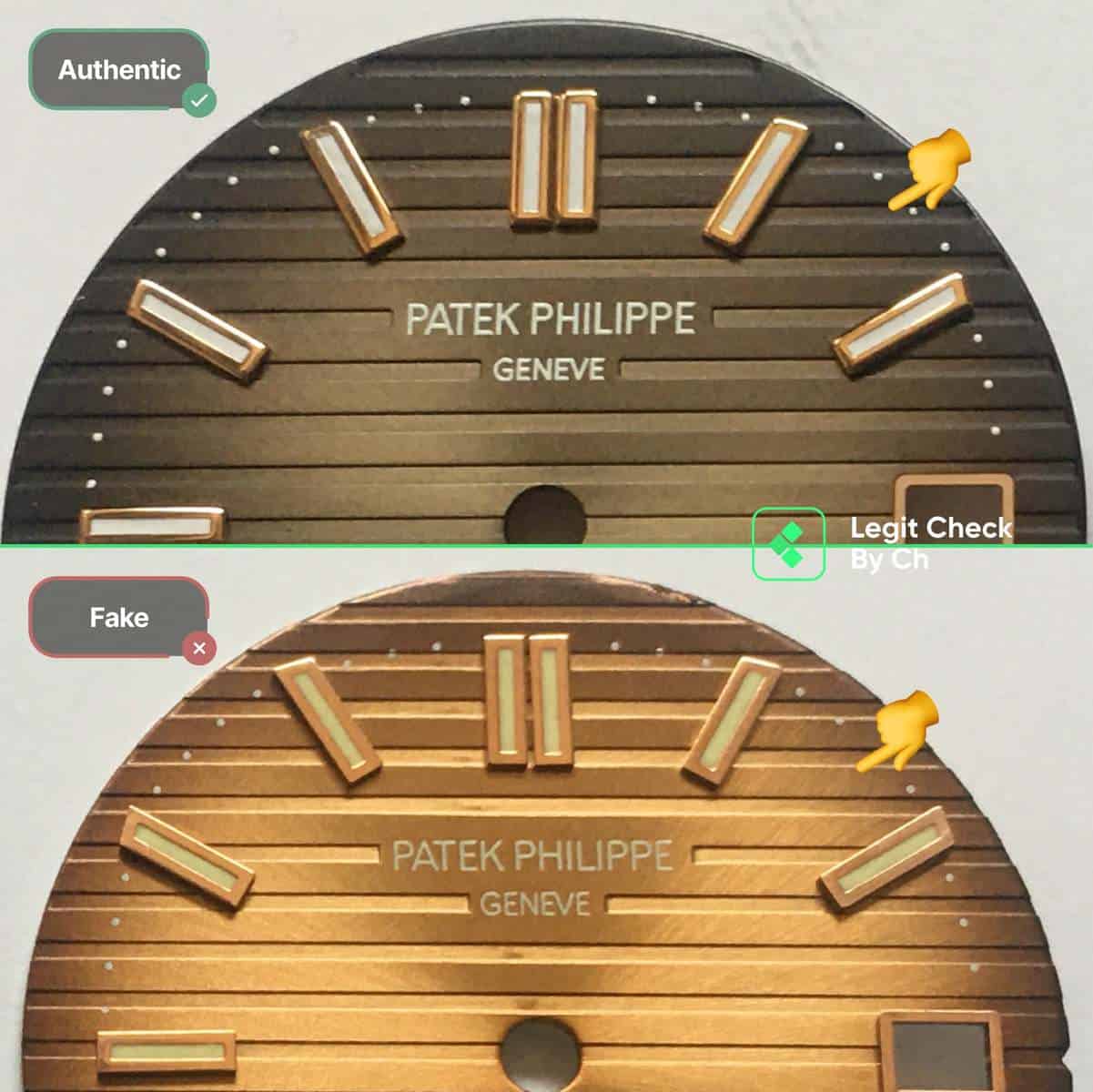
The Nautilus dial is one of the hardest details to imitate. Its horizontal embossing, paired with a perfectly calibrated gradient, gives the surface a sense of fluidity.
On the real watch, the color transition is smooth and natural, never abrupt or overly glossy.
Counterfeit dials rarely achieve this level of refinement. The center may appear washed out or too bright, while the outer edges fail to capture the rich, smoky tone of the original.
This loss of depth is a telltale sign – Patek Philippe’s gradient finishing is so intricate that even high-end replicas struggle to reproduce it faithfully.
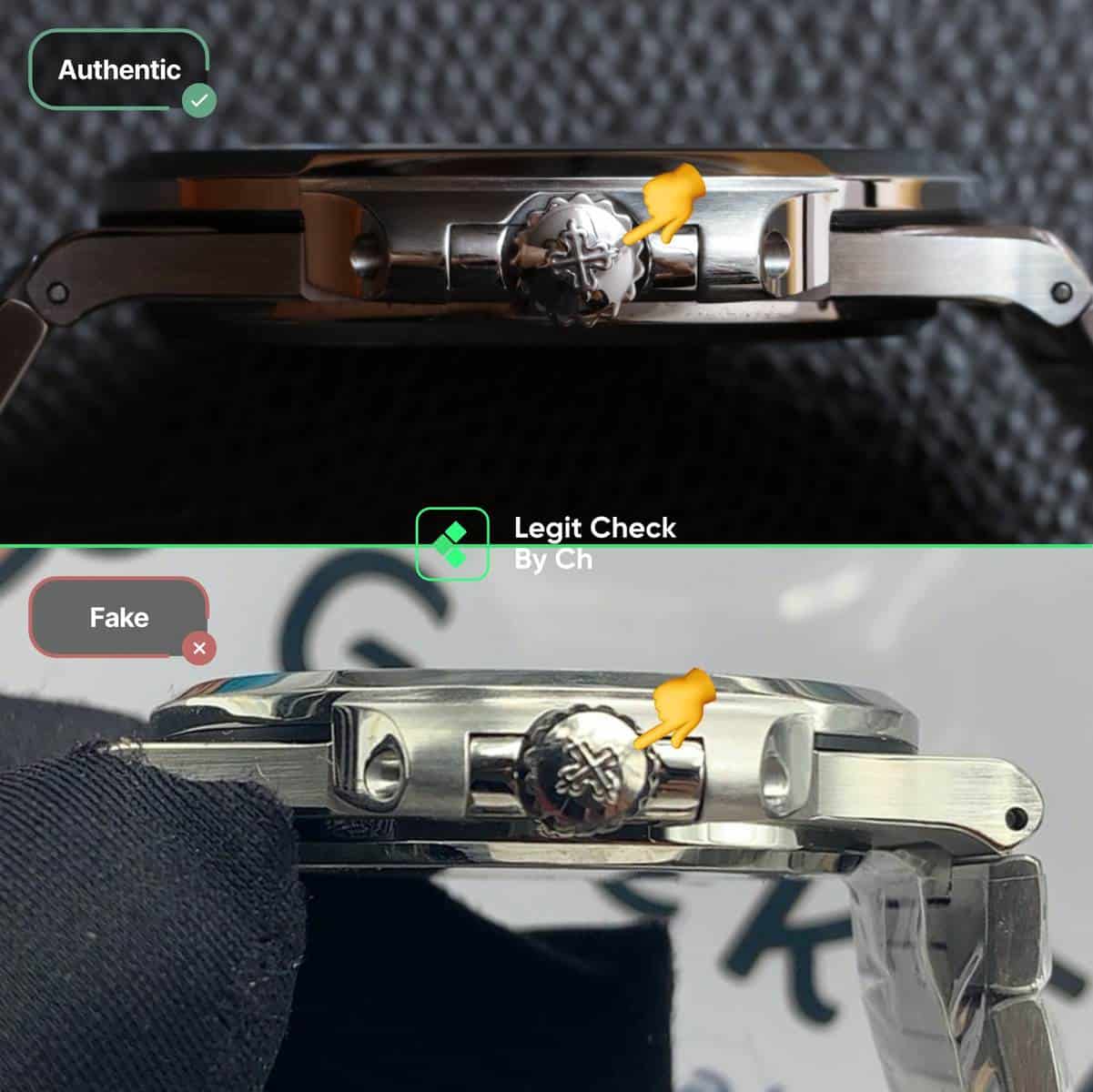
The crown logo is a small but powerful detail that embodies Patek Philippe’s attention to precision.
On an authentic Nautilus, the engraving feels tactile and defined, almost as if carved rather than stamped. Under magnification, the edges are perfectly clean, with no blur or distortion.
Replica crowns fail to capture this precision. The logo might look soft or unfinished, with inconsistent line depth and less defined edges. Some counterfeit crowns even have a printed or laser-marked logo instead of a true engraving.
If the emblem doesn’t cast a clear shadow under light, it’s almost certainly not authentic.
Movement engraving balance is clear in the Royal Oak guide.
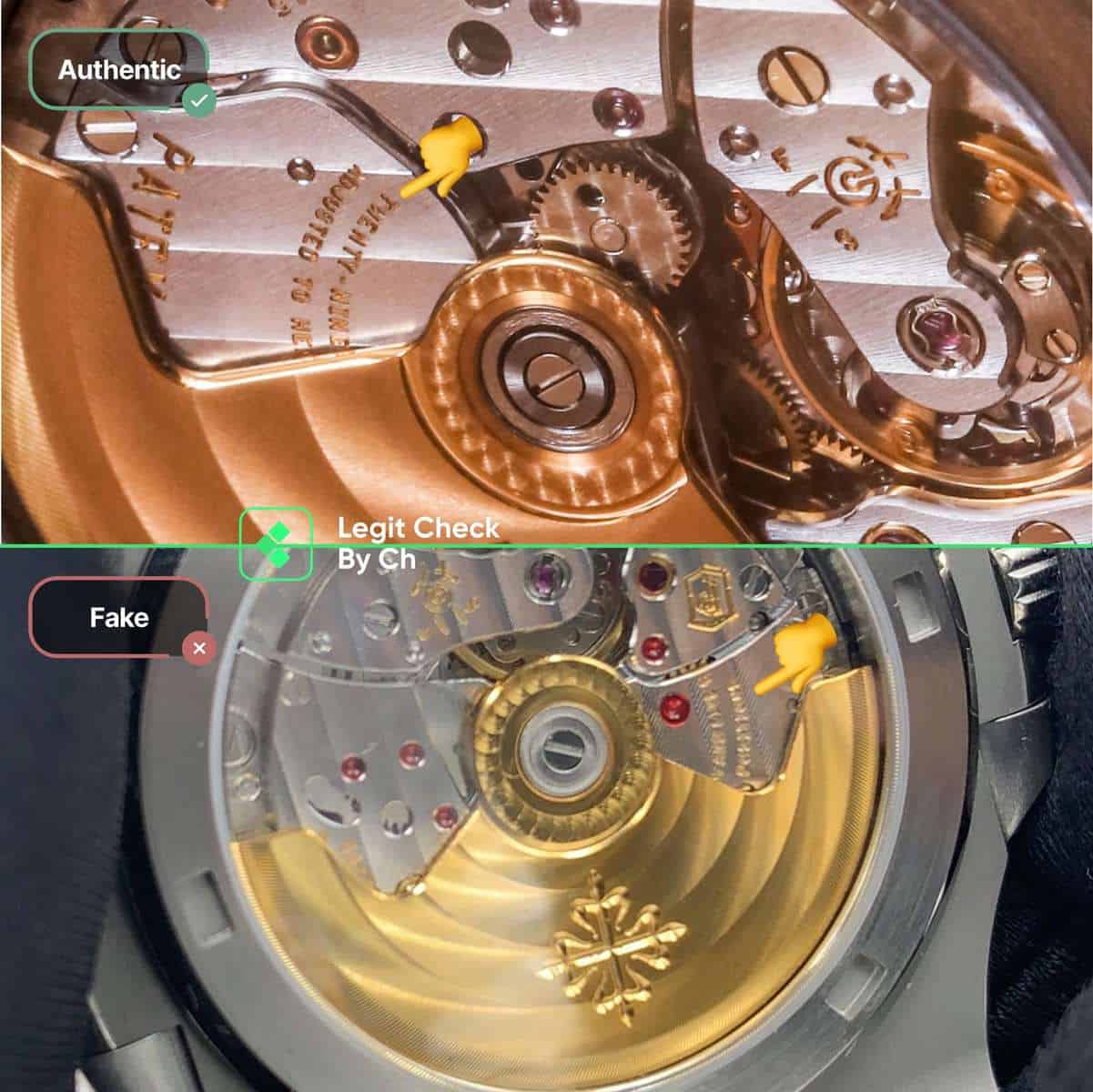
The movement of a genuine Patek Philippe is a masterpiece of hand-finishing.
Every inscription (from the brand name to the Geneva Seal) is applied with deliberate precision, maintaining a fine, delicate stroke.
The lines are consistent in both depth and spacing, and the overall layout exudes balance and grace.
Counterfeit movements, no matter how convincing at a glance, never achieve this harmony. Their engravings tend to be too deep or too wide, sometimes filled with irregular paint or inconsistent etching.
Let’s look at another comparison:
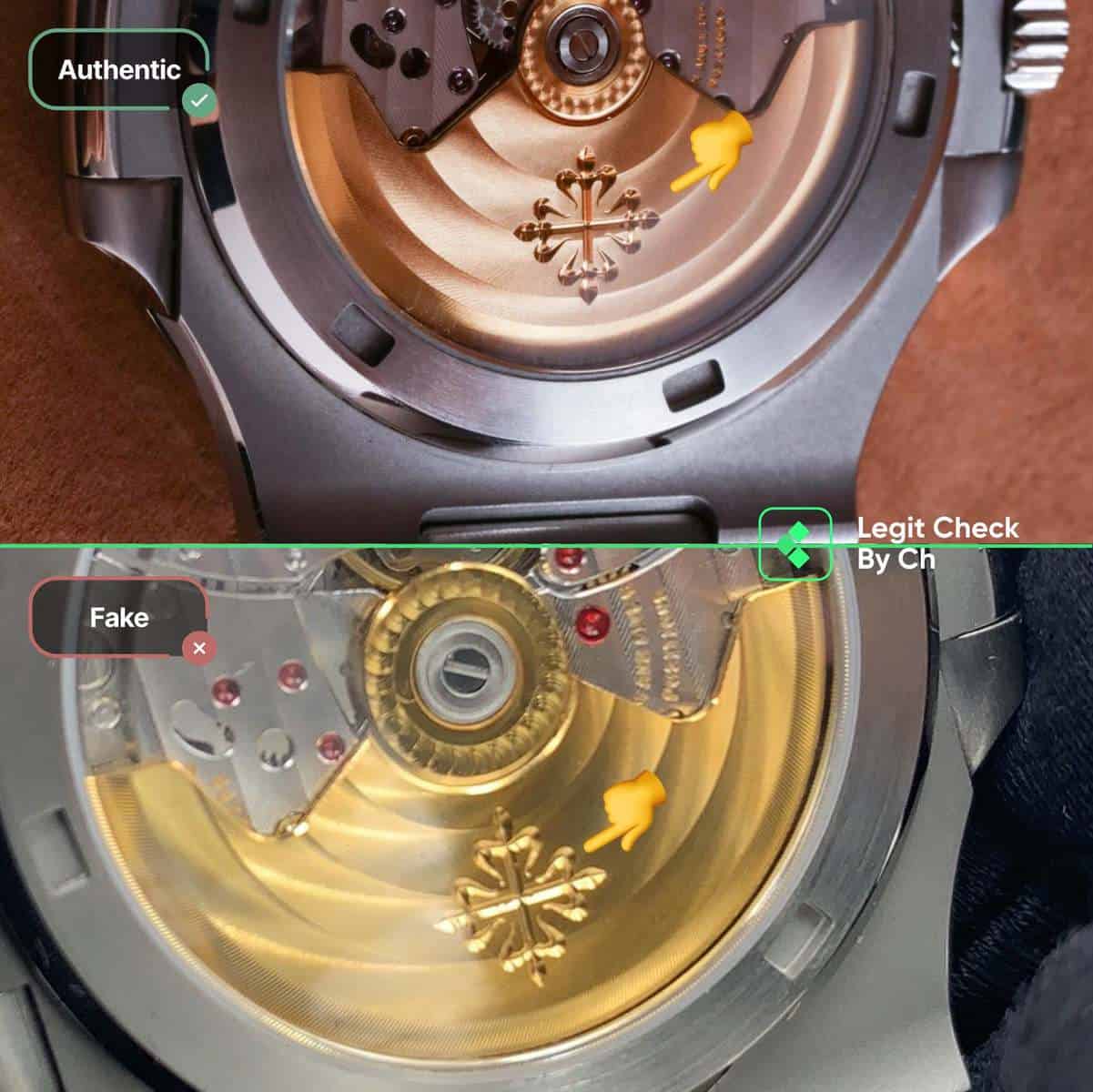
The Patek logo in particular often looks slightly oversized or poorly aligned. This difference in engraving quality is one of the most reliable ways to confirm authenticity when viewing the movement through a transparent caseback.
Let’s inspect the Calatrava Cross:
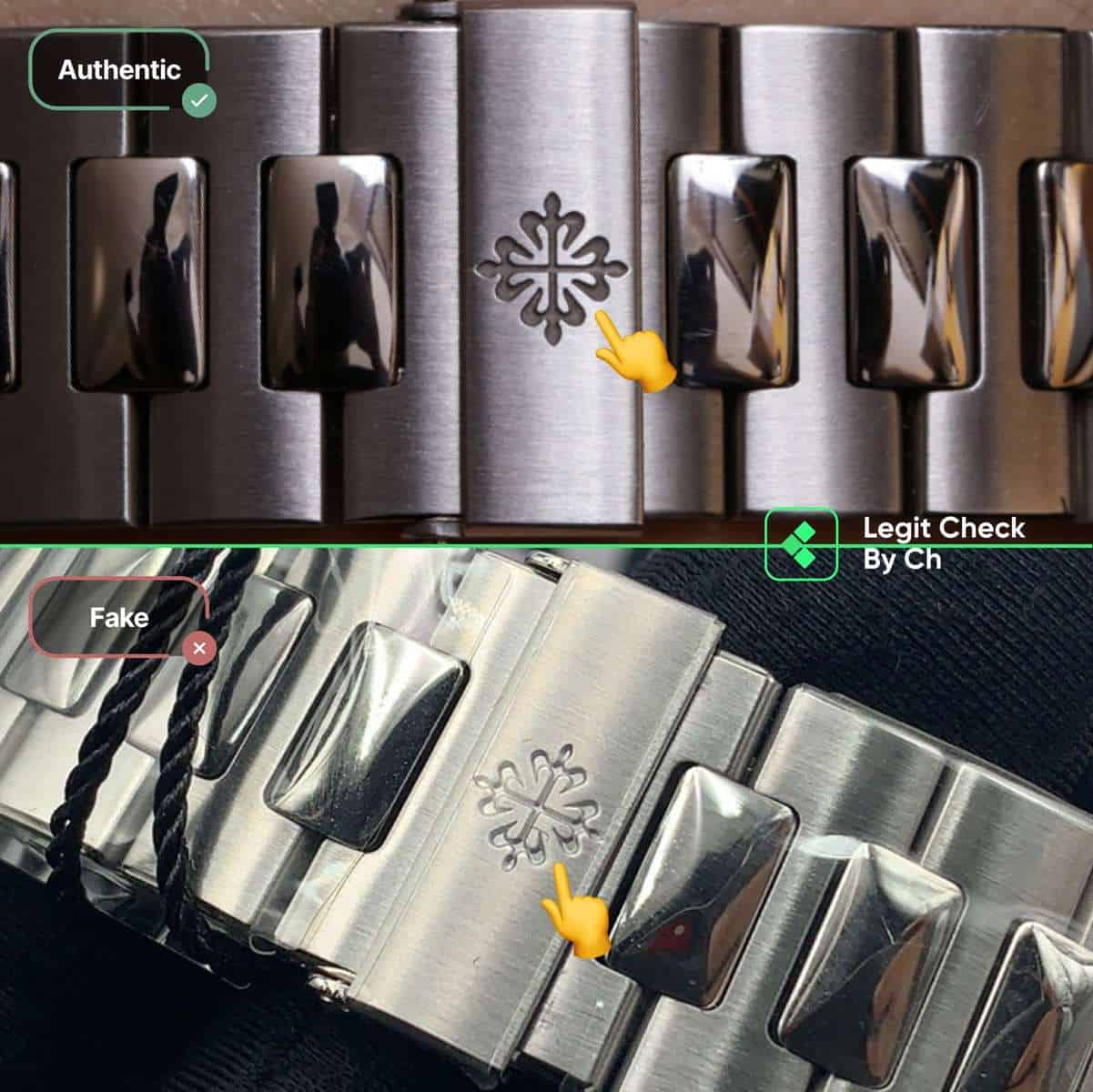
Patek Philippe’s bracelet finishing is where craftsmanship meets tactile luxury.
On the real Nautilus, the engraving feels sculpted rather than etched – you can feel its texture if you run your finger over it.
The logo sits precisely centered on the clasp, surrounded by polished metal that reflects light uniformly.
On fake models, this finesse is missing. The Calatrava Cross looks pressed rather than carved, and its lines appear less defined, especially around the corners.
The depth of the engraving also varies, creating an inconsistent look. Some replicas even have slightly misaligned logos, which never happens on a genuine Patek Philippe.
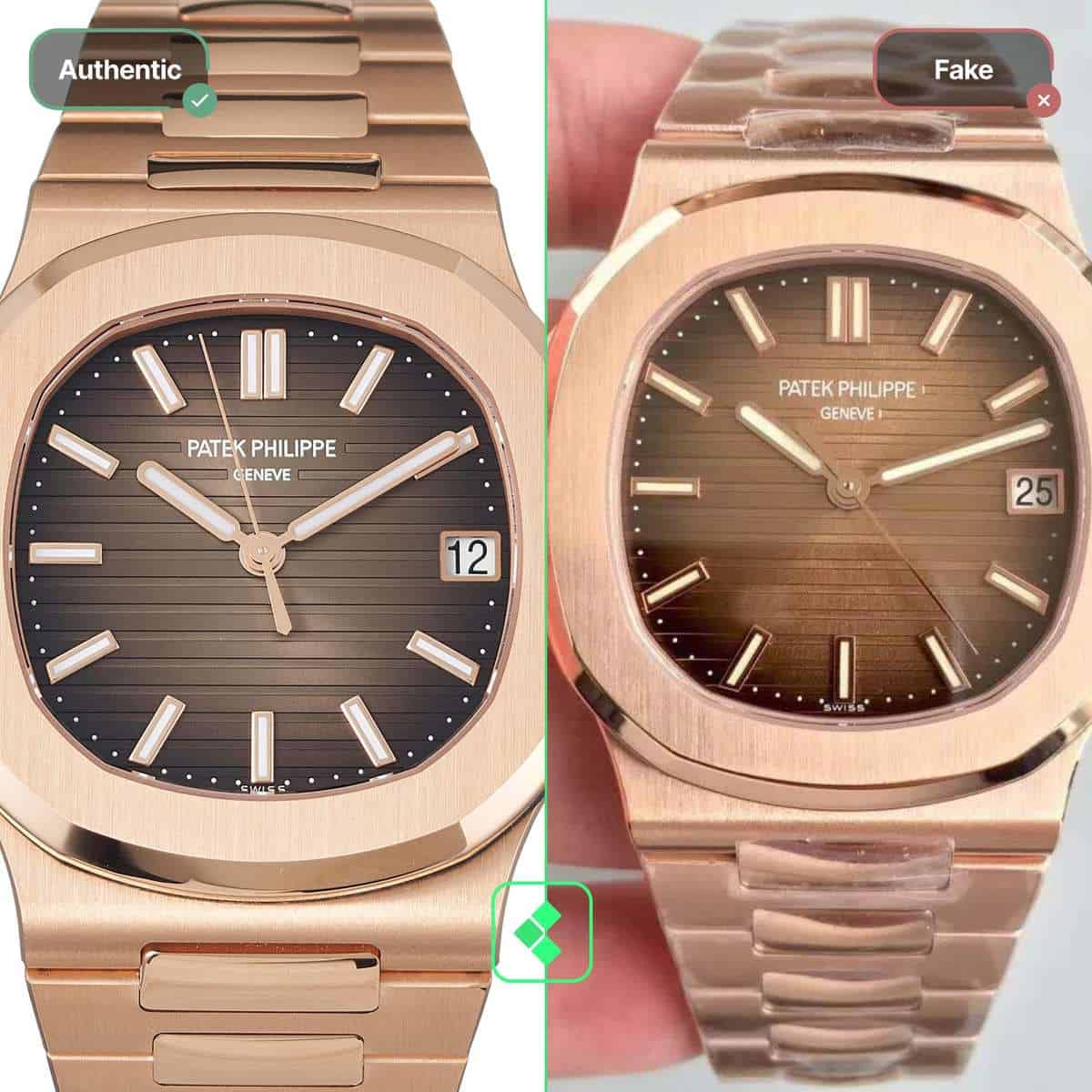
Material quality is one of the clearest distinctions between a genuine and fake Nautilus.
The real watch has a dense, luxurious weight and a refined surface finish that instantly conveys its quality. Whether it’s brushed steel or polished gold, the sheen feels natural – never overly reflective or artificial.
Counterfeits try to imitate these materials through plating or coloring, but the difference is apparent under close inspection.
Rose gold fakes often have an orange tint, while supposed “platinum” replicas lack the subtle grey-blue hue of real platinum. If there’s any doubt, a jeweler can perform a quick chemical test to confirm authenticity.
With Patek Philippe, the metal quality is as telling as the design itself – it’s where true craftsmanship can’t be faked.
Patek Philippe is renowned for using high-quality materials. It is one of the biggest players in the watch industry.
Precious-metal tells and clasp engraving checks mirror those in our Rolex Day-Date guide.
Short on time? Use this authenticity-check to nail the tells collectors rely on. It covers the exact points from the guide so you can separate a genuine Patek Philippe from a convincing replica fast.
These checks catch the vast majority of counterfeits. For peace of mind, compare against high-res reference images or have a professional authenticator inspect the watch and movement.
Visit our hub now to access various authentication guides for other prestigious watches like this one.
Patek Philippe purchases often begin at $60,000.
With that kind of money at stake, “looks right” is not enough. High-grade replicas copy the silhouette, then fail in the places that matter, from typography to finishing to movement work.
Our authentication is entirely human. Specialists examine every reference, year, and edition, including Nautilus, Aquanaut, Calatrava, complications, and precious-metal variants. No automation. No shortcuts. Just a careful inspection from people who handle these watches daily.
What we verify on a Patek Philippe:
Collectors use this service because it protects real money. We have completed thousands of authentications, earned consistent praise from buyers and dealers, and helped clients avoid counterfeit losses measured in the millions.
Any Patek you send in is checked reference-against-reference, then documented clearly so you can proceed with confidence.
Every pass or fail includes a Certificate of Authenticity. It is more than peace of mind, it is a safety net. Use it for refunds and disputes, as proof at resale, or for insurance.
If the watch is not genuine, you have formal evidence to act on.
👉 Authenticate your Patek Philippe with us today and protect your investment before you commit.
Authenticating a Patek Philippe is about proportion, typography, and finish.
In this guide we focused on the tells that separate genuine from counterfeit, from the way a date sits in its frame to the way light plays across the bezel and dial.
A real Patek reads as balanced and calm, nothing shouts. Fakes slip on centring, depth, or engraving quality.
Use a structured authenticity-check. Start with the date window and dial, confirm bracelet and case geometry, then review engravings and metal.
One weakness can be a mistake, two or more are a signal to pause and verify before money moves.
Key points to revisit
Still unsure?
When a decision involves $60,000 or more, certainty matters. Our authentication is 100% human, never AI, carried out by specialists who handle Patek Philippe daily.
You receive clear findings and a Certificate of Authenticity you can use for resale, insurance, or disputes.
If anything you checked feels off, let us perform a full authenticity-check before you buy. Peace of mind is worth it when the stakes are this high.
Elegance deserves evidence.
We verify what replicas fake and photos flatter (date-aperture geometry, dial gradient & typography, crown/case finishing, movement engraving, hallmarks and metal) so your Patek comes with proof, not hope.
Quiet, thorough, defensible – the way Patek should be verified.
To find the serial number on your Patek Philippe watch:
If you’re having trouble locating the serial number, Patek Philippe’s customer support can assist you in finding it.
The symbol of Patek Philippe is the Calatrava Cross, which is a stylized representation of a cross with rounded edges.
It symbolizes the brand’s commitment to tradition, excellence, and innovation in watchmaking.
Yes, Patek Philippe does offer authentication services for their watches. If you have concerns about the authenticity of your Patek Philippe timepiece, you can contact the brand directly for assistance with authentication.
A genuine Certificate of Origin is issued once when the watch is sold by an authorized retailer – Patek will not reissue it. If it’s missing, you can instead request an Extract from the Archives, which confirms when and how your watch left the factory.
It’s not an authenticity certificate, but paired with an expert inspection, it helps establish provenance and adds resale credibility.
The Nautilus combines hand-finished components, low production numbers, and Gérald Genta’s iconic design, which drives immense global demand. Each watch takes months of finishing and regulation. Add brand heritage, limited allocation, and collector hype – and you get a luxury watch that not only holds but often increases in value.
Need our opinion in regards to the authenticity of your watch? It’s a service we provide.
Alternatively, we have free authentication resources for watches: written guides and video tutorials.
Thank you for reading this,
Ch Alex
Other authenticity-check guides for you
The guides below explore timepieces and jewelry with similar levels of finishing and prestige, making them ideal companions for Patek enthusiasts and collectors.