Last Updated on January 13, 2026 by Ch David
Hublot authentication can be tricky, especially since the brand’s modern designs are so often imitated.
Known for its “Art of Fusion” philosophy, Hublot combines materials like titanium, ceramic, and gold in ways that make each model instantly recognizable – and equally tempting for counterfeiters to copy.
Many replicas succeed in matching the bold aesthetic, but they fail to capture the precision that defines a real Hublot.
The flaws often show in the details: misaligned hour markers, uneven dial elements, and incorrect spacing between the hands and sub-dials.
These small inconsistencies are what seasoned collectors use to separate genuine pieces from even high-end fakes.
This guide walks you through the essential checks for verifying any Hublot watch.
Whether you’re inspecting a Big Bang, Classic Fusion, or Spirit of Big Bang, the same principles apply – and once you know them, spotting a fake becomes much easier.
Fusion can be copied. Precision can’t.
We test what photos can’t show (alignment, materials, mechanics) so your Hublot proves itself before your money moves.
No automation • Expert eyes only • Turnaround: fast, written, defensible
A quick way to tell if a Hublot is genuine is to inspect the dial layout and alignment of its elements.
On a real Hublot, every index, sub-dial, and logo sits perfectly aligned, with crisp printing and symmetrical spacing.
Counterfeits often get this wrong, producing dials where the text looks off-center or the markers appear uneven.
These alignment errors might seem minor, but they’re one of the most reliable tells of a replica.
Genuine Hublot watches are built to exact tolerances, so even a small deviation is a clear warning sign. We’ll cover more checks (from case materials to movement finishing) in the detailed sections below.
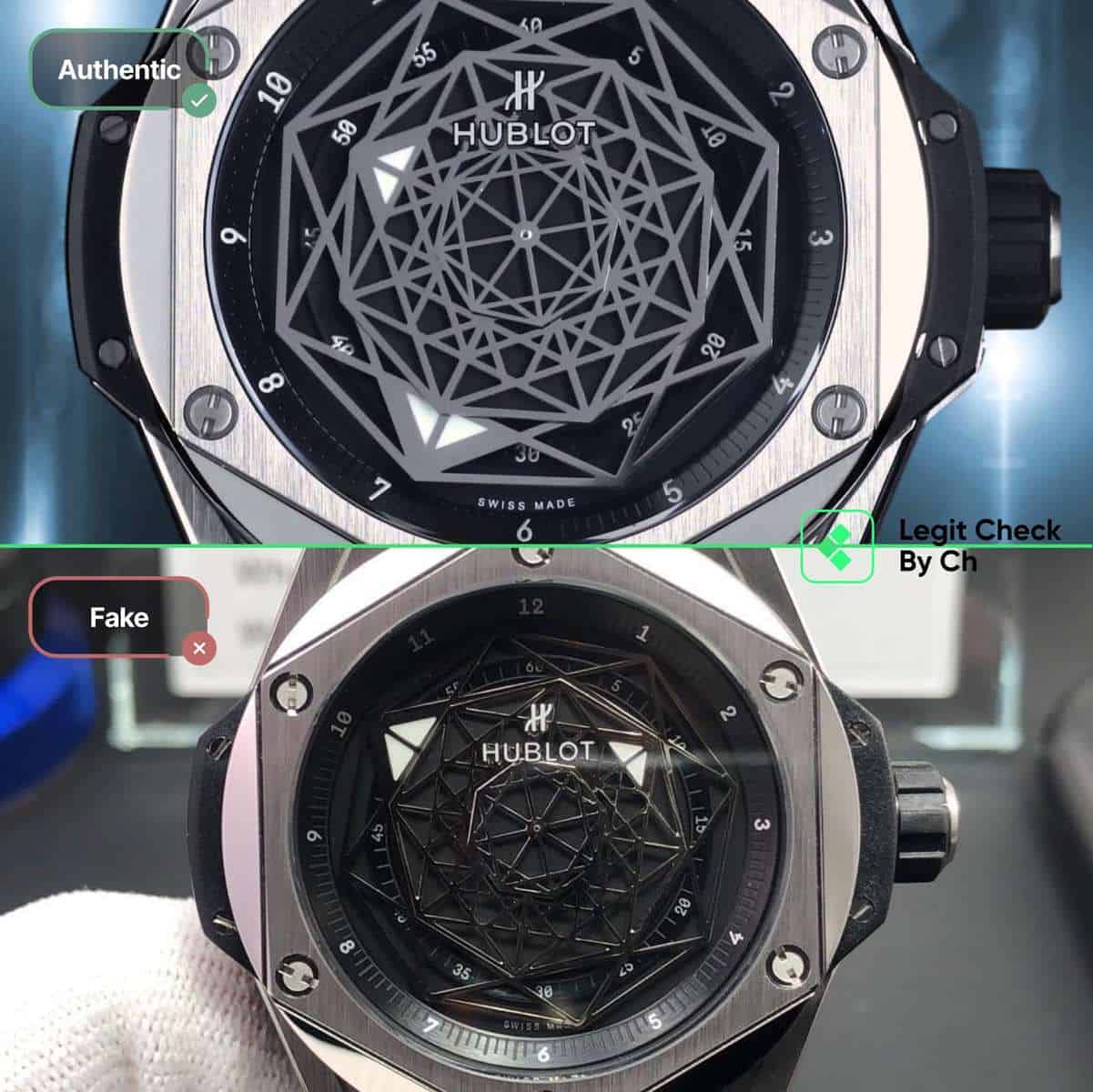
The dial is where Hublot’s craftsmanship is most visible – and most often imitated.
On a genuine model, the spiral square pattern inside the dial looks meticulously carved, with uniform depth that gives it a refined, almost architectural texture. Each line is symmetrical and sharp under magnification, revealing the precision of CNC machining used in authentic pieces.
The “HUBLOT” wordmark and the “H” emblem are perfectly centered, with dark outlines that add contrast against the dial’s background.
Fakes rarely capture this complexity. Their spiral textures look shallow or roughly printed, giving the surface a flat, plastic-like finish.
The absence of the black outline around the logo is another easy giveaway – it makes the text appear pale and poorly defined.
When you tilt the watch under natural light, a genuine Hublot dial creates a subtle play between matte and polished finishes, while a replica reflects light uniformly, showing no depth or layering.
This balanced light behavior is one of the clearest visual indicators of an authentic Hublot.
Want a dial with equally unforgiving standards? See how we judge spacing and depth on the Royal Oak.
Want the expert's opinion? Let our Hublot authenticators check your watch:
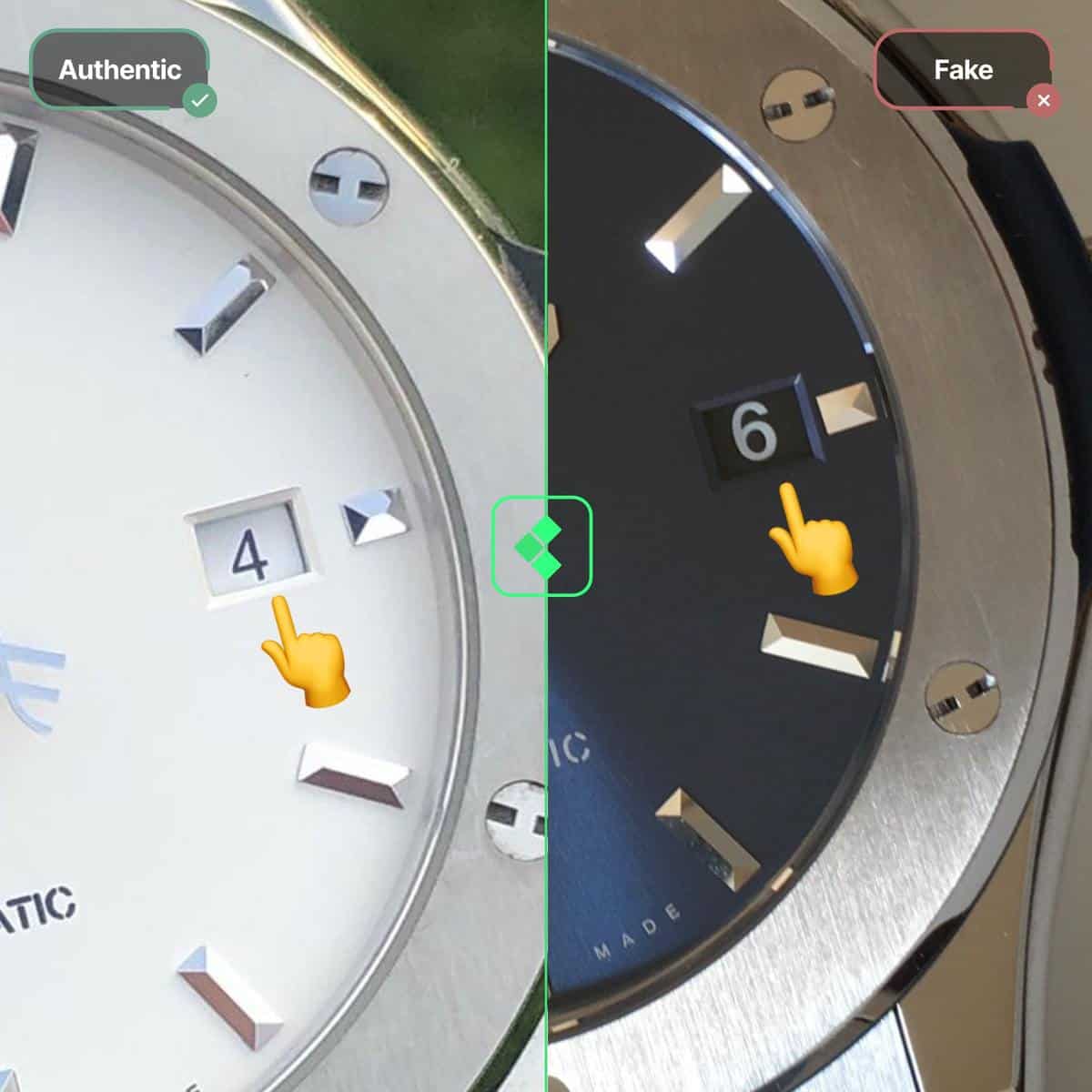
The date wheel is one of those subtle details that instantly exposes a replica when you know what to look for.
On an authentic Hublot, each number is printed with precision – evenly spaced, perfectly aligned, and consistent in both size and font thickness.
The numerals appear clean and crisp under magnification, and they always sit exactly in the middle of the window.
No matter which date is displayed, every digit looks uniform, reflecting the brand’s tight manufacturing tolerances.
Fake Hublot watches, by contrast, often struggle with this simple detail. Their numbers are too bold or too thin, with inconsistent placement from one date to another.
On many replicas, the digits lean toward the top of the frame, or the “6” and “9” appear cramped and uneven.
This misalignment might seem minor at first glance, but it’s one of the most reliable indicators of a counterfeit. If the date doesn’t sit neatly centered and sharp – it’s not a genuine Hublot.
For another good ‘date print + centering’ benchmark, compare with the Patek Philippe Nautilus.
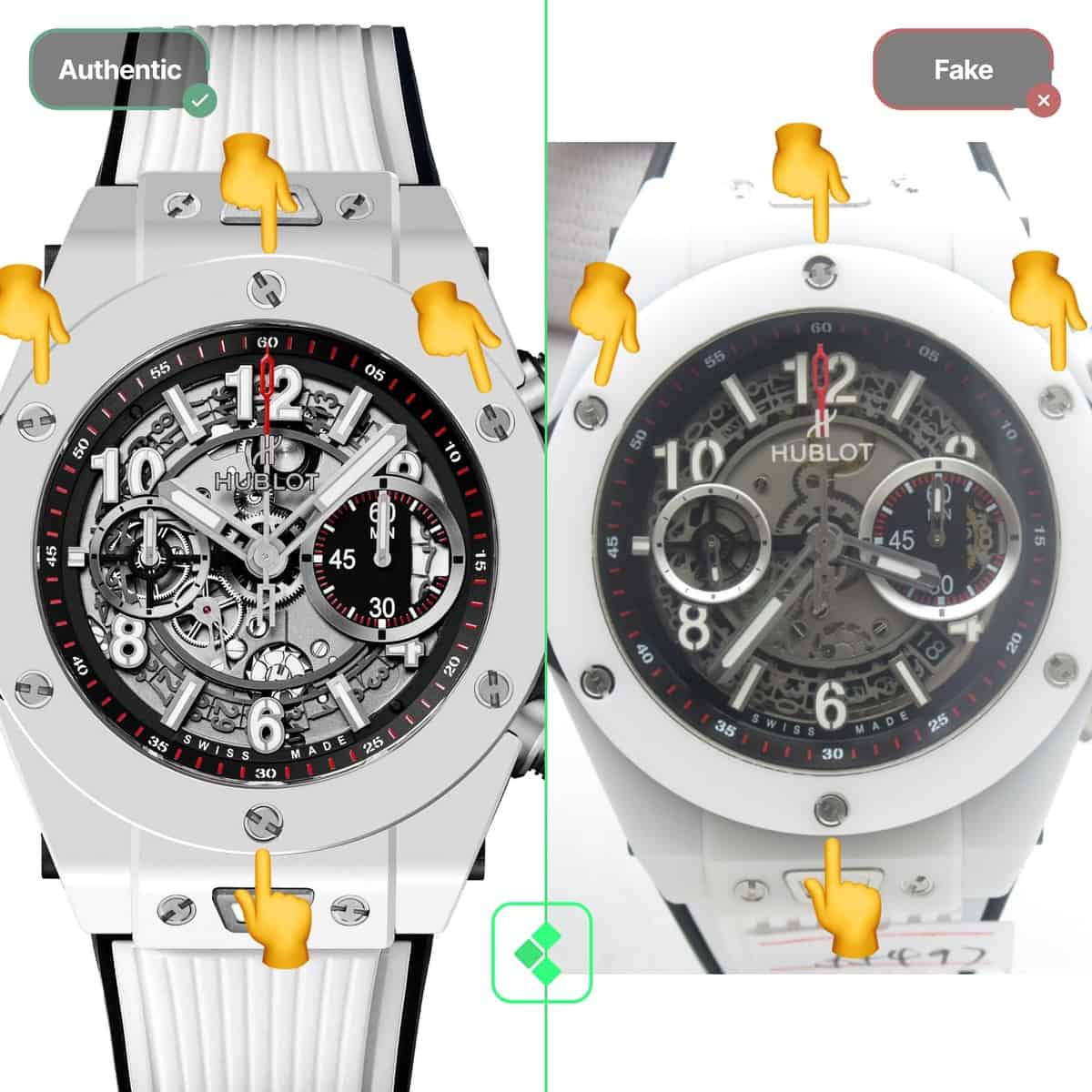
The screws are one of Hublot’s most iconic design elements and one of the easiest details to inspect when authenticating.
On a genuine model, each “H”-shaped screw is cut with impressive precision, showing crisp edges and a deep, balanced engraving.
The metal’s polish is so smooth it reflects light evenly, and the screws always align perfectly with the case geometry.
When you run your finger over them, they feel flush to the bezel – never sunken or protruding.
Fake versions struggle to replicate this craftsmanship. Their screws often have shallow grooves, irregular “H” shapes, or slightly rotated alignments that disrupt the symmetry.
The metal finishing is usually dull, grainy, or uneven, with visible machining marks around the edges.
Since these screws are functional as well as aesthetic, any sign of inconsistency, poor depth, or off-angle placement is a strong indicator that you’re not holding an authentic Hublot.
Check out these other authentication guides: IWC, Tag Heuer.
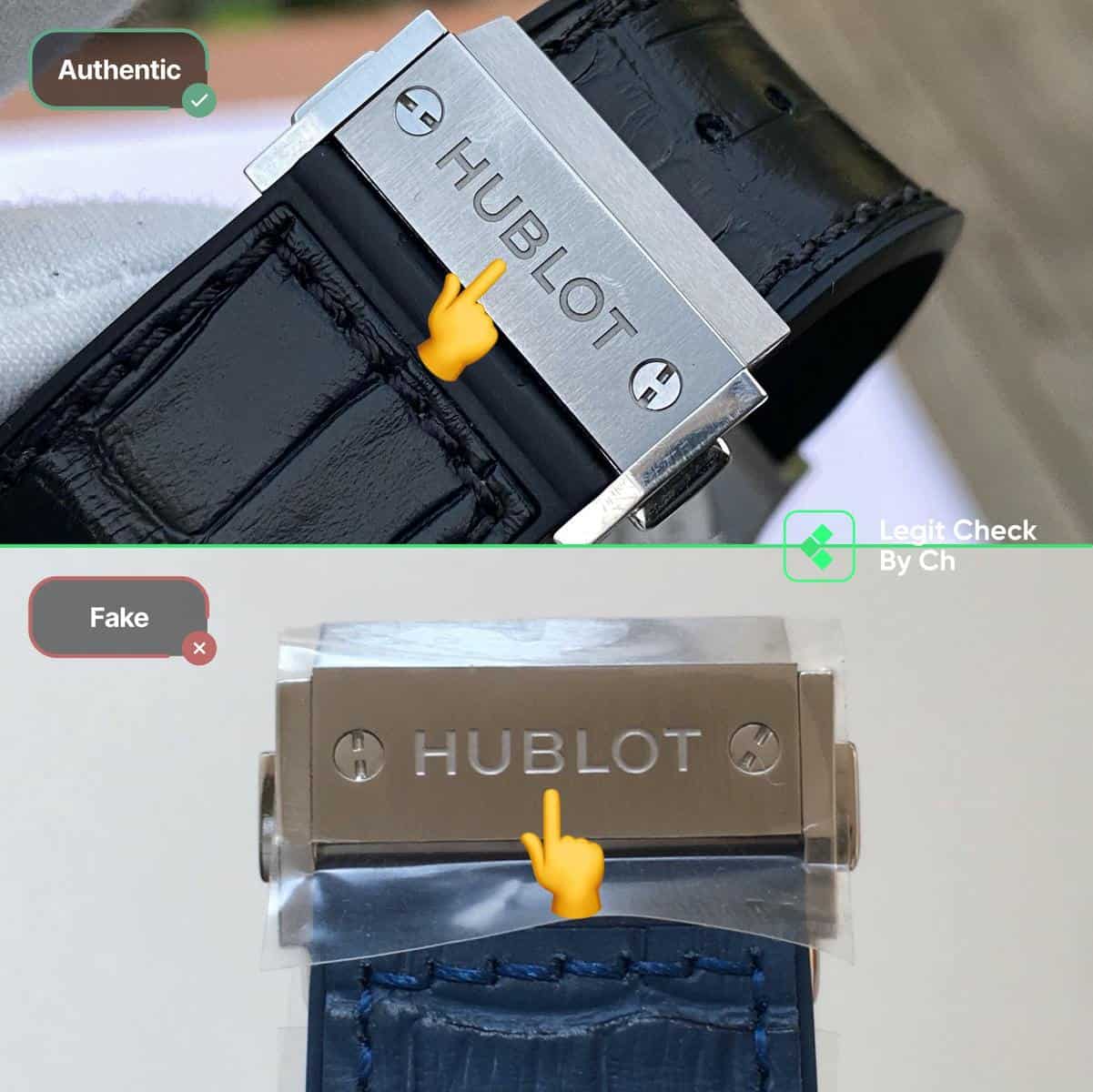
When you look closely at the clasp front, the quality gap becomes obvious.
The genuine engraving has a subtle depth that creates micro-shadows, while the fake one looks flat and lifeless under direct light.
On authentic models, the polish transitions smoothly into the engraved edges, a detail almost impossible to fake with cheap stamping methods.
The tactile feel also gives it away – a real Hublot clasp feels solid and heavy, while replicas often feel lighter or rattly when handled.

This small detail is one of the easiest tells for authentication.
On real Hublot clasps, the rear engravings are applied using precision CNC methods, resulting in sharp-edged lettering that reflects light evenly.
Fakes, on the other hand, rely on basic laser etching, which creates a faint or grainy texture under magnification.
A genuine clasp will also show no signs of bubbling or discoloration in the steel finish, even after regular use.
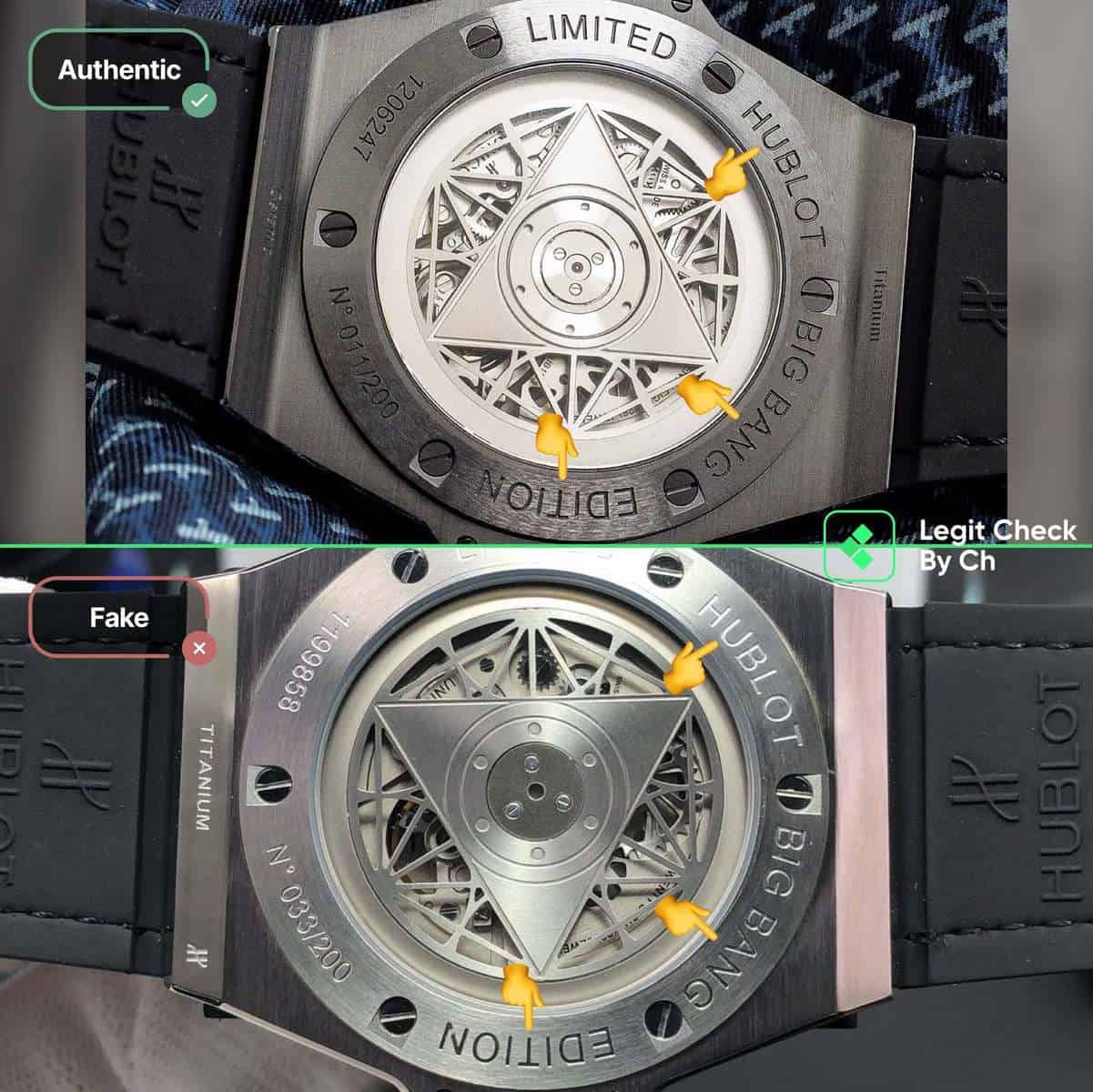
On genuine models, the rear case feels as premium as the front dial.
The engravings catch light differently depending on your viewing angle, while fakes often reflect it in a flat, matte way. Hublot uses deep laser engraving on polished surfaces, giving the text a clean contrast without bleeding edges.
On counterfeit pieces, poor etching leads to fuzzy borders and occasional letter inconsistencies, such as uneven “HUBLOT GENEVE” spacing.
Clasp engravings should look sculpted, not printed – the same standard we use when checking the Cartier Love Bracelet.

A quick mention:
If in doubt, we recommend double-checking the steps we’ve explained above this line.
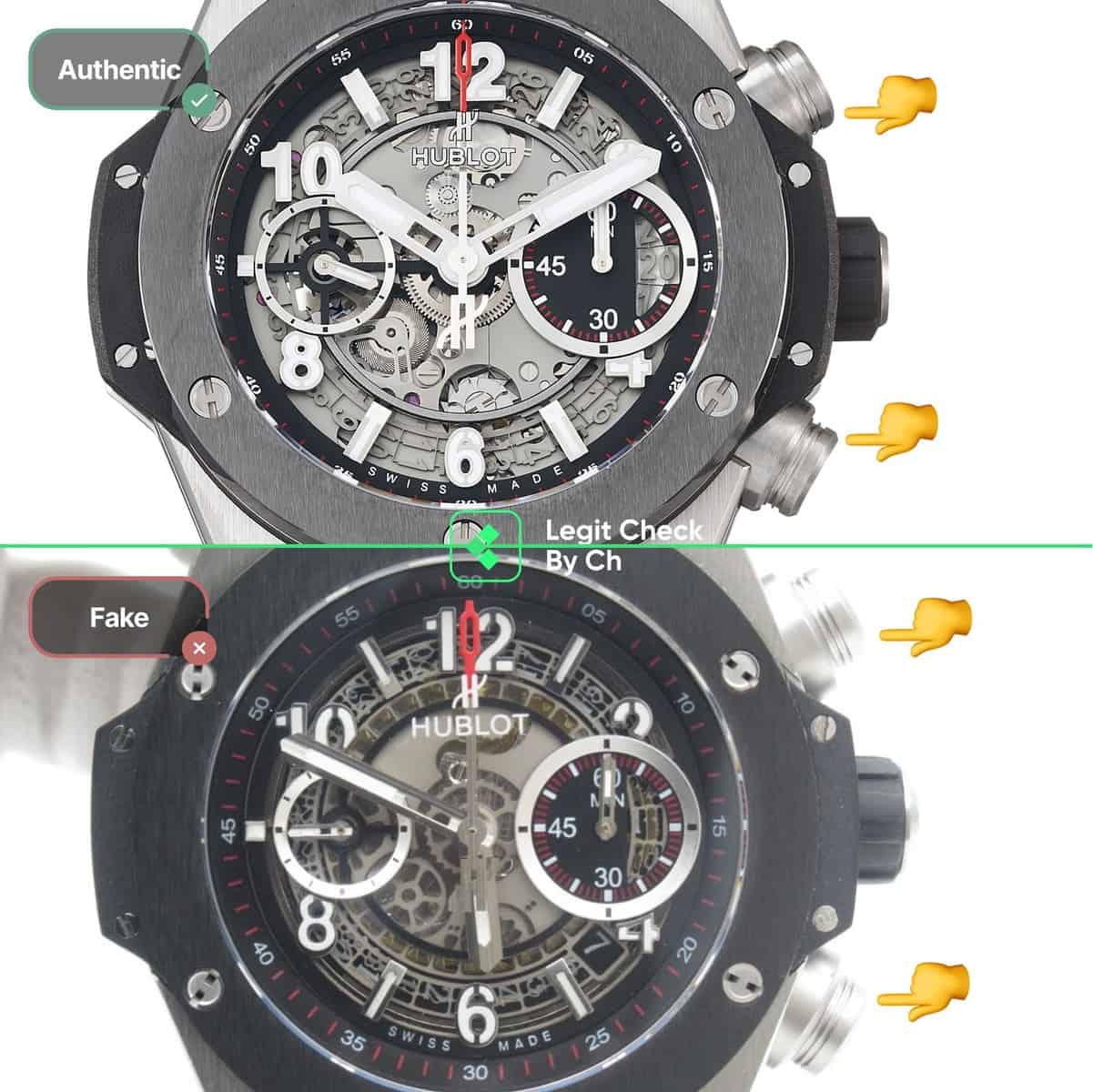
Testing the pushers is one of the fastest ways to separate a genuine Hublot from a replica.
On authentic models, the buttons have a solid resistance – they push in smoothly and return with a satisfying snap, directly activating the sub-dials as intended.
Each press should feel engineered and consistent, reflecting the precision of the in-house movement.
In contrast, fake pushers often feel hollow or springy, as if detached from any internal mechanism. Some don’t function at all, serving only as static decorations.
Even when replicas manage to mimic the movement of the button, their action lacks feedback and control.
The way Hublot engineers its pushers is comparable to chronographs like the Rolex Daytona, where button feel and sub-dial accuracy reveal more than any visual detail.
This difference in tactile quality is something you can feel instantly in hand – genuine Hublot chronographs behave like miniature machines, while fakes merely imitate the form.
If you’re comparing case-back typography and depth, this walkthrough on the Panerai Luminor is a helpful reference.
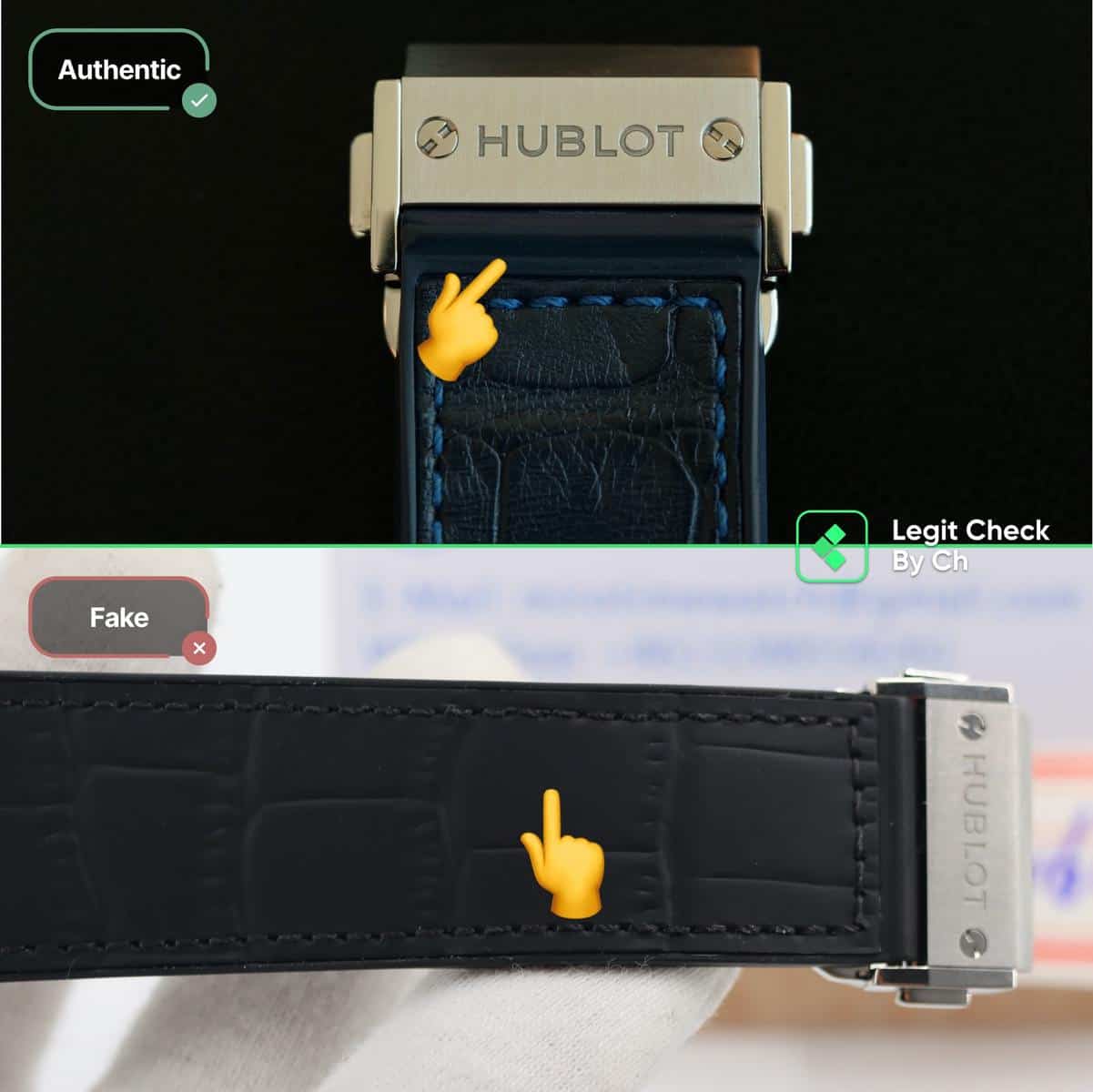
Hublot’s strap design is one of its most overlooked yet distinctive features.
On a genuine model, the narrow rubber base serves both a structural and aesthetic purpose – it keeps the strap sturdy while giving it a soft, ergonomic curve around the wrist.
The leather top feels rich and slightly textured, and the stitching follows a perfectly straight, even pattern along both sides.
Replica straps rarely capture this hybrid construction. Many are made from low-quality leather or plastic that feels thin, smells artificial, and lacks the flexibility of the real thing.
When you bend the strap gently, a genuine one maintains its shape and shows no surface cracking.
Fakes often crease or wrinkle easily, revealing inferior material quality. Checking this simple physical detail can tell you immediately whether you’re handling true Hublot craftsmanship or a copy trying to imitate it.
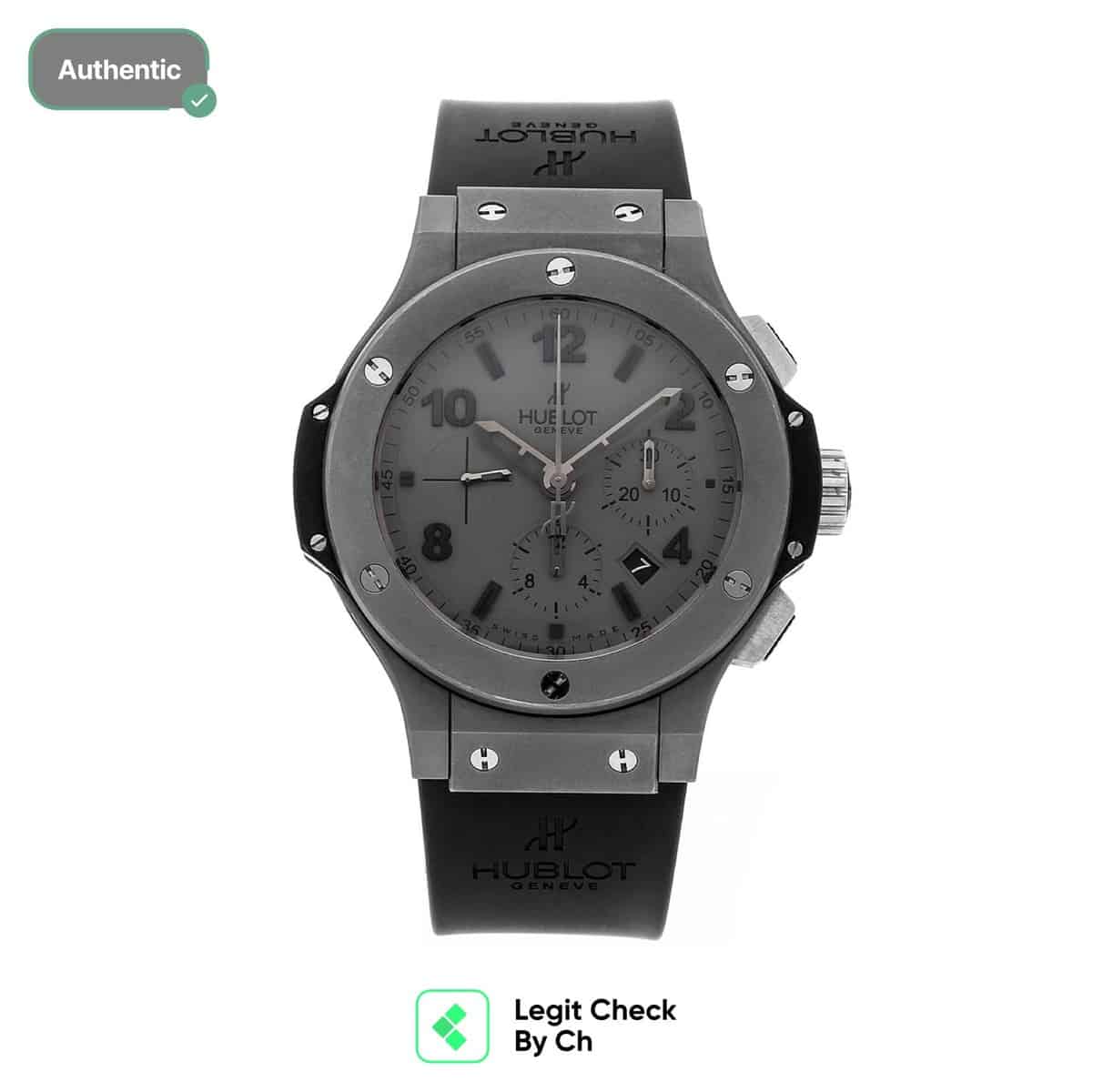
Material quality is one of the strongest indicators of authenticity in a Hublot.
Genuine models have a distinct tactile presence – the case feels cool and substantial, and the surface finish reflects light smoothly without streaks or inconsistencies.
The edges are sharply defined yet polished, and even under close inspection, you won’t find uneven tones or coating marks.
Hublot’s materials are engineered for durability, so genuine pieces resist scratches and maintain their luster for years.
In contrast, replica cases often give themselves away through poor finishing. Gold-plated fakes can lose color within months, and metal parts may feel lighter or warmer to the touch.
Ceramic copies lack the smooth, glass-like texture of Hublot’s real ceramic, while carbon fiber imitations are usually printed patterns rather than woven layers.
If you’re unsure, a professional jeweller’s metal analysis (especially for gold or titanium models) can immediately confirm authenticity.
You’ll find the same attention to case materials and finishing on the Omega Speedmaster Professional, another piece where texture, weight, and polish instantly separate real from fake.
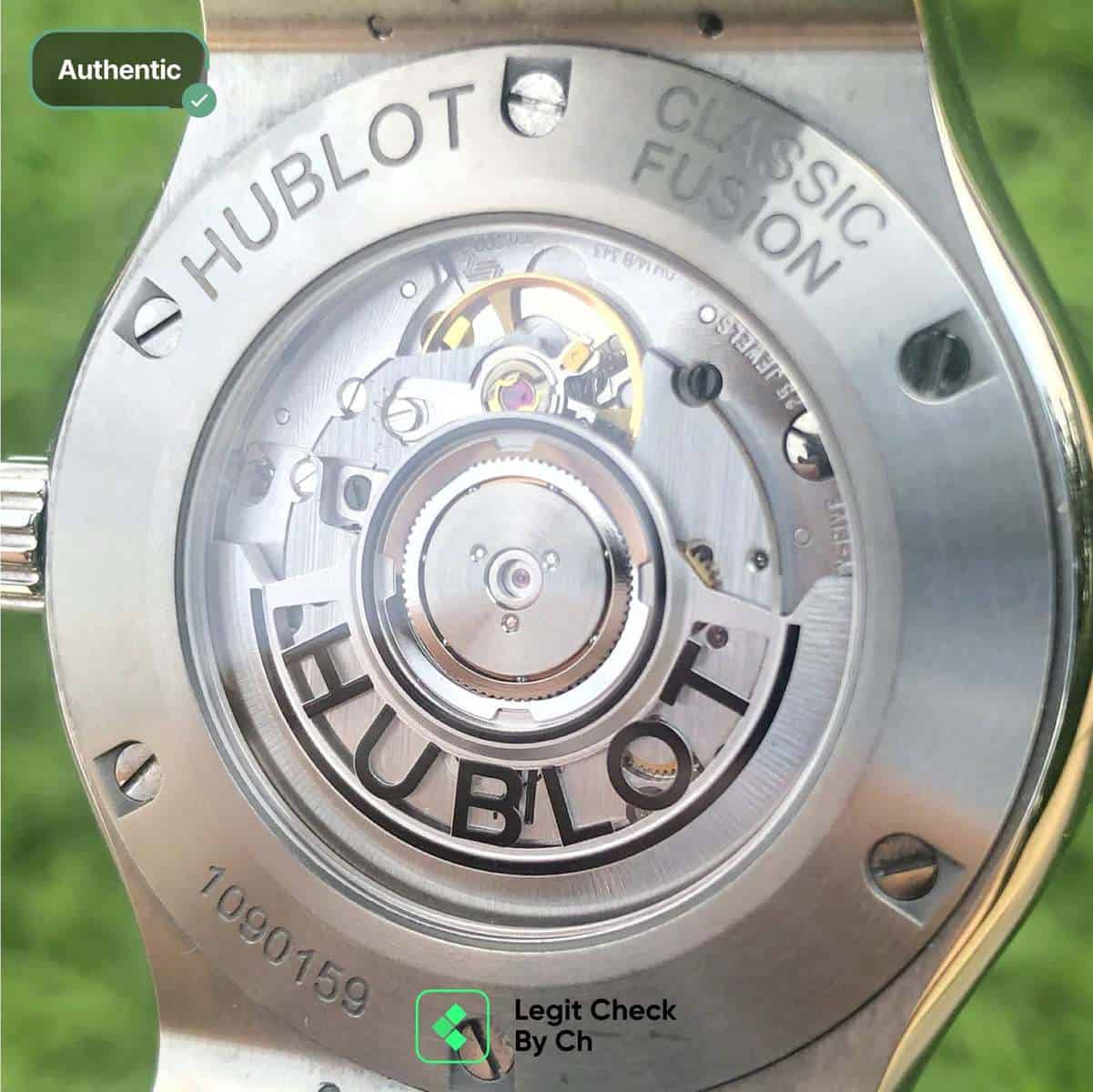
Every authentic Hublot is individually traceable, and the serial number is your most direct proof of that authenticity.
On genuine models, the engraving feels deep and consistent – you can easily feel it when running a fingertip across the case-back.
The digits are evenly spaced and perfectly aligned, showing no signs of fading or uneven depth.
The same serial number will appear on the official warranty card, printed with raised or embossed characters that reflect Hublot’s strict quality control.
Fake watches tend to get this detail wrong. Many use random codes or slightly altered sequences that don’t exist in Hublot’s database.
The engraving is often too shallow or laser-burned onto the surface, giving it a dull, flat look.
Some counterfeit cards feature mismatched numbers or poor print quality, revealing their lack of precision.
When in doubt, always verify the serial number with an authorized Hublot dealer – a matching case-back and warranty card combination is one of the most reliable signs you’re holding a real piece.
Serial/card consistency is also how we catch counterfeits in leather goods – see the heat-stamp and paperwork matchups we verify on the Hermès Birkin.
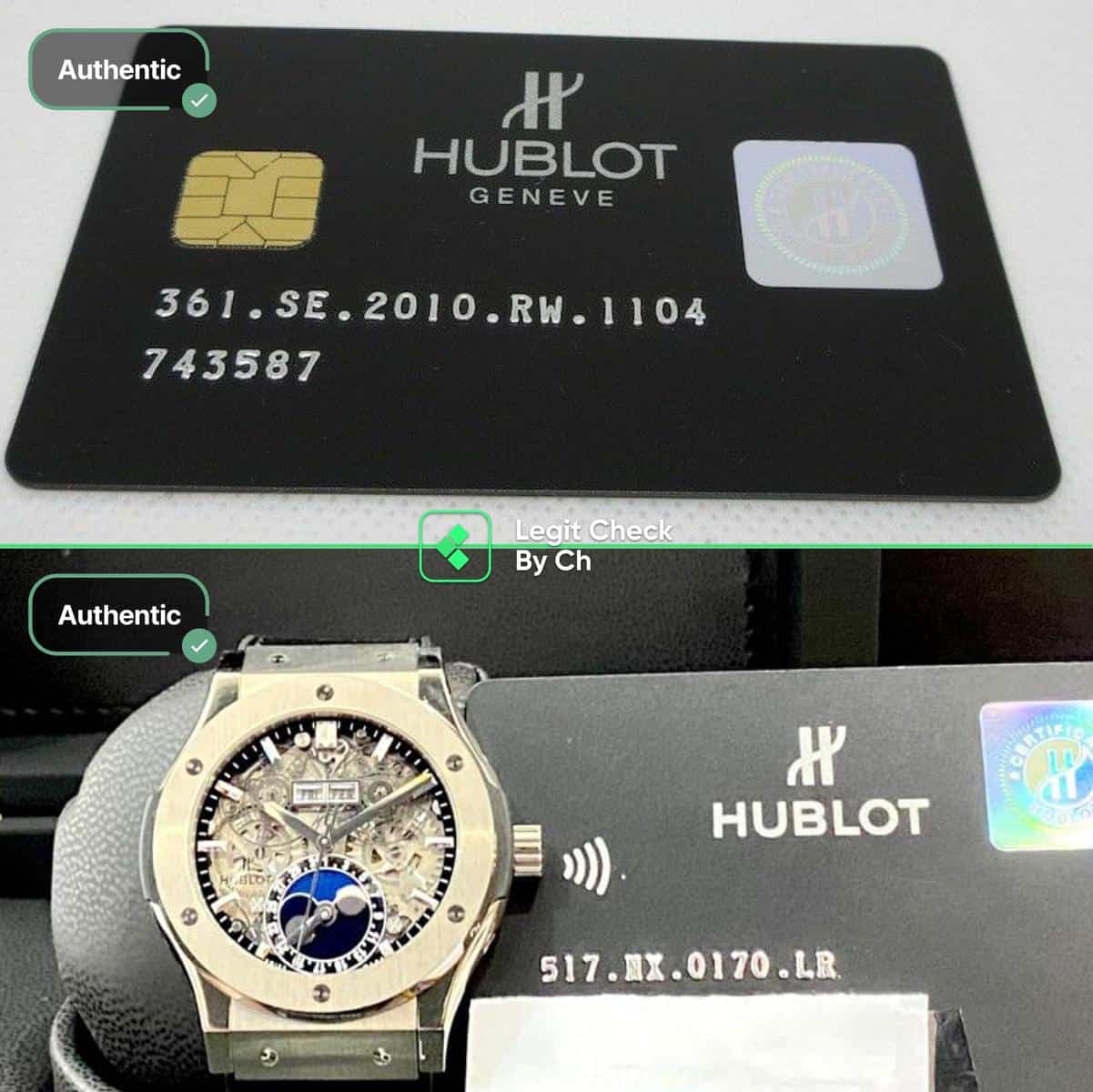
Hublot’s model number system is one of the brand’s most organized identifiers – and one of the easiest details to verify.
Each reference code tells a story: the first digits reveal the collection and size, the next set specifies the material and finish, while the last part indicates strap composition.
On genuine watches, this code appears both on the case-back and the warranty card, with perfect alignment and identical formatting.
Searching it on Hublot’s official website or authorized retailers should bring up the exact same model, down to the case color and strap type.
Counterfeits rarely get this right. Their codes often mix random letters or digits, omit dots, or describe materials that don’t match the watch itself.
A model number like 411.NM.1170.RX on a gold watch, for example, would make no sense – that mismatch is a clear red flag.
Always cross-check both the code and its formatting; even a minor inconsistency, such as a missing dot or altered letter, is enough to expose a replica.
Model codes are just as telling on other luxury timepieces — the Breitling Navitimer follows a strict reference system that makes spotting replica inconsistencies straightforward for collectors.
Authenticating a Hublot comes down to understanding the brand’s unique mix of design precision and material innovation.
Counterfeits can imitate the shape, but not the craftsmanship – and the differences become obvious once you know where to look. Here are the nine fastest checks experts use to confirm authenticity:
These checks reveal whether you’re holding a true Hublot masterpiece or a replica that only imitates its appearance.
Check out this watches hub for more guides like this one.
Buying a Hublot is a serious outlay, and the market is full of near-lookalikes. If you are weighing a five-figure purchase, guessing is not an option.
Our Hublot authentication is performed by expert watchmakers and brand specialists, start to finish, with zero automation. Every verdict is human, documented, and defensible.
We authenticate any Hublot reference, size, alloy, or limited edition. Big Bang, Classic Fusion, Spirit of Big Bang (current or discontinued) we handle them all.
Collectors use our reports to negotiate confidently, list for resale, or return counterfeits without drama.
What we examine on a Hublot, beyond surface tells:
Why do collectors choose us: thousands of successful authentications, consistent five-star feedback, and documented cases where our findings saved clients from six-figure losses.
Your Certificate of Authenticity is more than reassurance, it is leverage – useful for refunds, payment disputes, insurance, and future resale.
Pricing a Hublot without certainty invites risk. Lock in proof before you wire funds or hand over your trade.
👉 Get your Hublot authenticated now and receive a human-written report plus a transferable Certificate of Authenticity.
A real Hublot doesn’t just look bold, it’s ruthlessly consistent.
When the dial geometry lines up, the “H” screws sit flush and mirror-bright, the date sits dead-center, and the pushers feel like tiny hydraulic switches, fakes run out of places to hide.
Stack a few of these checks and you’ll separate “Hublot style” from Hublot quality in minutes.
Key points to revisit
Still unsure?
Don’t gamble on a five-figure buy. Our specialists verify references, materials, engravings, movement behavior, and identity numbers, then issue a Certificate of Authenticity you can use for resale, insurance, or disputes.
👉 Authenticate your Hublot today and turn a quick inspection into total certainty.
Fusion can be copied. Precision can’t.
We test what photos can’t show (alignment, materials, mechanics) so your Hublot proves itself before your money moves.
No automation • Expert eyes only • Turnaround: fast, written, defensible
No, most Hublot watches don’t tick in the traditional sense. Hublot primarily makes mechanical watches, which have a sweeping second hand that moves smoothly rather than ticking once per second like a quartz watch.
If you’re hearing a ticking noise from a Hublot watch, it could be a quartz model – but these are less common. Most Hublot models are known for their mechanical movements, where the second hand glides.
To verify a Hublot serial number, contact Hublot customer service or visit an authorized dealer. These sources can confirm the authenticity and details of your watch.
Verifying through Hublot directly or through an authorized dealer is the most reliable method.
Yes – Hublot is part of the LVMH Group (Moët Hennessy Louis Vuitton), the same luxury conglomerate that owns TAG Heuer, Zenith, Bulgari, and Louis Vuitton.
Since LVMH acquired Hublot in 2008, the brand has expanded globally and introduced new in-house movements while maintaining its “Art of Fusion” philosophy. This ownership also ensures strong after-sales service and access to top-tier material innovation shared across LVMH’s watch division.
It depends on what you value. Omega excels in technical precision: METAS certification, antimagnetic movements, and heritage models like the Speedmaster and Seamaster.
Hublot, on the other hand, focuses on design innovation, fusion materials, and limited editions.
For collectors who want proven chronometry and classic lines, Omega offers better value retention and heritage. For those who want cutting-edge aesthetics and unconventional materials, Hublot delivers a more distinctive, statement-making experience.
Other authenticity-check guides for you
The guides below follow the same step-by-step structure and are ideal if you’re comparing Hublot to other modern luxury icons in the same price and prestige range.
Need our opinion in regards to the authenticity of your watch? It’s a service we provide.
Alternatively, we have free authentication resources for watches: written guides and video tutorials.
Thank you for reading this,
Ch Alex