Last Updated on October 24, 2025 by Ch David
IWC watch authentication matters more than ever, especially as the brand’s popularity continues to rise.
Known for its engineering precision and timeless design, IWC has built a reputation through models like the Pilot’s Watch, the Portuguese, and the Portofino – all of which blend technical depth with understated elegance.
That reputation has, naturally, attracted counterfeiters. While many fakes look close enough to pass at a glance, they rarely capture the clean symmetry and balance that define a real IWC.
The spacing, alignment, and finishing of the dial text are small but revealing details that often give replicas away.
In this guide, you’ll learn how to recognize those subtle differences and verify whether an IWC in front of you is truly authentic.
We’ll cover what experts check first, from dial printing to case engraving, so you can inspect with confidence.
Make the movement prove itself before you pay.
Real IWCs earn their worth through balance, precision, and feel. We check what replicas can’t fake – the harmony of mechanics and detail.
Expert review • 24–48 h turnaround • Trusted by collectors worldwide
Answer: An effective way to begin authenticating an IWC is to inspect the dial text carefully.
On genuine models, every letter has uniform thickness, clean edges, and balanced spacing. Fake IWCs often miss this precision, producing thicker or uneven fonts that disrupt the dial’s symmetry.
This subtle inconsistency is one of the easiest tells once you know what to look for.
It’s a reliable first check, though a full authentication should also include examining the caseback engravings, crown logo, and movement finishing – all of which we’ll detail below.
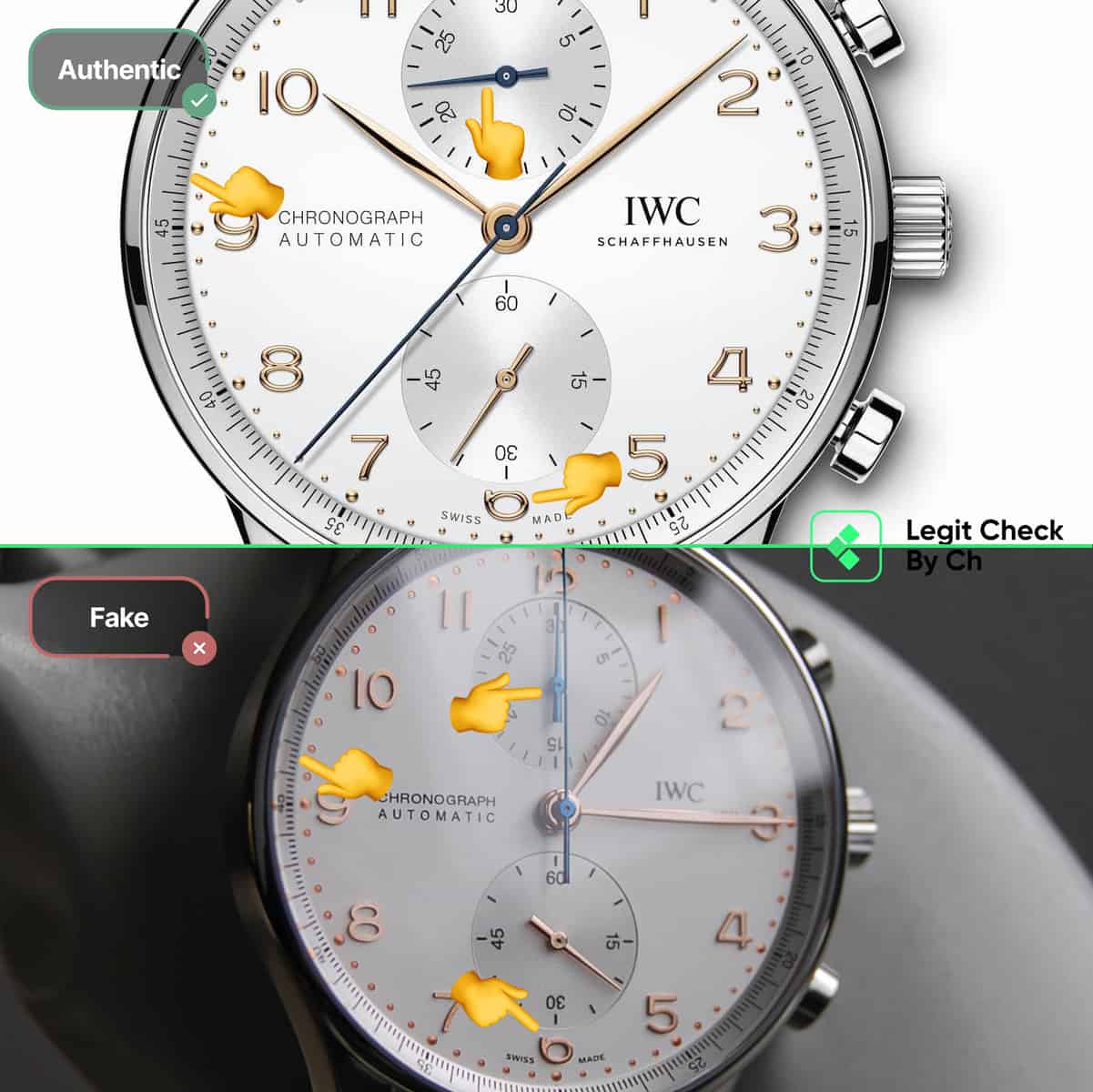
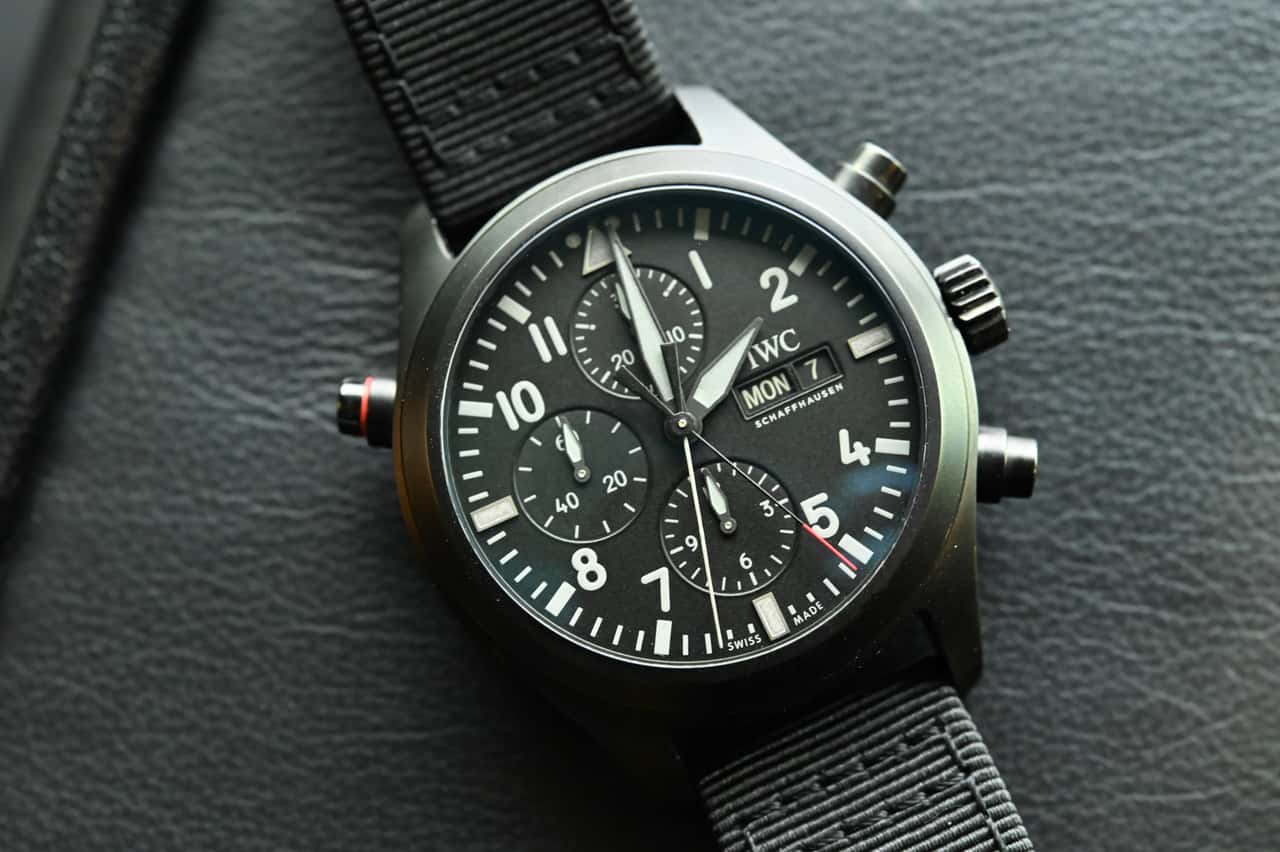
On an authentic IWC dial, precision defines everything.
Each numeral and index is carefully engraved or applied, giving a crisp, dimensional look.
The surfaces have a refined matte sheen, and the print quality of the “IWC Schaffhausen” logo feels perfectly integrated, not printed on top.
Fakes struggle to capture this refinement. The font weights may vary, the embossed numbers can look glued instead of molded, and the lacquer or color treatment lacks depth.
If your sub-dial blue looks flat, or the 6 o’clock marker seems too round, that’s an immediate red flag.
Let’s look at another comparison:
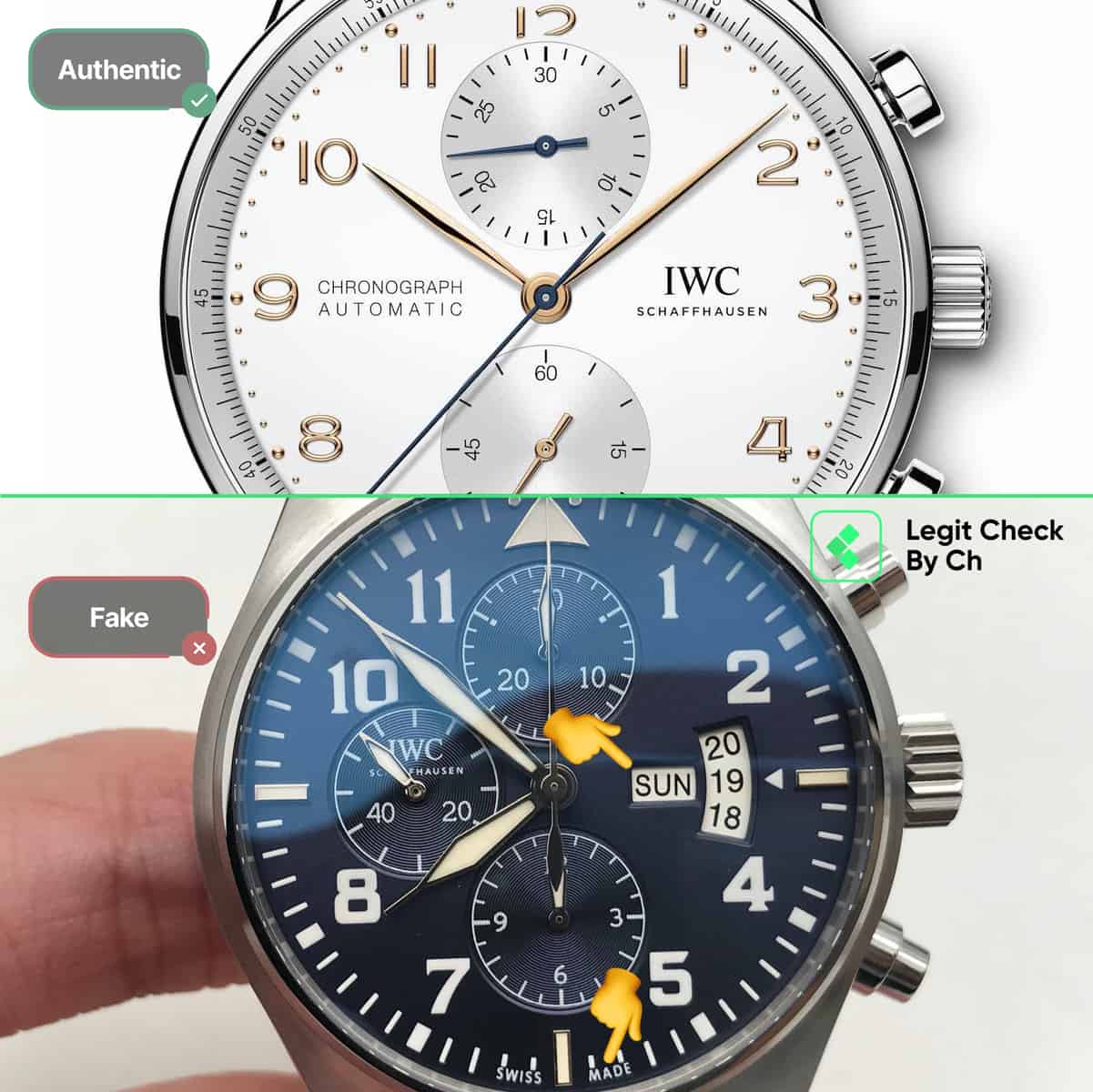
Be aware of the embossed numbers on the genuine dial. On the replica dial, those numbers will more often look like they are “glued”.
See how sub-dial spacing and dial fonts expose fakes on the Speedmaster.
Want the expert's opinion? Let our IWC authenticators check your watch:
Just like the notorious Rolex Daytona, the IWC’s watches also have sub-dials.

The sub-dial layout is one of the most mechanically revealing aspects of an IWC chronograph.
The spacing is symmetrical and proportionate to the case size – a harmony that replicas often miss. The 9 o’clock sub-dial, for instance, should have a rich red accent that appears consistent from every angle.
→ When authenticating, gently test the pushers. On a real IWC, each press feels firm and triggers an immediate mechanical response in the chronograph sub-dials.
If the sub-dials remain static, move out of sync, or the pushers feel “dead,” you’re likely dealing with a replica.
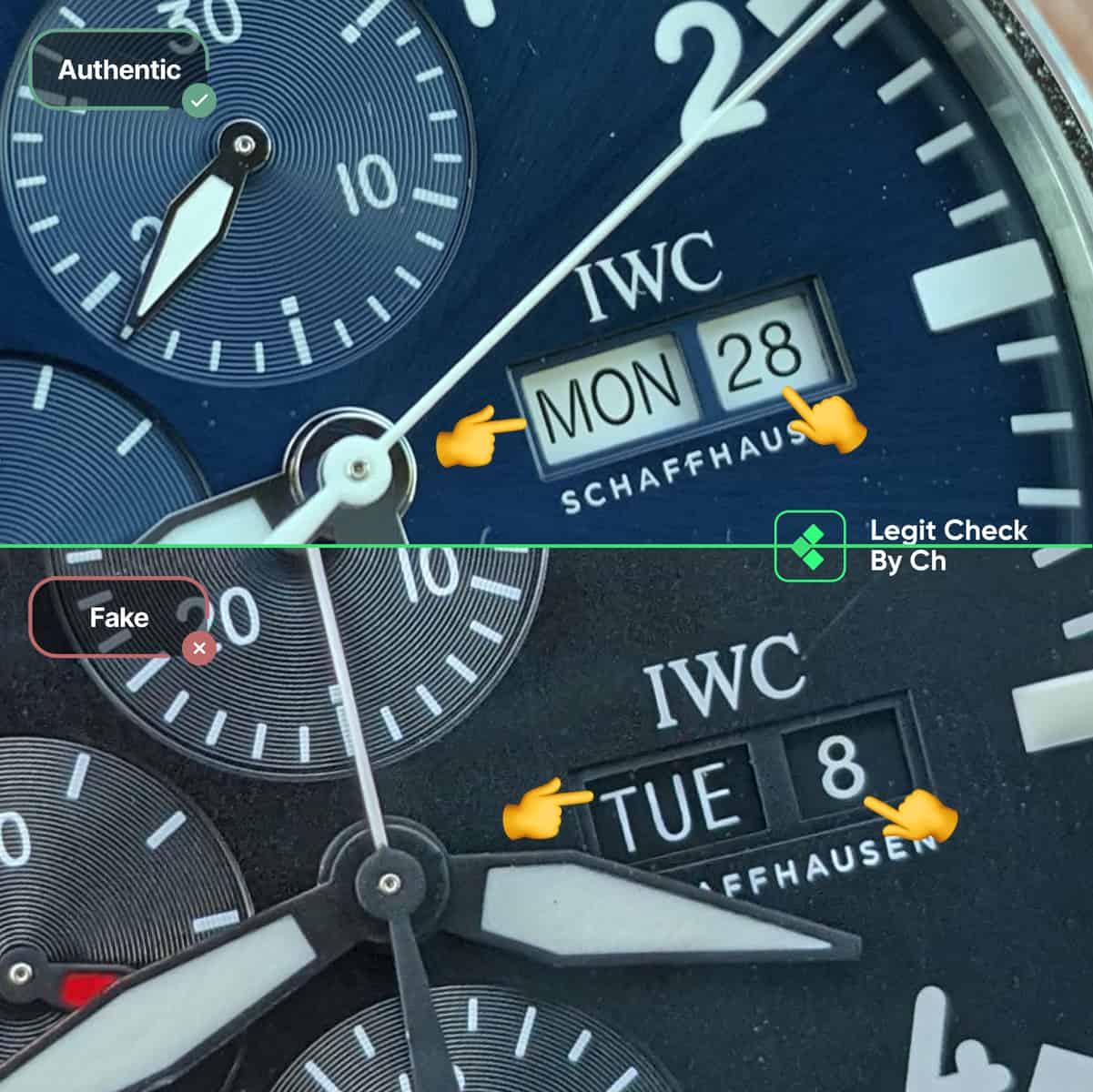
The typography of the day and date display is subtle but distinctive.
On an authentic piece, the typeface has perfect vertical alignment – no crowding near the edges, no faint or over-bold printing. The cut of the window itself is also clean, with sharp edges and a consistent bevel.
Replicas fail most often in this area. Their fonts may be too narrow or faint, with inconsistent spacing between numbers.
In some cases, the day or date sits just off-center – a detail that’s instantly noticeable once you compare it to official IWC photos.
→ Always cross-reference your model against IWC’s official website or an authorized dealer’s listings for font and window size accuracy.
Just like on the Rolex Datejust, the balance and centering of the date window reveal more than most people realize.
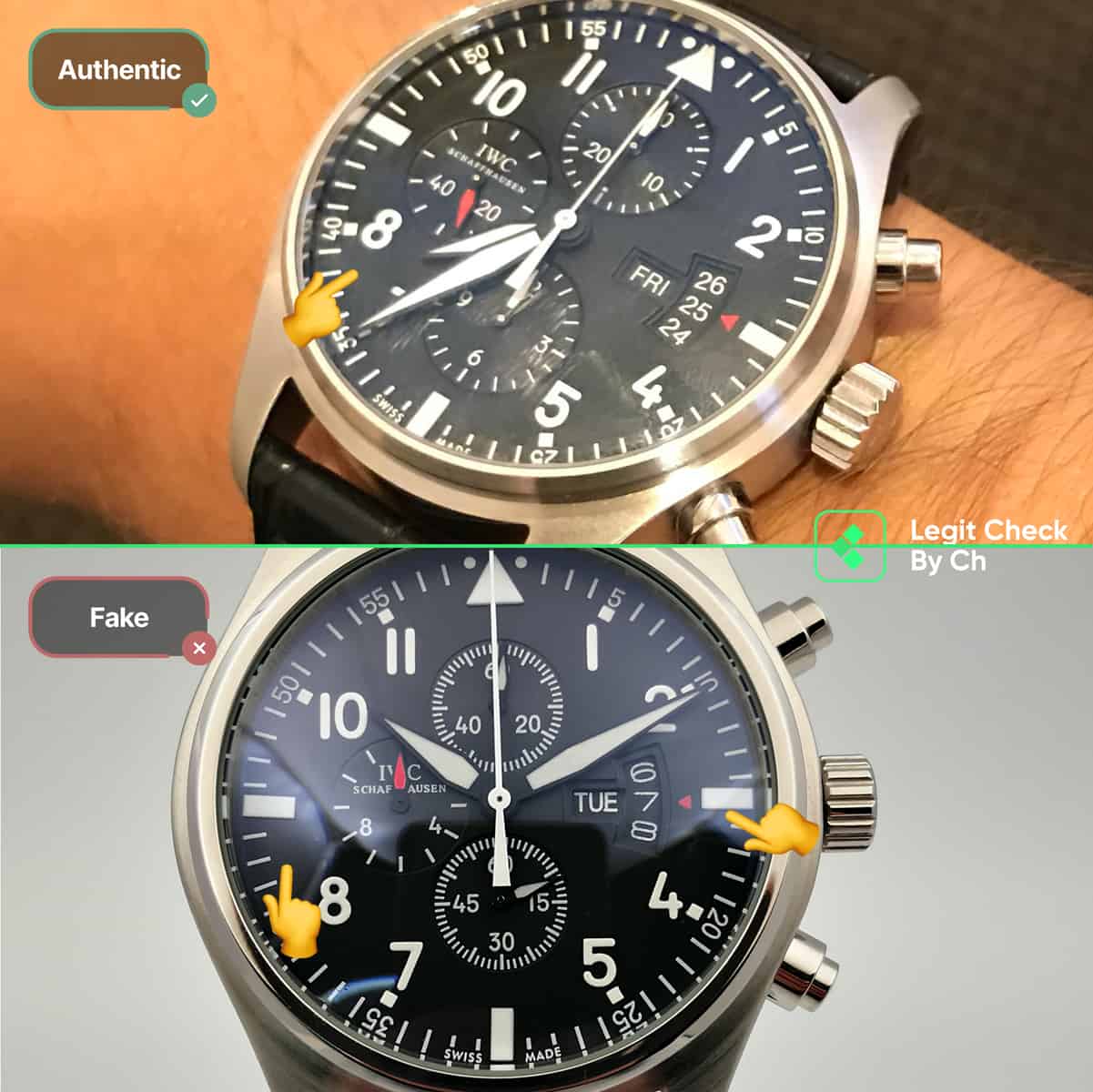
The difference becomes obvious the moment you handle the watch under natural light.
On a real IWC, the crystal almost disappears. You can look straight into the dial from any angle without catching glare.
The anti-reflective treatment also gives off a faint bluish hue in certain lighting conditions, a sign of authentic IWC craftsmanship.
Fakes, however, tend to use untreated or cheaply coated glass. These watches reflect every surrounding light source, from ceiling lamps to daylight.
→ The “mirror effect” is an instant giveaway. Genuine IWC crystals are built to highlight the dial, not reflect the room around it.

A quick mention:
If in doubt, we recommend double-checking the steps we’ve explained above this line.
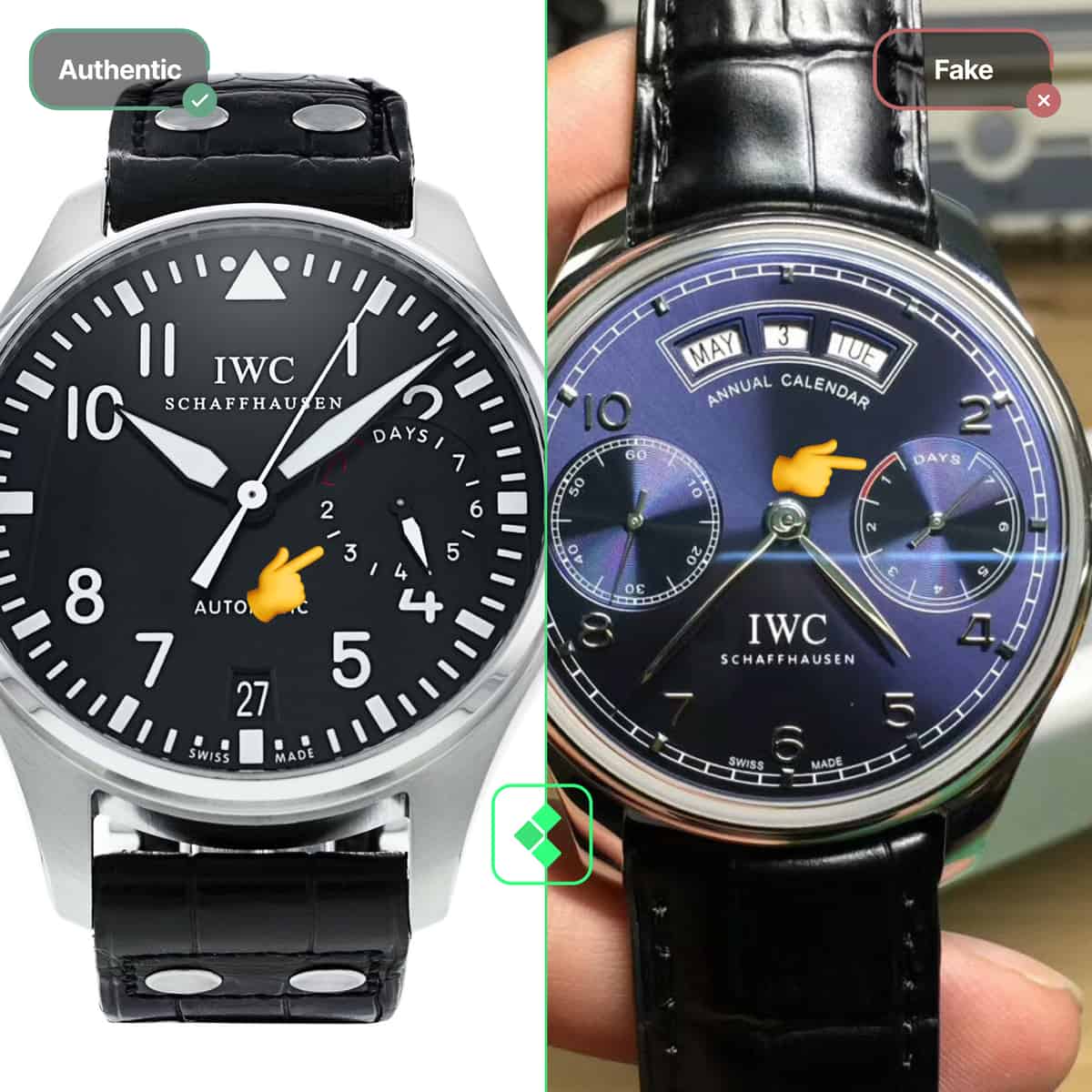
The power reserve indicator is a signature feature on several IWC models. A small sub-dial that displays how much energy remains before the watch needs winding.
It’s both aesthetic and functional, designed for precision and ease of use.
How to check it:
To test this feature, gently wind the crown of your IWC when it’s partially unwound.
On a genuine piece, you’ll see the small arrow or hand in the power reserve sub-dial shift steadily toward “FULL” as you rotate the crown. The response is instant and mechanical.
→ If the arrow doesn’t move (or moves only after several rotations) the indicator is fake.
Real IWCs display real-time power buildup, while counterfeits only mimic the design without the engineering behind it.
This single test can confirm or debunk authenticity with over 70% certainty.
You’ll find a comparable mechanical detail on the Panerai Luminor, where the power-reserve display behaves just as smoothly when wound.
This is an aspect that is much tougher to reflect in the picture, but we will try to do it in writing.

The winding crown of an IWC is a tactile experience – it’s engineered for precision.
When you rotate it, the gears glide seamlessly, producing a quiet, controlled motion. The resistance feels natural, never stiff or gritty.
This refined sensation is the result of IWC’s in-house movements and precise machining.
Fakes can’t replicate this feel. Their crowns may catch or grind as you turn them, and the hands can jump slightly when setting the time.
→ If winding feels “scratchy,” irregular, or unnaturally light, that’s a clear indicator that the internal mechanism isn’t genuine IWC quality.
That refined tactile feedback during winding is shared with luxury models like the Audemars Piguet Royal Oak.
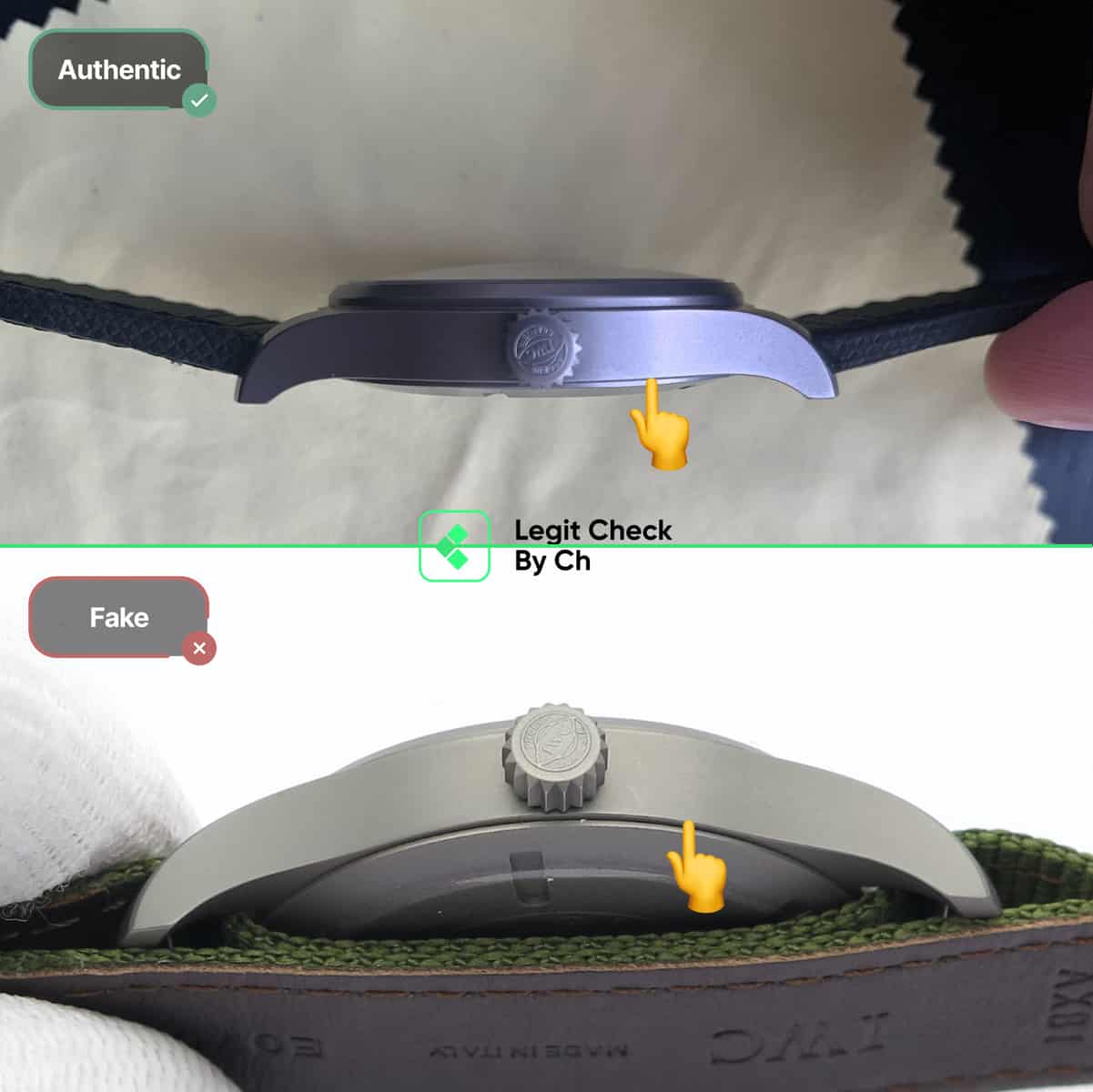
From the crown side, an authentic IWC shows impeccable machining.
The crown fits snugly into its recess without gaps, and the brushing or polishing of the steel flows seamlessly across surfaces.
On fakes, this harmony is missing: the case looks bulkier, and the join between the crown and case may show uneven spacing or visible machining lines.
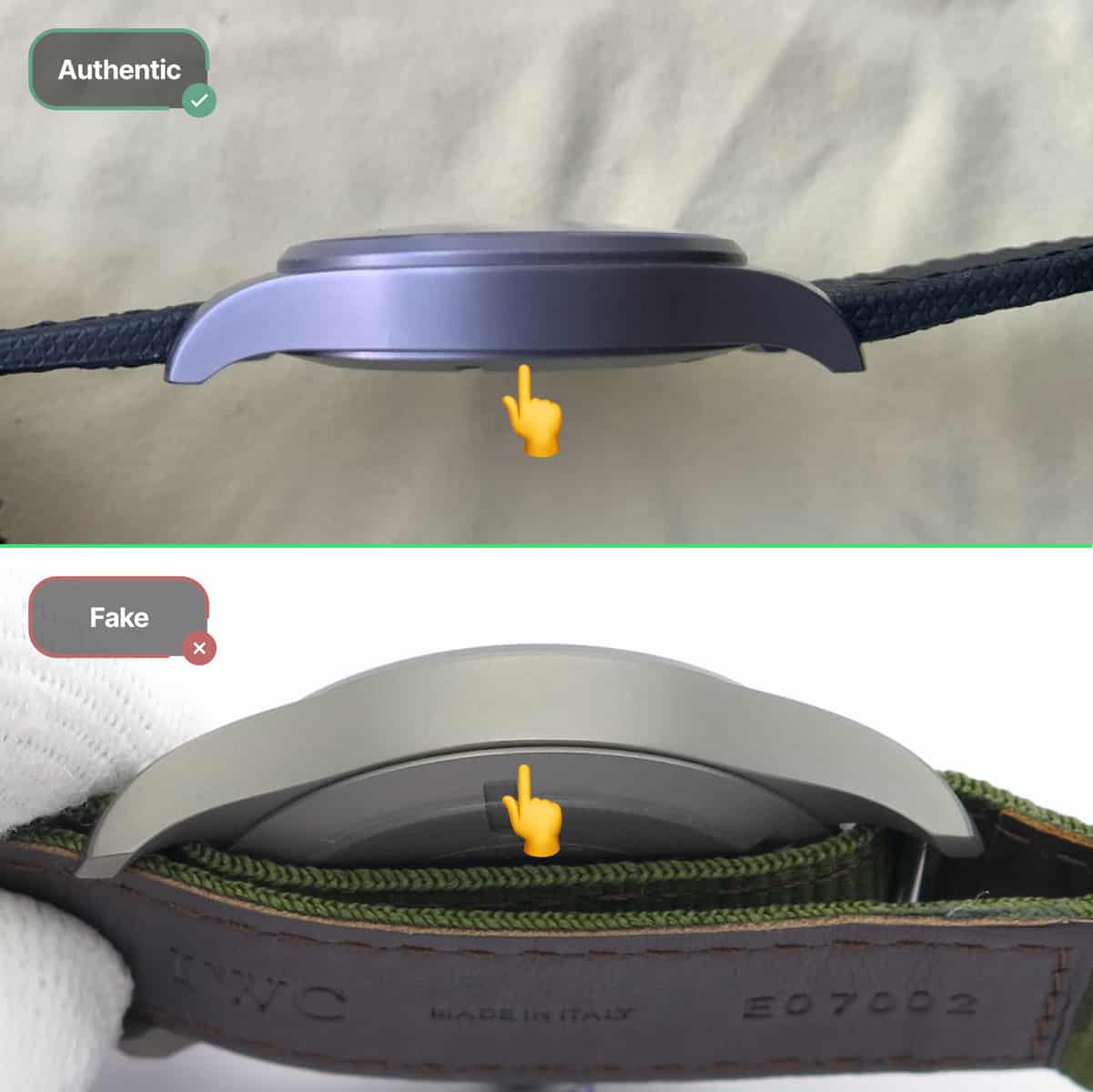
The side profile of an IWC is a small masterpiece of proportion.
Every curve, edge, and millimeter of height is deliberate. Counterfeit cases tend to appear heavy-handed, lacking the elegant balance between dial depth and case thickness.
When viewed from the side, the difference becomes instantly noticeable: the real one feels precise; the fake feels forced.
The level of proportion and machining here is comparable to the Patek Philippe Nautilus, another watch admired for its balanced case geometry.
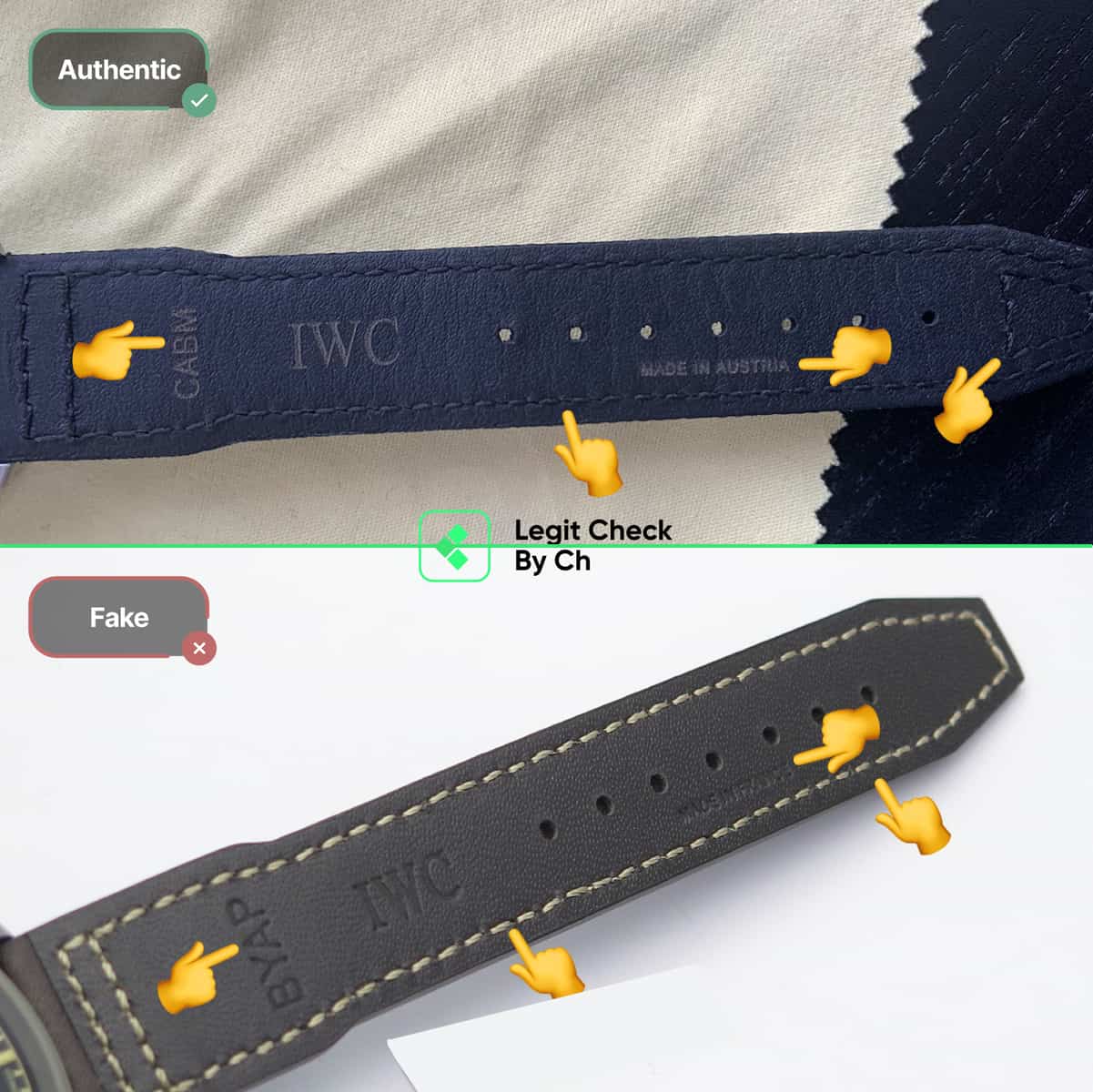
With IWC, even the strap is a sign of craftsmanship.
Over time, genuine leather will age gracefully, developing a soft patina and subtle flexibility. The edges are sealed neatly with no fraying or excess glue, and the lining feels smooth against the skin.
Fake straps deteriorate quickly. They crack instead of softening, and the stitching unravels at the bends.
Some replicas even feature a decent-looking outer layer but reveal cheap filler leather underneath.
→ If the strap feels synthetic or the texture doesn’t improve with wear, it’s almost certainly a replacement or a fake.
Even the strap finishing follows the same principles of craftsmanship seen in items like the Hermès Kelly bag, where stitching and embossing define authenticity.
Tip: Some second-hand IWCs come with aftermarket straps. While not always fake, non-original straps lack the brand’s distinct embossing and finishing – so always cross-check your strap’s markings and build quality with official IWC references.
Need a quick summary? Here’s how to tell an authentic IWC from a replica in under a minute – based on the 8 key checkpoints collectors and experts use.
These eight details capture IWC’s essence – mechanical precision, symmetry, and refinement. Any deviation in these areas should raise suspicion and warrant a professional authentication.
More watch authenticity guides in this hub.
IWC watches are more than precision instruments – they’re heirlooms of engineering.
That’s why authentication has become essential, especially with the growing market for near-perfect replicas that mimic models like the Portuguese, Pilot’s Watch, and Portofino.
Our IWC authentication service is performed entirely by human experts, not algorithms.
Each watch is inspected under magnification and natural light by professionals trained to detect even the smallest inconsistencies that no automated tool can catch.
Here’s what our authenticators verify:
Each detail is cross-checked against factory specifications and official IWC references to ensure full accuracy.
Once your watch is analyzed, you’ll receive a digital Certificate of Authenticity confirming whether it’s genuine or counterfeit, along with our detailed assessment notes.
This documentation is recognized for resale listings, insurance coverage, and buyer protection worldwide.
👉 Authenticate your IWC today and protect your investment with expert verification you can trust.
Great fakes copy the silhouette; real IWCs earn it in the details.
On a genuine piece, typography is disciplined, sub-dials obey the pushers, the crystal disappears under light, and the crown winds like finely cut gears, not sand.
When you combine these visual and tactile cues, an authentic IWC separates itself fast.
Key points to revisit
Still unsure?
If any point feels off, don’t guess. Our human experts verify dial print, sub-dial function, AR coating, winding behavior, case geometry, and strap authenticity – then issue a Certificate of Authenticity you can use for resale, insurance, or disputes.
👉 Authenticate your IWC today and turn doubt into certainty.
Make the movement prove itself before you pay.
Real IWCs earn their worth through balance, precision, and feel. We check what replicas can’t fake – the harmony of mechanics and detail.
Expert review • 24–48 h turnaround • Trusted by collectors worldwide
Yes. On most IWCs you’ll find the case serial engraved on the caseback (outer ring) or on a lug’s underside; the movement number is separate and sits on the movement itself (visible on display-back models).
Cross-check the case serial with your warranty card and any service paperwork. If anything doesn’t match, ask an IWC boutique/authorized dealer to verify it against their records.
Pro tip: keep clear photos of the caseback, lugs, and warranty card together – buyers will ask for them.
Swiss. IWC = International Watch Company, founded in Schaffhausen, Switzerland (a German-speaking Swiss city).
Design and manufacturing are Swiss; the brand’s clean, technical aesthetic reflects its location near the German border.
They target slightly different sweet spots. IWC leans into refined casework, minimalist dials, and pilot/portuguese design language, with strong in-house calibres across mid-to-high price tiers.
Omega offers broader tech value (METAS Master Chronometer, widespread antimagnetism) and huge depth of references at generally lower prices. Pick IWC for the design/finishing vibe and pilot heritage; pick Omega for cutting-edge spec density per dollar and iconic tool lines.
On resale/liquidity, many Omegas and core IWCs behave similarly – individual references matter more than the logo.
Different propositions. Rolex prioritizes industrial robustness, parts longevity, and global service scale; IWC emphasizes elegant proportions, complications variety, and dress/sport crossover aesthetics.
In day-to-day use, both are reliable; Rolex typically holds value better on mainstream models, while IWC offers more dial/case variety and classical design in the same budget.
Choose based on wear style and value retention priorities.
All modern watches can depreciate. Historically, core IWC models (Pilot’s, Portugieser three-hand/chronograph) see moderate first-owner depreciation and then stabilize.
Limiteds, desirable sizes, and steel pilot references tend to hold stronger; precious-metal dress pieces usually soften more. Box, papers, recent service, and original strap/bracelet materially improve resale.
Other authenticity-check guides for you
The guides below follow the same collector-oriented approach, each focusing on a different chronograph reference often compared with IWC models.