Last Updated on January 13, 2026 by Ch David
Tudor watch authentication has become increasingly relevant as the brand’s popularity continues to grow.
Once seen as Rolex’s more affordable sibling, Tudor has built its own reputation for craftsmanship, reliability, and modern tool-watch design – making models like the Black Bay and Pelagos highly collectible.
As demand has risen, so has the number of replicas. Many look convincing at first glance, but they rarely capture the sharp, balanced dial printing or high-quality case finishing found on genuine Tudor watches.
Knowing how to tell them apart is essential, whether you’re buying your first piece or adding another to your collection.
This guide walks you through the most effective ways to confirm a Tudor’s authenticity.
From dial inscriptions to case engravings and bracelet quality, you’ll learn the same steps our Tudor experts use to spot the differences between real and fake.
Many enthusiasts who admire the Tudor Black Bay also collect the Rolex Submariner and the Omega Seamaster Diver, both known for their dive-ready precision and timeless design.
Let precision speak for your Tudor.
We confirm what replicas can’t imitate – typography, engraving depth, color accuracy, and movement behavior. Authenticity, backed by data and expertise.
Trusted by collectors • Expert-led evaluation • Fast, defensible results
Answer: A dependable way to start checking a Tudor’s authenticity is to look closely at the dial inscriptions.
On genuine models, the text is perfectly aligned, evenly spaced, and printed with crisp edges.
Counterfeits often get this wrong; the lettering may sit slightly off-center, appear too thick, or show uneven spacing between lines.
Because Tudor maintains very tight standards in dial printing, even the smallest irregularity usually signals a fake.
This check is quick and revealing, but a complete authentication should also include examining the caseback, movement, and bracelet – all covered later in this guide.
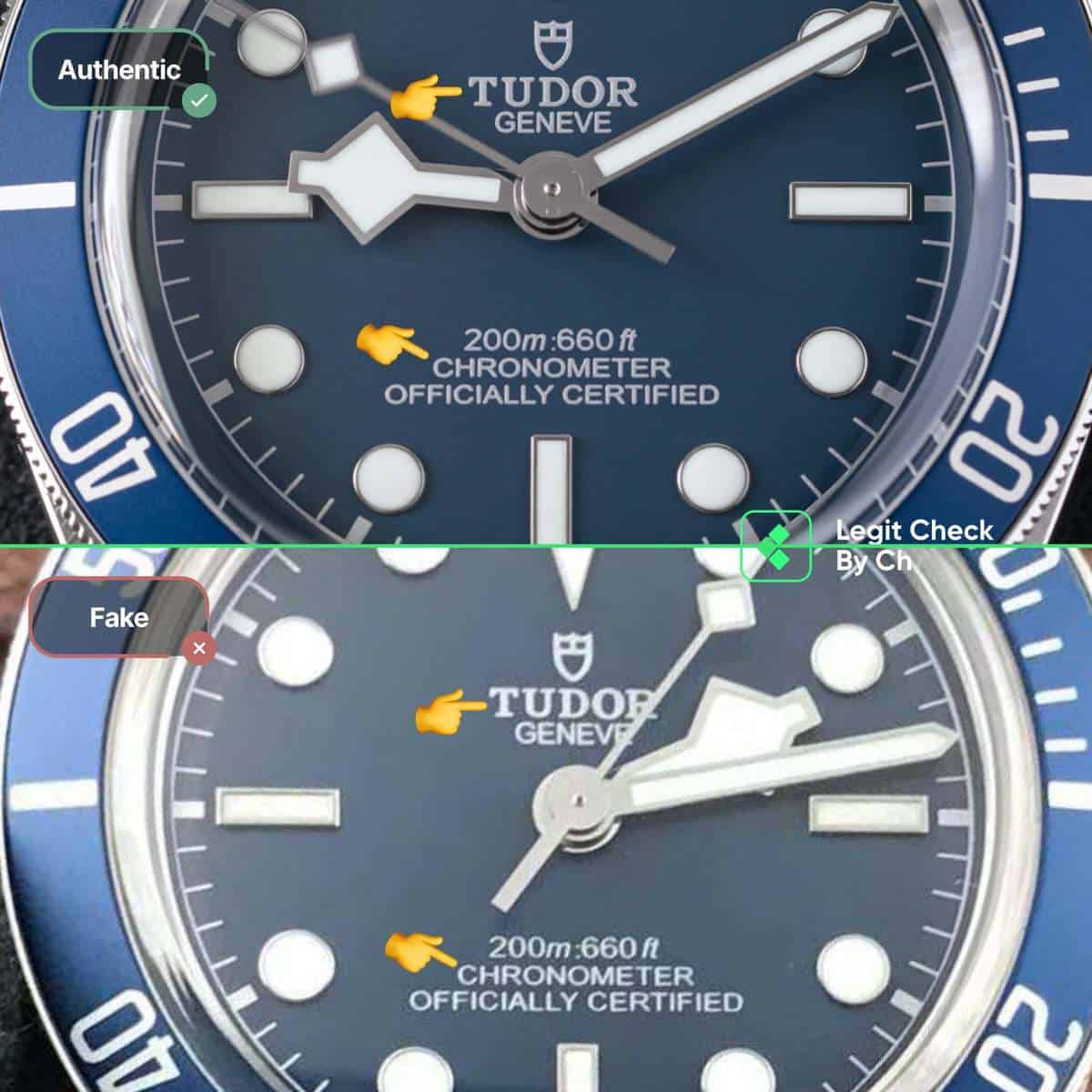
On a genuine Tudor, the printing quality is one of the most reliable signs of authenticity.
The brand’s manufacturing process ensures every inscription has consistent ink density, perfectly aligned baselines, and balanced thickness.
Under magnification, the text should appear clean, not fuzzy or raised. Replicas often struggle to reproduce this precision – the font may look bold, slightly smeared, or overly glossy.
→ These minor imperfections, particularly around the brand name and chronometer text, are a clear giveaway that the watch is not genuine.
Like the IWC Portuguese, Tudor’s finishing standards rely on microscopic precision that counterfeiters struggle to match.
Let our experts authenticate your Tudor:
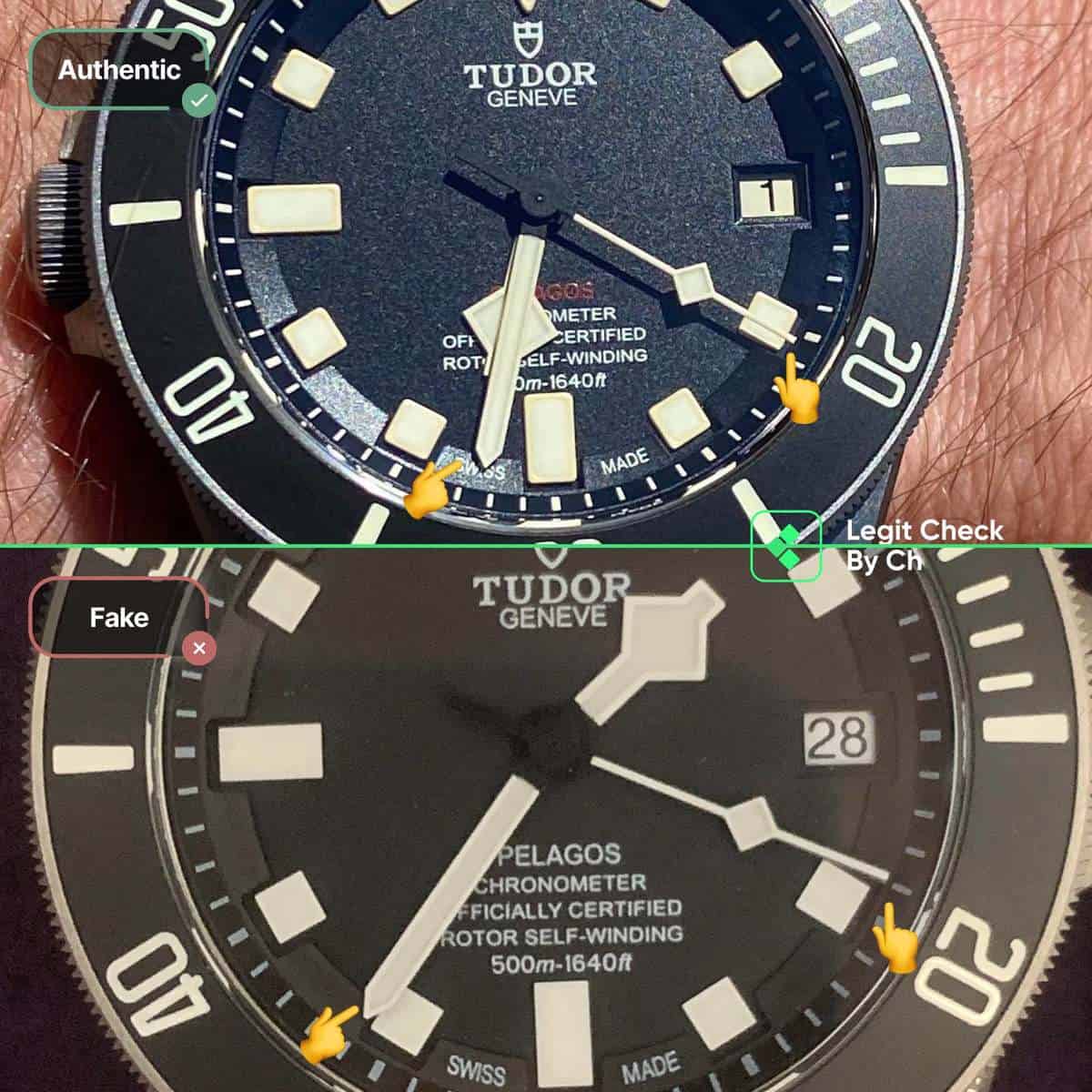
Tudor pays close attention to the finishing of its hands, ensuring that all components reflect light consistently.
On a real watch, the surface of the hands looks fluid and balanced, without irregularities or discoloration. The edges are sharp, not rounded, and the luminous material (if present) is applied neatly.
Fake versions often have visible inconsistencies – one hand might look shinier or darker than the others, and the finishing may appear cloudy or grainy.
Even subtle differences in the hand length or tip shape are major red flags when authenticating a Tudor.
Lets look at another comparison:
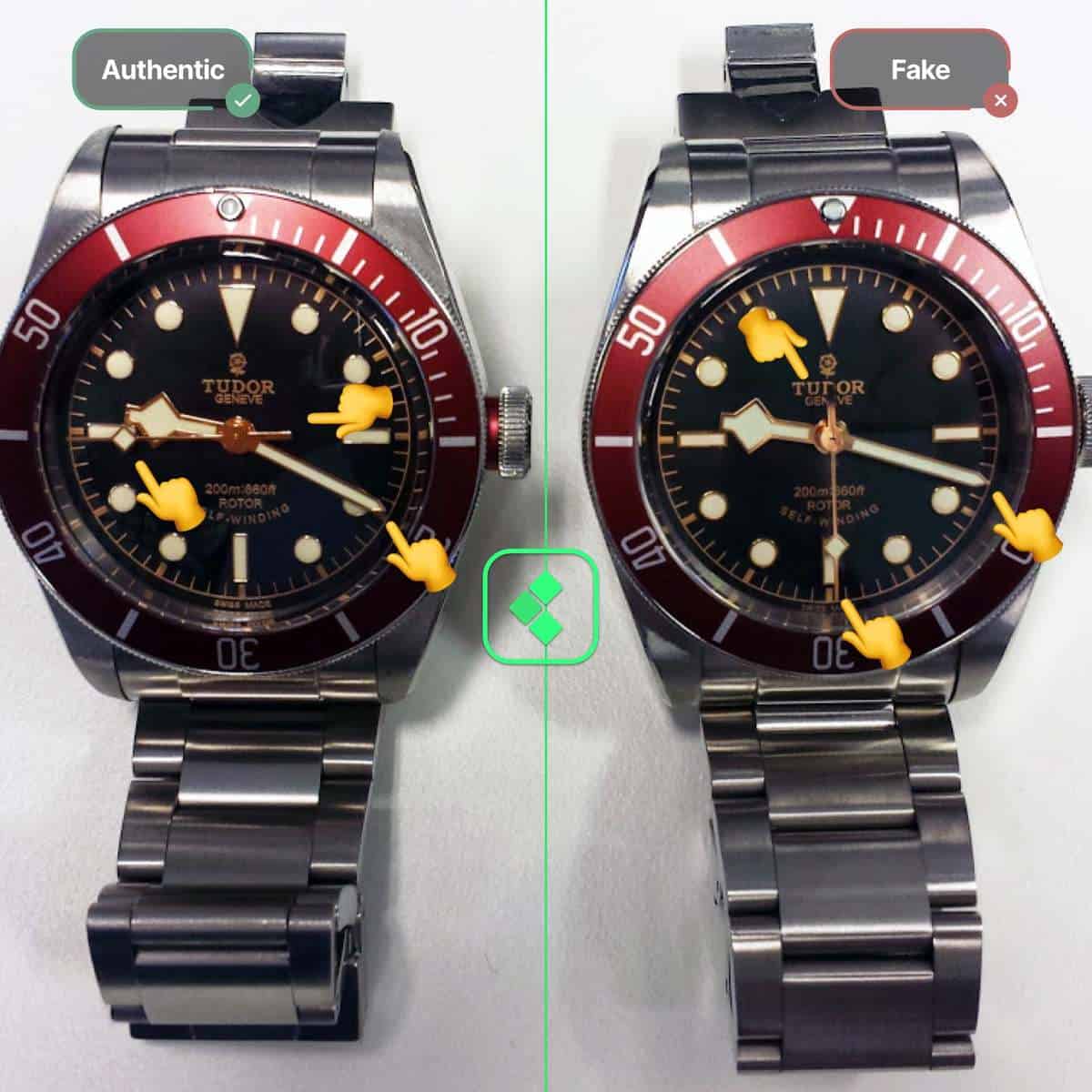
Yet again, the same flaw is visible in the image with the real vs fake Tudor watches above as well.
The way Tudor finishes its hands is comparable to what you’ll find on a Tag Heuer Carrera: smooth polishing, sharp edges, and symmetry are non-negotiable indicators of quality.
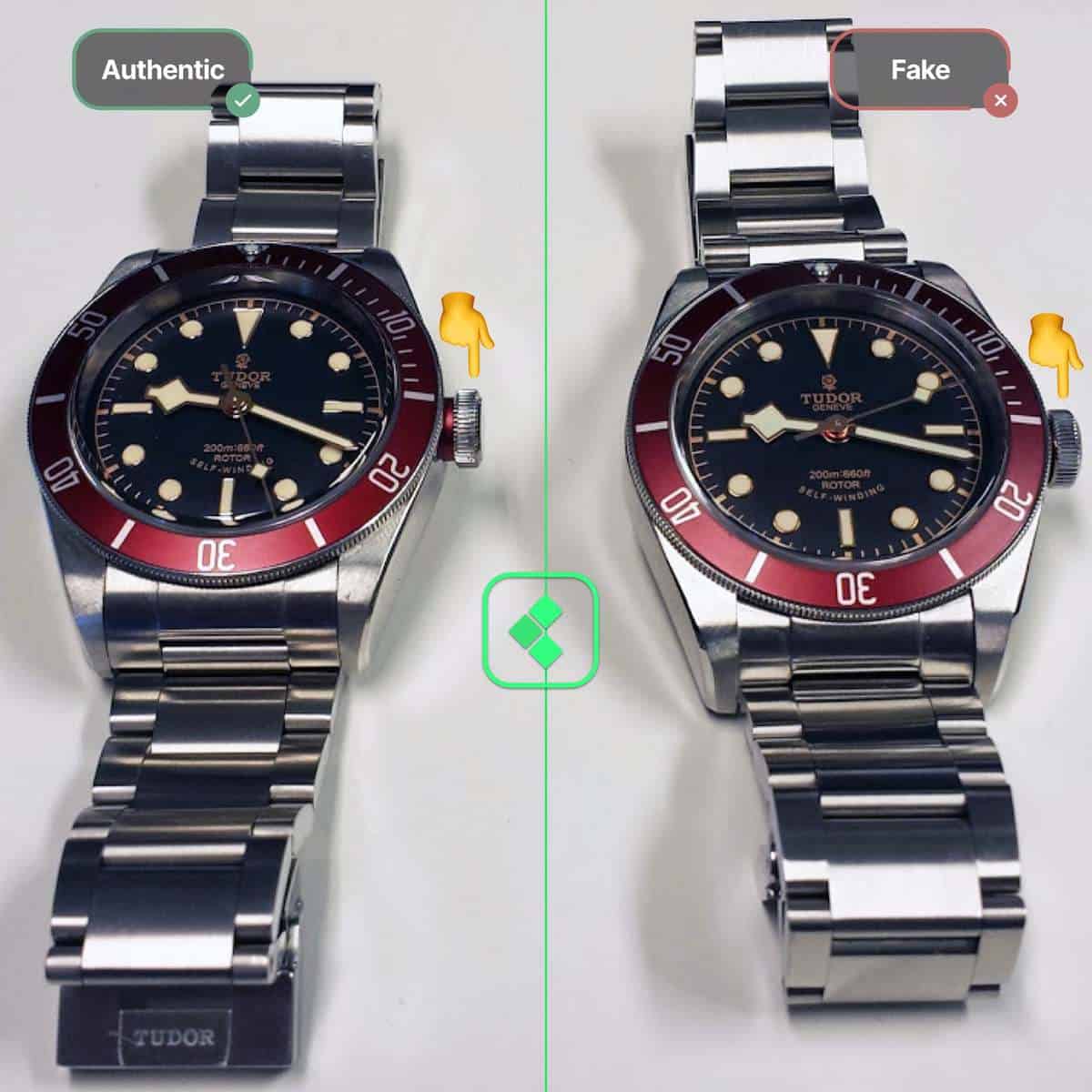
Precisely, we are going to care about the bezel’s colour, the numbers that are printed on it, and also the rotation of the bezel.
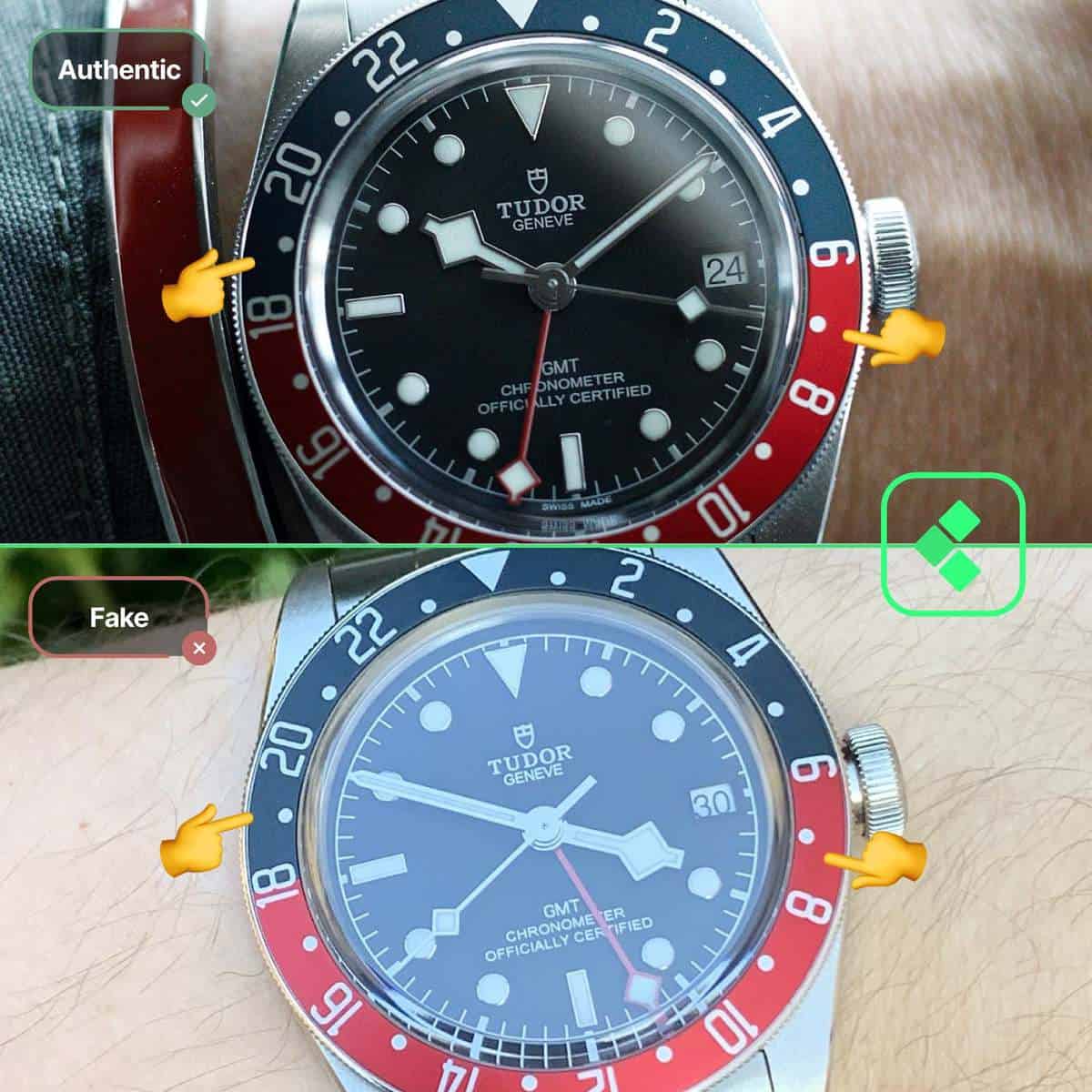
The Pepsi bezel is one of the most recognizable Tudor details – and one of the hardest for counterfeiters to replicate.
On genuine models, the transition between red and blue is seamless, showing a perfectly even gradient. Fakes tend to have an abrupt or uneven color blend, often looking lighter than they should.
→ The printed numerals also reveal a lot: authentic bezels have a deep, uniform print that feels embedded, while replicas display inconsistent thickness or blurry edges.

Real Tudor bezels achieve their rich tone through anodized aluminum or ceramic, giving them a vivid but soft color depth. Fake bezels often rely on surface paint, which appears overly glossy or opaque.
Tilt the watch slightly, an authentic Tudor bezel retains its elegant shade across angles, while replicas show uneven highlights or sudden tone shifts.
This color transition flaw is similar to what’s often seen in fakes of the Rolex GMT-Master II Pepsi, where bezel tones and gradients expose replicas instantly.
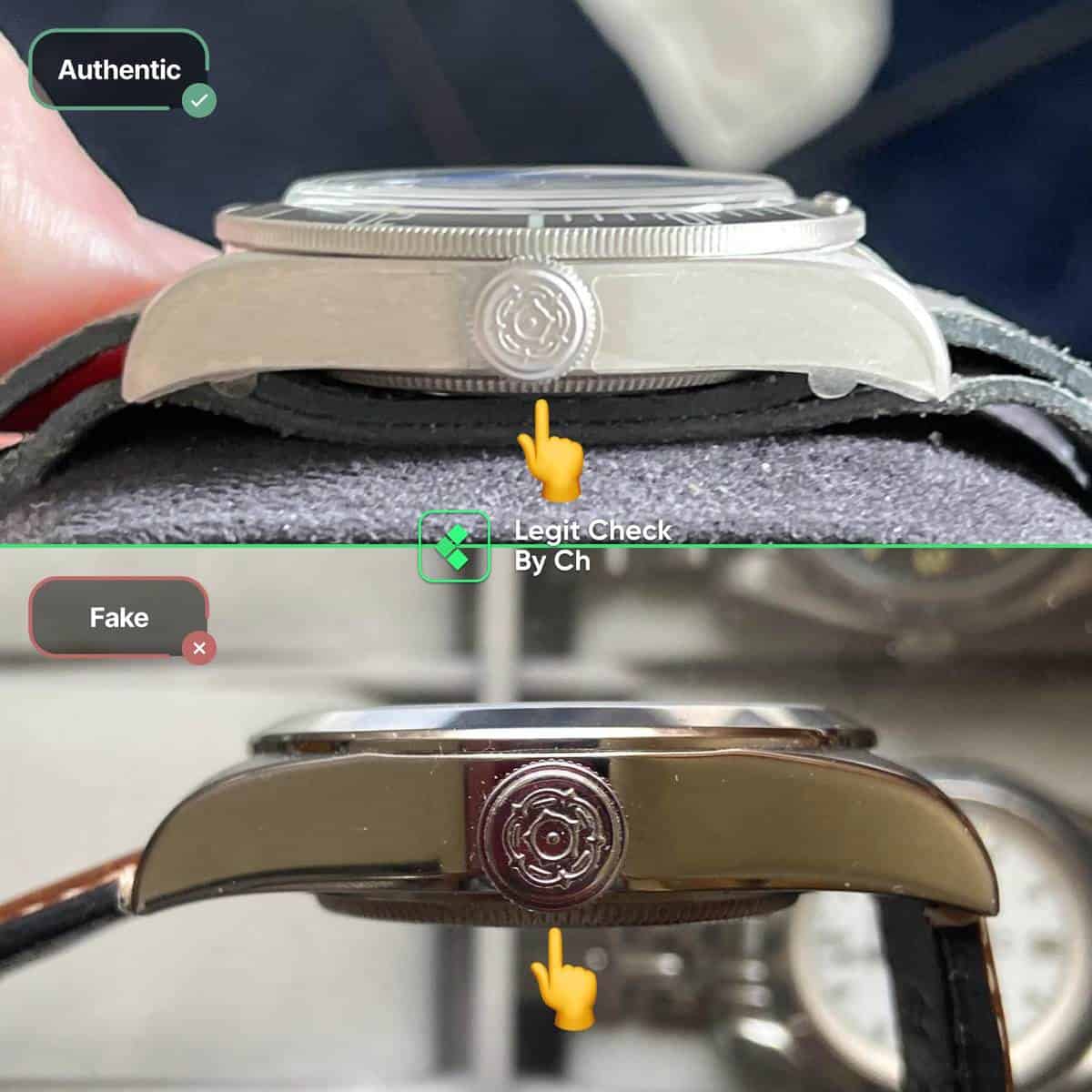
The Tudor Rose is a small but crucial detail that reveals a lot about build quality. On genuine crowns, the engraving feels shallow yet perfectly defined, with smooth edges that transition seamlessly into the surrounding metal.
The finish is soft and elegant, catching light in a gentle way. Fake crowns, by contrast, have rougher edges, deeper cuts, and a more reflective surface – the rose design looks almost embossed instead of engraved.
This excessive sharpness gives away the counterfeit immediately.
When authenticating, rotate the crown under light; the real emblem reflects softly, while replicas tend to glint harshly due to poor finishing.
That level of engraving sharpness is on par with the Audemars Piguet Royal Oak, where case finishing and emblem depth separate authentic from imitation instantly.

A quick mention:
If in doubt, we recommend double-checking the steps we’ve explained above this line.
The tactile feedback of the crown is one of the most trustworthy indicators of authenticity.
On a genuine Tudor, you’ll feel a steady, controlled tension as you wind or adjust it – each click or rotation feels deliberate and well-engineered.
The screw-in mechanism locks securely without skipping threads, maintaining a waterproof seal.
Replica crowns rarely replicate this precision; they might spin freely, feel jerky, or even fail to engage properly with the movement.
→ When testing, always rotate slowly. A genuine crown feels silky yet firm, while a fake one will either wobble or grind.
You’ll find the same tactile precision in the Rolex Daytona, whose winding feedback and crown threading are among the most refined in Swiss watchmaking.

A Tudor case-back is a true mark of Swiss finishing. The engravings are laser-cut to a uniform depth and have a soft sheen that reflects high-quality metalwork.
Each letter and numeral is perfectly spaced and legible even under magnification. Counterfeit versions fail to achieve this balance – their text looks too shallow or uneven, often fading toward the edges.
The difference is also tactile: if you run your finger across a real engraving, you’ll feel defined yet smooth edges; on a fake, it feels flat and inconsistent.
→ This step alone often separates a genuine Tudor from even a well-made replica.
You can see similar precision in the Breitling Navitimer, whose rear engravings are equally consistent and evenly cut.
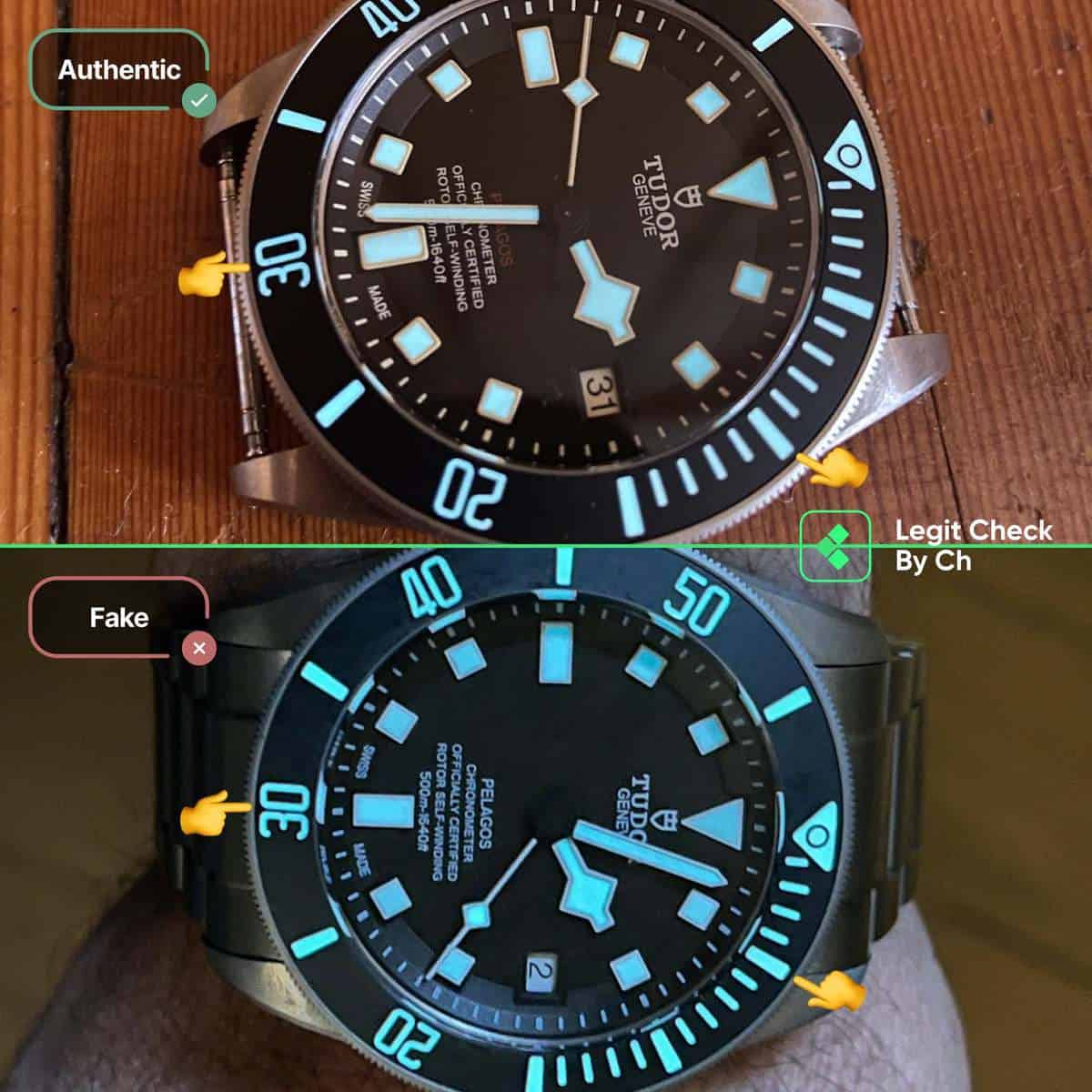
Lume brightness is one of the easiest ways to spot a replica.
Authentic Tudor watches use high-grade Swiss Super-LumiNova that holds its charge for hours, giving a balanced glow that fades gradually and consistently.
Fake models often cut corners by using cheap luminescent paint, which not only shines dimly but also fades in seconds.
Another sign to look for: on real watches, the lume is applied neatly and evenly, without spills or uneven edges.
→ If you see blotchy patches or inconsistent brightness between the hands and markers, the watch is almost certainly counterfeit.
The glow performance here is similar to what collectors look for in the Panerai Luminor, where strong, long-lasting lume has become a defining authenticity marker.
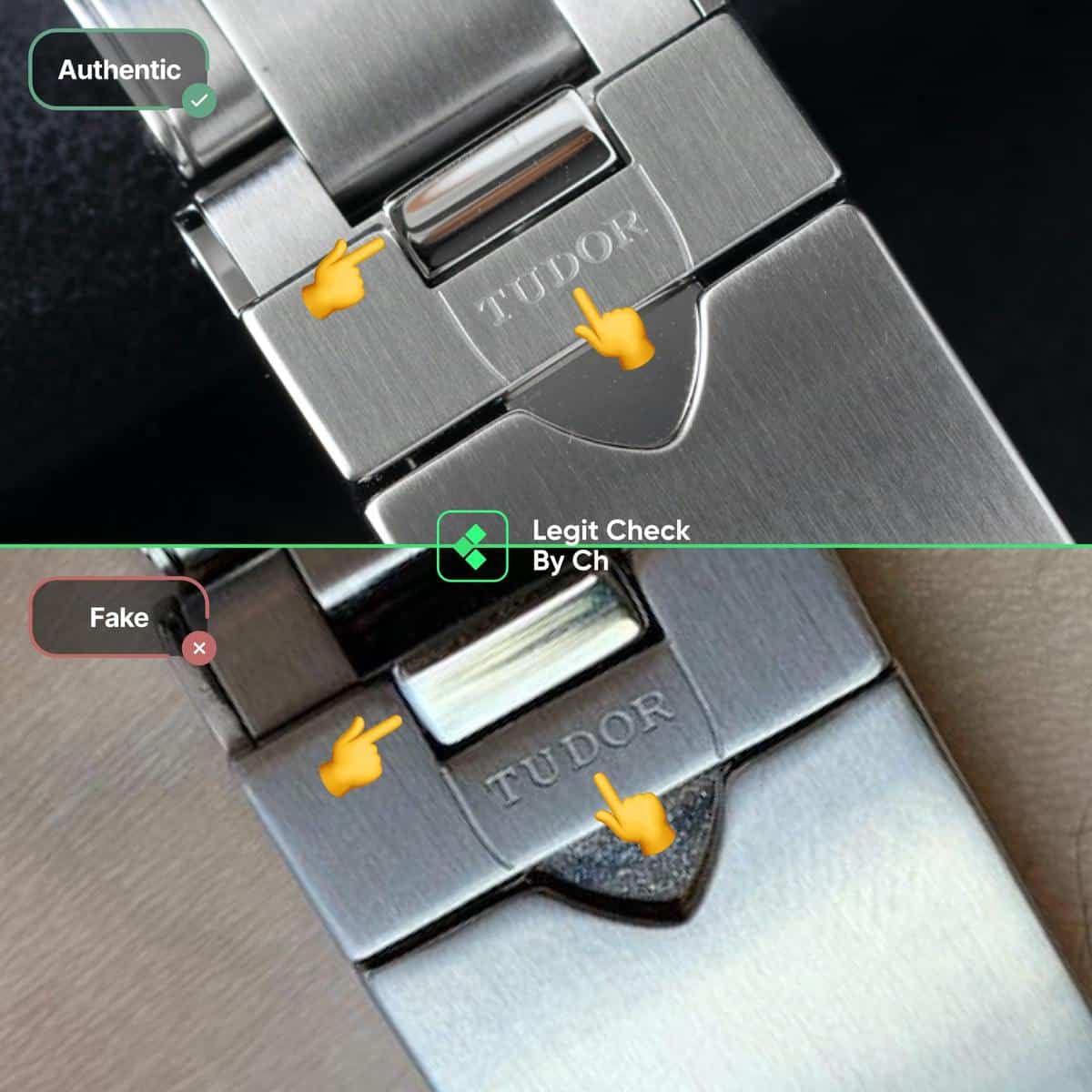
The bracelet is one of the first things collectors notice when handling a Tudor.
Genuine bracelets have a refined weight that feels secure on the wrist. Each link moves fluidly without gaps or stiffness.
Replicas often fail to match this level of precision: the links rattle, edges feel rough, and the folding mechanism clicks loosely.
→ When you inspect the clasp, focus on the engraving: on authentic pieces, the “TUDOR” text is perfectly centered and has a soft depth, while fake engravings appear overly dark or too shiny from excessive pressure.
The difference becomes especially noticeable when you tilt the clasp under light.
For comparison, see how this level of craftsmanship translates to luxury accessories like the Louis Vuitton Belt, where engraving depth and clasp balance are just as telling.

Tudor’s engravings are a hallmark of precision; subtle, balanced, and perfectly aligned around the case. Each letter is finely machined, maintaining consistent width and spacing.
Replicas often exaggerate the text thickness or use low-quality etching that lacks refinement.
On a real Tudor, you can read the inscription from any angle with clarity; on a fake, the letters blur or appear faint under light.
Even if everything else looks convincing, sloppy or oversized engravings are one of the most reliable signs that you’re handling a replica.
The precision of Tudor’s engravings rivals that of the Patek Philippe Nautilus, where every letter and line is cut with perfect symmetry — a hallmark of high horology craftsmanship.
Tudor may be Rolex’s sibling brand, but it has its own distinct character – clean design, sharp craftsmanship, and understated luxury.
Because of this reputation, it’s also one of the most counterfeited watch names on the market. While fakes might look convincing from afar, they consistently miss the subtleties in printing, finishing, and functionality that define the real thing.
Here’s a fast authenticity checklist trusted by collectors:
Run through these checks and you’ll quickly see what separates a real Tudor from even a convincing fake – flawless alignment, balanced engraving, and unmistakable build quality.
Check out our other guides to authenticate your other luxury watches.
Tudor replicas have reached a level where even experienced collectors hesitate – and with the Black Bay and Pelagos gaining value year after year, guessing isn’t an option.
That’s where our Tudor authentication service comes in.
Each verification is performed by human experts who specialize in Swiss tool watches.
Every case, dial, and movement is inspected under magnification – not by an algorithm, but by a professional who knows what factory precision actually looks like.
Here’s what our team checks during authentication:
After the inspection, you’ll receive a Certificate of Authenticity confirming whether your Tudor is genuine – a document accepted for refunds, insurance, and resale listings.
👉 Authenticate your Tudor now and get a human-verified report before you buy, sell, or list it online.
Genuine Tudors look clean at a glance, then keep looking cleaner the closer you get.
Text stays razor-thin and even, hands match in finish and tone, bezels hold color without looking painted, crowns wind with silky firmness, and engravings read sharp from any angle.
When two or three of those cues slip, you’re not looking at Tudor quality.
Here’s what you should check:
When should you get a pro opinion?
Need certainty before you buy or list?
Our Tudor authentication is fully human. We check dial typography, bezel construction and color, crown feel, case-back and peripheral engravings, bracelet articulation, lume behavior, plus serial and reference formatting.
You get a clear pass/fail and a Certificate of Authenticity you can use for refunds, insurance, or resale.
👉 Authenticate your Tudor now and turn a quick inspection into proof.
Let precision speak for your Tudor.
We confirm what replicas can’t imitate – typography, engraving depth, color accuracy, and movement behavior. Authenticity, backed by data and expertise.
Trusted by collectors • Expert-led evaluation • Fast, defensible results
Yes, Tudor watches generally retain strong resale value, especially models like the Black Bay, Pelagos, and Ranger. Their value stability comes from Tudor’s connection to Rolex, durable build quality, and consistent collector demand.
While not at Rolex levels, Tudor models often lose less value than similarly priced Swiss brands such as TAG Heuer or Longines. Limited editions and discontinued references can even appreciate over time, particularly when they include their original box, warranty card, and service history.
Absolutely. Tudor is a Swiss luxury watchmaker, owned by Rolex SA, and uses many of the same manufacturing standards, testing procedures, and quality controls.
The main distinction lies in materials and movement finishing – Tudor focuses on robust, tool-oriented designs with in-house calibers, while Rolex emphasizes prestige and exclusivity.
This positioning makes Tudor a favorite among enthusiasts who want genuine Swiss craftsmanship without the extreme price tag of its sibling brand.
It depends on what you value most. Tudor stands out for its heritage, tool-watch durability, and connection to Rolex, offering excellent mechanical performance for the price.
TAG Heuer focuses on motorsport-inspired chronographs and modern aesthetics, while Breitling emphasizes aviation heritage and larger, bolder designs.
If you prefer timeless design, rugged build quality, and long-term value, Tudor tends to have the edge – but for cutting-edge chronographs, TAG Heuer and Breitling remain strong contenders.
In terms of craftsmanship and performance, Tudor watches come surprisingly close to Rolex, especially in recent years. Both brands share manufacturing facilities and quality control standards under Rolex SA.
However, Rolex watches use more premium materials (like 18k gold and proprietary alloys) and feature higher-end movement finishing. Tudor, meanwhile, focuses on functionality and affordability – offering similar reliability at roughly one-third of the cost.
Collectors often describe Tudor as “Rolex DNA without the luxury markup.”
Yes. Every Tudor watch is 100% Swiss made, produced under the same corporate umbrella as Rolex in Geneva and Biel, Switzerland. The brand manufactures its own in-house movements, assembles all cases and dials domestically, and meets strict Swiss Made certification standards.
Even components like the MT5402 and MT5612 calibers are developed and tested in Switzerland, ensuring complete authenticity and quality consistency across all models.
Need our opinion in regards to the authenticity of your watch? It’s a service we provide.
Alternatively, we have free authentication resources for watches: written guides and video tutorials.
Thank you for reading this,
Ch Alex
Other authenticity-check guides for you
The guides below follow the same collector-focused process and cover models often compared or cross-shopped with Tudor watches, from precision divers to refined chronographs